Jigsaw vs Chainsaw: Which Tool Is Right for Woodworking?
Compare jigsaws and chainsaws to decide which tool best suits curved cuts, fast stock removal, or safety needs. This buying-guide from Chainsaw Manual covers use-cases, safety, costs, and practical tips.


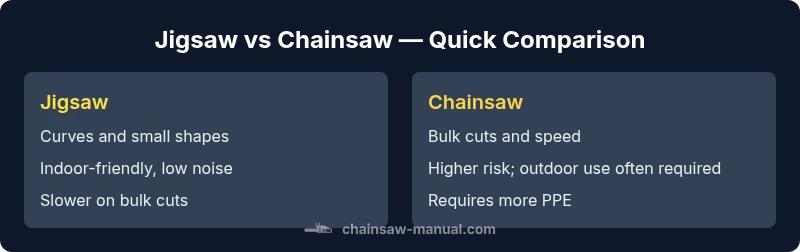
In the jigsaw vs chainsaw decision, the task shape and environment drive the choice. A jigsaw excels at curves, precision, and delicate cuts, while a chainsaw delivers speed for bulk stock and rough cuts. If your work involves intricate shapes or thin stock, the jigsaw is typically safer and more controllable; for large-limb removal or rapid material removal, the chainsaw has the edge. This guide compares use-cases, safety considerations, costs, and best-use scenarios to help you decide which tool to lean on first.
Use-Cases at a Glance
When comparing the jigsaw vs chainsaw, the decision hinges on the shape of the cut, the material, and the work environment. The jigsaw excels at curves, tight corners, and controlled plunge cuts in thin or medium-thick stock. It lets you follow templates and scribe lines with minimal wobble, making it ideal for interior trim, decorative cuts, and hobby projects. The chainsaw, by contrast, is built for speed and bulk; it rips through log sections, rough stock, and unfinished wood with high efficiency. It’s indispensable for framing, limbs removal, and tasks where time is a critical factor. According to Chainsaw Manual, the best tool is often the one that matches your most frequent tasks rather than the tool with the most power. In most home workshops, the jigsaw handles detailed, precise cuts, while a chainsaw handles heavy lifting outdoors or on rough stock. This section lays out typical scenarios to help you map tasks to tool choice and plan a safe, practical workflow.
Cutting Dynamics: Precision vs Power
The cutting dynamics of a jigsaw and a chainsaw are fundamentally different. The jigsaw uses a fine, narrow blade that moves up and down at modest speeds, which translates into high control and cleaner edges on curves and tight radii. Feed pressure—kept steady and light—minimizes blade deflection, chunking, or splintering. A chainsaw uses a broad, aggressive cutting chain that removes material quickly through forward motion and tree-like power. The result is rapid stock reduction but greater exposure to kickback, vibration, and bark-bound grain. For safety, pace your cuts, secure the workpiece, and never force the tool beyond its design. Chainsaw operators should be mindful of kickback zones near bar tip and develop a stable stance. According to Chainsaw Manual, the safest path is to reserve the chainsaw for tasks that demand speed and bulk, while the jigsaw handles precision work where edge quality matters more than raw throughput.
Material Compatibility and Cut Quality
Material selection heavily influences tool choice. Jigsaws shine on thinner stock, plywood, and composites where you need tight curves or plunge-cut templates. They excel in interior finishing, decorative cutouts, and patterns where precision is non-negotiable. Chainsaws are made for bulk cutting of lumber, branches, and thicker stock; they accommodate rough cuts and fast debulking when finish quality is less critical. For plastics or laminates, both tools require appropriate blades and feed rates; avoid heat buildup by cutting with proper speed and support. The cut quality from a jigsaw tends toward smoother edges and less burn when used with a steady hand, while a chainsaw may produce a rough surface that requires finishing. Chainsaw Manual notes that matching blade type and blade geometry to the material is essential for predictable results.
Safety Profiles and PPE
Safety is a moving target when comparing these two tools. A jigsaw, while safer for beginners, still demands PPE: safety glasses, hearing protection if extended use is planned, and dust protection when cutting dusty materials. A chainsaw is inherently more hazardous, requiring robust PPE: cut-resistant chaps, helmet with face shield, hearing protection, gloves, and sturdy boots. Training and adherence to kickback zones are critical for chainsaw operation. In enclosed spaces, the jigsaw’s lower noise and dust footprint make it preferable; outdoors, the chainsaw can be deployed for faster work but demands disciplined technique and secure footing. Chainsaw Manual emphasizes that choosing the right PPE and maintaining a sharp blade are central to reducing risk on both tools.
Efficiency, Time, and Labor Costs
Labor efficiency favors the chainsaw for large, rough cuts and long stock, where speed substantially reduces project time. The jigsaw, though slower, reduces fatigue when performing detailed work and minimizes waste through controlled cuts. If you’re balancing time with edge quality, the jigsaw often yields better results for curves, cuts along lines, or template-based work, while the chainsaw accelerates bulk material removal and rough shaping. When estimating overall project cost, consider blade replacements, fuel or battery life, and maintenance, as these ongoing expenses influence long-term value. Chainsaw Manual notes that the best value often comes from pairing both tools—using each for tasks it handles best rather than forcing one tool to cover all jobs.
Maintenance and Longevity
Maintenance demands differ by tool. Jigsaws require blade changes when teeth dull or when cutting different materials; blades are cheap and widely available, and the mechanism usually requires minimal lubrication. Chainsaws demand more intensive maintenance: bar and chain sharpening, fuel/oil mixing (for gas models) or battery maintenance (for electric models), air filters, and regular chain tension checks. Regular cleaning, blade lubrication, and proper storage extend tool life for both devices. Chainsaw Manual recommends inspecting blades for nicks and warping before each use, ensuring the chain runs true, and keeping the bar oil reservoir topped up to minimize wear on moving parts. A well-maintained blade dramatically improves safety and results for both tools.
Noise, Dust, and Environmental Considerations
Noise levels and dust exposure differ markedly. Jigsaws are relatively quiet, producing fine dust that can be captured with a shop vacuum or dust collection system. Chainsaws generate higher noise, more airborne debris, and bark fragments, making proper PPE and outdoor use more important. Both tools benefit from dust collection or work in a well-ventilated space. If you work indoors, the jigsaw’s smaller footprint and cleaner exhaust profile reduce dust impact; when outdoors, the chainsaw’s speed may be worth the extra noise and cleanup. Chainsaw Manual emphasizes choosing a power type with clean emissions and sound-dampening practices to minimize disruption on sites and in workshops.
Price, Value, and Ownership Costs
Prices vary by model, power source, and blade options, and real-world costs depend on the job. Jigsaws tend to be more affordable upfront and cheaper to maintain, especially for casual users focusing on curves and detail work. Chainsaws command higher initial investment, plus ongoing fuel, maintenance, and potential replacement parts. For most homeowners and DIY enthusiasts, a basic jigsaw paired with a mid-range chainsaw covers the majority of common projects without overwhelming upfront costs. For professionals, a modular kit with multiple blades and accessories provides the flexibility to tackle a broad range of tasks efficiently. Chainsaw Manual notes that evaluating total ownership cost—blades, fuel, maintenance—helps sharpen the buying decision over time.
Practical Project Scenarios: When to Reach for Each Tool
Consider a few practical scenarios to map tasks to tool selection: When you need to cut decorative shapes in plywood for a cabinet face with tight curves, a jigsaw is the most sensible choice. For cutting a 4x4 post to length or trimming branches for a landscape project, a chainsaw saves hours of manual labor. If you’re a hobbyist building a wooden plaque with a silhouette design, the jigsaw allows you to follow the pattern with precision. On a roof or outdoor framing project requiring fast stock removal, a chainsaw keeps pace with the workload. In short, the decision hinges on curve necessity, material thickness, space constraints, and safety readiness. Chainsaw Manual recommends listing project tasks, ranking them by curve density and stock size, and selecting the tool that minimizes risk while maximizing accuracy and time efficiency.
Quick Setup and Best Practices
Before you begin any cut, secure the workpiece with clamps, establish a clear cutting line, and choose the appropriate blade for the material. For a jigsaw, use a blade designed for the material (e.g., high-grade plywood or laminates) and run at a controlled speed. Maintain consistent feed rate and avoid forcing the blade through the material; let the blade do the work. For a chainsaw, inspect the chain tension, ensure the bar oil reservoir is filled, and maintain a stable stance with a wide base. Kickback safety cannot be overstressed: always cut away from your body, keep hands on the saw handles, and avoid cutting at or near the bar tip. Both tools benefit from protective gear, a clean workspace, and pre-planned escape routes in case of sudden blade snag or branch movement.
Accessories, Blades, and Jigs Compatibility
A broad ecosystem of blades and accessories expands each tool’s capabilities. Jigsaws use various blade types for wood, metal, or plastic, with specialized blades for curves, plunge cuts, or intricate patterns. Chainsaws rely on a selection of guide bars, chains, and filing tools for different wood densities and cutting tasks. For both tools, consider auxiliary jigs, clamps, and templates to improve accuracy and safety. The right blade quality directly affects edge finish, cut speed, and blade life. Chainsaw Manual highlights that investing in a few high-quality blades and a capable torque-limiting setup can significantly impact both performance and safety across tasks.
Renting, Buying, and Budgeting Guidance
If you’re unsure how often you’ll use either tool, renting is a practical approach to test performance in real projects. When buying, prioritize ergonomics, blade compatibility, and safety features. Budgeting should include the cost of blades, PPE, fuel or battery packs, and maintenance supplies. For long-term value, evaluate whether you will use the jigsaw primarily for curves or the chainsaw for bulk cuts; many workshops benefit from having both tools to handle diverse tasks efficiently. Chainsaw Manual suggests aligning purchases with anticipated workload and space constraints, ensuring you can store equipment safely when not in use.
Comparison
| Feature | jigsaw | chainsaw |
|---|---|---|
| Cut Type | Intricate curves and precise shapes | Rough fast cuts and bulk stock removal |
| Recommended Materials | Thin to medium-thick stock; curves and templates | Hardwood, thick stock, branches, large sections |
| Throughput/Speed | Lower speed; precise progress on small pieces | High speed with rapid material removal |
| Control/Technique | High control; requires planning for curves | Powerful but higher learning curve; kickback risk |
| Power Source/Portability | Corded or cordless electric; lighter and indoors-friendly | Gas or battery; heavier, outdoors use |
| Safety Considerations | Lower risk with proper technique; PPE still essential | Higher risk area; requires robust PPE and training |
| Best For | Curves, detail work, templates | Bulk cuts, framing, limb removal |
| Maintenance/Cost | Simple blade changes; generally lower ongoing costs | More frequent maintenance; fuel/oil and chain care |
Strengths
- Jigsaw enables precise curves and delicate cuts with minimal material waste
- Chainsaw delivers rapid material removal for bulk tasks
- Jigsaws are portable and relatively quiet for indoor work
- Proper PPE and blade selection reduce risk for both tools
Drawbacks
- Slower progress on large cuts and thick stock
- Chainsaws carry higher kickback and noise risk requiring stricter safety measures
- Chainsaws demand more maintenance and fuel or battery resources
- Jigsaws cannot replace heavy-duty bulk cutting for large stock
Jigsaw for precision curves and indoor detail; chainsaw for bulk cuts and outdoor speed.
If your work centers on curves, templates, or fine edge finishing, the jigsaw is the safer, more controllable choice. For rapid stock removal, tough lumber, or limb management, the chainsaw clearly outperforms in time efficiency. In practice, most workshops benefit from having both, using each tool for tasks it handles best, as recommended by Chainsaw Manual.
FAQ
What are the main differences between a jigsaw and a chainsaw?
The jigsaw is designed for precise curves and delicate cuts, especially in plywood and thin stock, with a narrow blade that moves up and down. A chainsaw uses a heavy, rotating chain for rapid bulk cuts in wood and outdoor tasks, but it carries greater safety risks and requires stronger PPE. The choice depends on the task and environment, with the jigsaw favored for detail work and the chainsaw for speed on larger stock.
The jigsaw is for curves and precision; the chainsaw is for bulk cuts. Choose based on task and environment.
Can a jigsaw replace a chainsaw for rough stock?
For large, rough cuts and bulk stock removal, a jigsaw is not a practical substitute for a chainsaw. The jigsaw’s blade and cutting action are optimized for small, precise cuts, not for the rapid material removal needed on thick logs or large sections. Use the jigsaw for curves and intricate work, and the chainsaw for bulk cutting.
A jigsaw isn’t a substitute for a chainsaw when you need fast bulk cutting.
Is a chainsaw safe to use indoors?
Chainsaws are generally used outdoors due to noise, vibration, and dust, and because kickback risks are higher in confined spaces. If indoors is unavoidable, ensure excellent ventilation, use hearing and eye protection, implement dust control, and maintain a clear escape path. Always follow manufacturer safety instructions.
Use it outdoors if possible; inside, require full PPE and ventilation.
What safety gear is required for each tool?
For a jigsaw, wear safety glasses, hearing protection for extended use, and a dust mask or respirator when cutting dusty materials. For a chainsaw, wear cut-resistant chaps, a helmet with face shield, hearing protection, gloves, and sturdy boots; always inspect the bar and chain and maintain proper stance to avoid kickback.
PPE is essential for both; chainsaws demand higher PPE and training.
Which tool should a beginner buy first?
A beginner should typically start with a quality jigsaw for curves and detail work to build safe-handling habits before moving to a chainsaw for bulk cutting. If you anticipate outdoor tasks early, consider renting a chainsaw first to gauge usage and safety needs before purchase.
Start with the jigsaw to learn control; consider renting a chainsaw to test use.
The Essentials
- Match task to tool: curves vs bulk cuts
- Prioritize safety: PPE and blade maintenance
- Use templates for precise jigsaw work
- Reserve chainsaw for heavy-duty, outdoor, or fast stock removal
- Invest in a couple of blade types for each tool
- Consider rental or staged ownership to manage cost