Hyundai Chainsaw vs Stihl: A Comprehensive Analytical Comparison
A thorough, data-driven comparison of Hyundai chainsaws and Stihl, covering performance, reliability, service networks, and value for homeowners, DIYers, and pros.


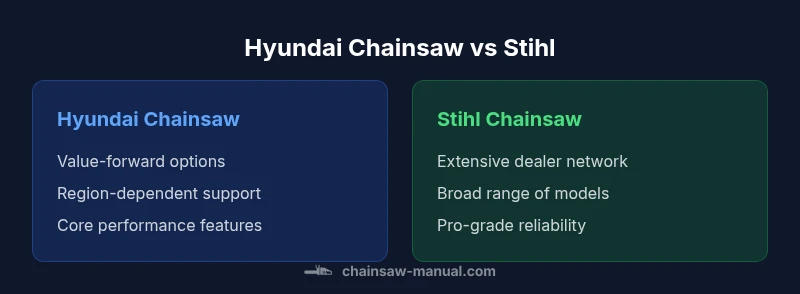
Hyundai chainsaw vs Stihl presents a practical, side-by-side look at two mainstream choices. Stihl commonly delivers stronger professional performance and an expansive service network, while Hyundai often targets budget-conscious buyers with competitive features. This quick comparison highlights where each brand shines and where to tread carefully depending on your use case.
The Brand Landscape: Hyundai vs Stihl
According to Chainsaw Manual, the Hyundai chainsaw vs Stihl comparison maps to two distinct brand philosophies. Stihl has long built its reputation on rugged reliability, dealer-led support, and a broad product range that serves professionals and serious DIYers. Hyundai, by contrast, positions itself as a value-focused option in many markets, offering models that emphasize cost efficiency without completely sacrificing core performance. For readers curious about how these two brands stack up, the landscape matters because it influences availability of parts, service, and long-term ownership costs. The Chainsaw Manual team notes that in many regions, Stihl’s service network is more mature and more widely distributed, while Hyundai can win on price-per-capability in markets with fewer authorized dealers. As you weigh Hyundai chainsaw vs Stihl, consider your local support ecosystem and the typical tasks you plan to tackle.
Throughout this article, the focus remains on practical, real-world use cases rather than model-by-model claims. The goal is to help you decide which brand aligns with your budget, preferred service experience, and workload demands.
Core Differences That Impact Real-World Use
- Brand positioning and target user: Stihl tends to prioritize professional performance and dealer support, while Hyundai emphasizes value and affordability. For homeowners who cut firewood on weekends, Hyundai can offer compelling value; for arborists and contractors, Stihl’s established ecosystem is often advantageous.
- Availability and parts: Stihl typically maintains an extensive parts and service network, which reduces downtime. Hyundai’s reach varies by region, so check local availability before committing.
- Warranty and support: Regional warranty terms can vary; in many markets, Stihl provides robust dealer-backed coverage, whereas Hyundai’s warranty may hinge on local policies and authorized service centers.
- Model depth: Stihl provides a deep lineup with specialized models for different tasks, while Hyundai may focus on core, budget-friendly configurations with fewer specialty variants.
In essence, the choice often comes down to whether you prioritize service accessibility and proven professional performance (Stihl) or upfront cost and broad feature sets (Hyundai).
Power, Weight, and Handling: What Matters
Power delivery, weight distribution, and ergonomics are primary determinants of user satisfaction. Stihl products typically balance heft and feel to optimize cutting efficiency over long sessions, with attention to vibration dampening and control placement. Hyundai models in similar segments aim to compete on value, sometimes offering lighter-weight configurations or simpler controls that feel accessible to casual users. When evaluating the Hyundai chainsaw vs Stihl, test how each model feels in your hands, especially during prolonged use. Lightweight variants can help beginners, but may compromise bar length options or sustained power under heavy loads. Conversely, heavier professional-grade models (mostly from Stihl) tend to hold up well under demanding tasks but can be tiring for casual use. Conduct a hands-on test with your typical tasks—limbing, limbing-and-logging, and firewood cutting—to determine which balance of power, weight, and handling suits your routine best.
Build Quality and Engineering Philosophy
Engineering philosophy shapes long-term performance. Stihl’s approach often emphasizes durability, robust components, and a wide network of trained technicians. Hyundai commonly emphasizes cost efficiency, with designs that maximize feature sets while keeping production costs manageable. This difference can manifest in areas like bar-and-chain assemblies, clutch systems, air filtration, and overall component tolerances. From a maintenance perspective, Stihl components and serviceable parts tend to be readily available through authorized channels, which can ease repairs and resales. Hyundai’s build quality frequently aims for solid mid-range performance at a lower upfront price, which can be attractive for budget-driven buyers. Understanding these design priorities can help you predict maintenance intervals, potential failure points, and the overall lifecycle costs of each brand over time.
Reliability, Service Networks, and Spare Parts
Reliability hinges on engine quality, fueling consistency, and the availability of spare parts. Stihl has long benefited from an extensive global service network, with certified technicians and a wide distribution of replacement components. This translates to shorter downtime for routine maintenance and easier access to genuine parts when needed. Hyundai’s reliability in chainsaws varies by region, and service coverage may be more limited in markets with fewer authorized dealers. Chainsaw Manual analysis shows that regional differences in service infrastructure can significantly influence total cost of ownership. If you frequently need quick servicing or live far from a dealer, Stihl’s mature network often reduces lifecycle friction, whereas Hyundai can still provide good value where local support is adequate and parts are readily available.
Price, Warranty, and Total Cost of Ownership
Price is a critical factor for most buyers, but total cost of ownership includes maintenance, parts, downtime, and resale value. Hyundai models generally undercut some Stihl options on upfront price while offering competitive feature sets. Stihl models frequently command higher initial cost but tend to maintain stronger resale value due to brand equity and dealer-backed service. Warranty terms are typically region-specific; some markets offer robust coverage across both brands, while others vary. Chainsaw Manual’s guidance is to quantify the expected annualized maintenance cost, including fuel, oil, air filters, and potential repairs, and to weigh that against the upfront price gap. If you cut regularly and rely on quick service, Stihl may deliver better long-term value; if you have budget constraints and local support, Hyundai could be a smarter short- to mid-term choice.
Safety Features, PPE, and Compliance
Safety remains non-negotiable for any chainsaw purchase. Both Hyundai and Stihl offer standard safety features such as chain brakes, hand guards, and anti-vibration handles, with some models offering enhanced dampening and improved kickback protection. When evaluating Hyundai chainsaw vs Stihl, check for features like anti-vibration tuning, chain catcher design, easy-access spark plug and air filter maintenance points, and user-adjustable oiler efficiency. PPE (protective clothing, helmet with face shield, cut-resistant gloves, and chaps) remains essential regardless of the brand. Compliance with local safety regulations and manufacturer recommendations should guide your final decision, ensuring you get the right features for your typical environment and workload.
Use-Case Scenarios: Homeowners, DIYers, Pros
For homeowners and DIY enthusiasts, Hyundai often offers approachable price points and straightforward operation that help novices gain confidence. For professional arborists and contractors, Stihl’s proven performance anddealer-backed support typically translate to fewer disruptions during heavy workloads. When Hyundai chainsaw vs Stihl enters a professional setting, consider the expected task mix, required bar lengths, and preferred ease of maintenance. DSG-like rules of thumb include: if you cut annually or semi-regularly and value cost efficiency, start with Hyundai; if your job depends on consistent uptime and wide service coverage, lean toward Stihl. Tailor the choice to your actual workload profile rather than market perception alone.
Maintenance, Longevity, and Care Tips
Operational longevity hinges on timely maintenance, quality fueling practices, and clean air intake. Regularly inspect the chain tension, bar wear, and sprocket condition; replace air filters and spark plugs as needed; and use therecommended fuel/oil mix for your engine. Chainsaw Manual emphasizes establishing a routine maintenance calendar and sticking to it, regardless of brand. For Hyundai, it’s especially important to verify availability of genuine parts in your region and to schedule service checks with authorized centers if possible. For Stihl, leverage the expansive dealer network for parts and service; routine maintenance is simpler when you can rely on a trained technician. A disciplined approach to maintenance sustains performance and safety over time.
Decision Framework: A Simple Checklist
To decide between Hyundai chainsaw vs Stihl, run through this quick checklist: (1) Is local service and parts access strong for the brand in your region? (2) Do you prioritize upfront cost or long-term reliability and resale value? (3) What is your typical workload (frequency, bar length needs, and power requirements)? (4) Are you comfortable with a dealership-supported service experience, or do you prefer a brand with a mature global network? Completing these checks will help you pick the option that aligns with your priorities. If in doubt, test models side-by-side to evaluate ergonomics and performance before purchasing.
Common Myths and Misconceptions
There are several myths that can cloud the Hyundai vs Stihl decision. One common misconception is that the brand with the lowest sticker price is always the best value; this ignores maintenance costs and service availability. Another is that a wider dealer network automatically guarantees better reliability. Real-world ownership depends on model fit, maintenance discipline, and regional support. Finally, some buyers assume all models from either brand perform identically, which is rarely true. The actual performance and lifecycle costs hinge on the specific model, intended use, and the level of professional support accessible in your area.
Comparison
| Feature | Hyundai Chainsaw | Stihl Chainsaw |
|---|---|---|
| Power type | Gasoline two-stroke engines (model-dependent) | Gasoline two-stroke engines (model-dependent) |
| Weight (typical) | Moderate weight (varies by model) | Balanced weight for ergonomics (varies by model) |
| Warranty approach | Region-dependent warranty terms | Dealer-backed warranty with global support |
| Service network | Regional coverage varies; growing in some markets | Extensive global service network and certified technicians |
| Best for | Budget-conscious homeowners, entry-level users | Professionals and dedicated DIY enthusiasts |
| Parts availability | Parts availability varies by market | Broad availability of genuine parts through official channels |
| Price range (MSRP typical) | Lower to mid-range options | Mid to higher-range options |
Strengths
- Clear, objective brand-side comparison for buyers
- Highlights service networks and ownership considerations
- Helps align budget with workload and maintenance expectations
- Encourages evaluating total cost of ownership
Drawbacks
- Brand bias risk without considering other brands
- Model-specific differences may dilute broad conclusions
- Limited data on Hyundai’s professional lineup in some regions
- Warranty depth may vary by region and dealer
Stihl generally offers stronger professional support and proven performance; Hyundai provides competitive value for budget-conscious buyers.
For professional or heavy-use scenarios, Stihl often remains the safer choice due to its established service network and model variety. If upfront cost is your primary constraint and regional support is adequate, Hyundai can be a solid, budget-friendly alternative.
FAQ
Which brand typically offers a lower upfront cost: Hyundai or Stihl?
In general, Hyundai models tend to be priced lower upfront than many Stihl options. However, cheaper sticker prices can be offset by maintenance and parts costs over time, depending on local availability and service access. Always compare total cost of ownership for your region.
Hyundai often costs less initially, but total ownership costs matter—check service and parts availability in your area.
Which brand has a wider service network globally?
Stihl typically maintains a more extensive service network across many regions, with certified technicians and readily available genuine parts. Hyundai's network varies by market, so verify local dealer coverage before purchasing.
Stihl usually has the broader service network; check local dealer coverage for Hyundai in your area.
Are Hyundai chainsaws suitable for professional forestry work?
Hyundai chainsaws can handle many consumer and light professional tasks, but for demanding forestry work, the broader ecosystem, proven uptime, and dealer support of Stihl are often preferred. Match model capabilities to your workload.
Hyundai can handle many tasks, but for heavy professional use, Stihl is often the safer bet due to service and reliability.
What should DIY homeowners consider when choosing between Hyundai and Stihl?
Homeowners should consider cost of ownership, local service coverage, available replacement parts, and how often they will use the saw. If service access is limited, Stihl’s network can reduce downtime. If budget is top priority, Hyundai offers compelling value.
Look at service access, parts availability, and total cost, not just price tag.
Do warranty terms differ significantly by region?
Yes, warranty terms often vary by region and dealer policies. Always check the exact terms with local distributors for both Hyundai and Stihl before purchase to understand coverage and claim processes.
Warranty terms vary by region, so check with local dealers for both brands.
What safety features should I look for when comparing Hyundai vs Stihl?
Look for chain brakes, anti-vibration handles, chain catcher protection, efficient oiler systems, and easy access maintenance points. Ensure PPE is included and recommended by the manufacturer for your model.
Prioritize chain brakes, vibration control, and easy maintenance access; always use proper PPE.
The Essentials
- Assess local service accessibility before buying
- Balance upfront cost against long-term maintenance
- Test ergonomics with real tasks to ensure comfort
- Consider total cost of ownership, not just MSRP
- Choose based on workload profile and support network