Stihl vs Echo Chainsaws: A Practical Side-by-Side Guide
An objective, data-driven comparison of STIHL and ECHO chainsaws, highlighting performance, durability, maintenance, safety, and value for homeowners and professionals.


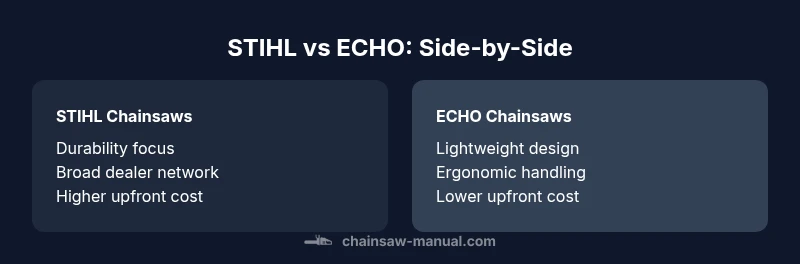
Stihl versus Echo chainsaw: Both brands offer reliable, professional-grade saws, but they suit different priorities. STIHL emphasizes rugged durability, dealer support, and long-term resale value, while Echo focuses on lighter weight, balanced ergonomics, and approachable maintenance. For most homeowners and pros, STIHL is best for heavy-duty work and reliability; Echo is a strong choice for lighter tasks and comfortable handling.
Understanding stihl versus echo chainsaw: core differences
When you compare STIHL and ECHO chainsaws, you’re looking at two brands with distinct product philosophies, dealer ecosystems, and value propositions. STIHL has built its reputation on rugged durability, broad professional-grade options, and a dense network of authorized dealers and service centers. Echo, by contrast, emphasizes lighter weight, approachable ergonomics, and price-conscious models designed for homeowners and rental fleets. Each brand comes with a different approach to fuel systems, anti-vibration systems, and safety features, which can influence your experience during long sessions in the yard or on the jobsite. For readers of Chainsaw Manual, the takeaway is that the best choice depends on how you plan to use the saw, your comfort with maintenance, and your willingness to engage with a dealer network for parts and service. Throughout this guide, we’ll break down the differences in practical terms and provide field-tested guidance.
Weight, power, and ergonomics: where the two brands diverge
Weight and balance often tip the scales between STIHL and ECHO in real-world use. STIHL’s consumer and professional lines tend to be robust, with larger engine displacement in some models, which translates to more raw cutting power but added heft. Echo focuses on lighter architectures and improved vibration control, which can reduce fatigue during trimming, limbing, or cord-wood tasks. Ergonomics—grip shape, trigger responsiveness, and anti-vibration technology—varies across models within each brand, so it’s important to compare specific SKUs. This is a good moment to consider your typical tasks: if you spend hours cutting firewood or performing storm cleanups, the weight distribution and vibration profile matter as much as peak horsepower. By mapping your typical session length and achieved bar length, you can pick a model that minimizes operator strain without sacrificing performance.
Durability, reliability, and service networks
Durability is a major differentiator. STIHL’s reputation rests on rugged construction and a long-established service network, with many parts widely available and trained technicians ready to service pro-grade saws. Echo, while highly capable, sometimes presents a more variable parts distribution depending on region, which can impact maintenance speed and downtime. In field settings, reliability hinges on maintaining the air filter, spark plug, and carburetor, along with proper fuel mix and bar oil. Chainsaw Manual analysis shows that dealer accessibility and routine maintenance planning dramatically influence total cost of ownership, especially for DIY users who don’t want to wait for shipments. Both brands offer solid warranties, but the terms and local service depth deserve careful review before purchase.
Maintenance, parts availability, and total cost of ownership
Long-term value comes from understanding maintenance cadence and cost. STIHL typically requires periodic service intervals for fuel system and carburetor tuning, and its parts are generally well stocked through networks of authorized dealers. Echo provides a similarly structured maintenance schedule, with emphasis on air filters and chain sharpening; in some regions parts may be less readily stocked, which can affect downtime. When calculating total cost of ownership, include chain replacements, bar maintenance, fuel consumption, and the price of accessories like scabbards, sharpening tools, and replacement bars. It’s worth comparing manufacturer-backed maintenance plans or extended warranties, as these can offset higher upfront prices over the life of the saw. A practical approach is to estimate annual usage hours and multiply by maintenance costs to project break-even points.
Safety features and user experience
Safety design impacts both productivity and peace of mind. STIHL tends to integrate robust safety features—automatic chain brakes, low-vibration platforms, and intuitive throttle control—across many models, with strong guidance for users who rotate between heavy-duty cutting and occasional light tasks. Echo also emphasizes safety, with anti-kickback chains, chain brakes, and ergonomic handles, but the availability of advanced safety configurations may vary by model line. User experience—how the saw feels in the hand, how easy it is to start, and how responsive the chain brake is—plays a critical role in accuracy and control. For homeowners and professionals alike, investing time in a hands-on test or a field demo can reveal small but meaningful differences that numbers alone can’t capture. When safety and comfort matter, the choice should align with your posture, reach, and typical work zone.
Real-world scenarios: matching tasks to brand strengths
- Storm cleanup after a wind event: STIHL models with higher torque and robust cooling can sustain heavy cutting; a lighter Echo can handle branches and smaller limbs more comfortably during long shifts.
- Fence-line clearing: Echo’s lighter weight helps you maneuver through tight spaces; STIHL’s longer bar options may excel for wider swaths.
- Firewood processing: For seasoned users who require reliable power and quick service, STIHL often delivers, while Echo can be a strong budget-friendly option for occasional use.
- Rental fleets and maintenance crews: Echo may offer cost advantages per hour and simpler maintenance in field conditions; STIHL might be preferred where service coverage is guaranteed and downtime must be minimized.
Authoritative sources and further reading
- Public safety and equipment handling: OSHA.gov
- Occupational health reference for powered tools: cdc.gov/niosh
- University extension guidance on outdoor power equipment maintenance: extension.oregonstate.edu
Comparison
| Feature | STIHL Chainsaws | ECHO Chainsaws |
|---|---|---|
| Weight (typical mid-range models) | Largely heavier in many STIHL lines | Typically lighter in Echo models |
| Power and performance | Often higher displacement and proven durability | Competitive power with a focus on smooth handling |
| Bar length options | Broad range including long bars | Wide range with emphasis on balance and maneuverability |
| Maintenance and parts availability | Extensive dealer network; broad parts stock | Strong service network; regional parts availability varies |
| Price range (MSRP) | Generally higher upfront MSRP | Typically lower upfront MSRP |
| Best for | Pro-grade durability and broad service coverage | Budget-conscious users valuing ergonomics and ease |
Strengths
- Clear differentiation by priority (durability vs. weight)
- Strong dealer/service networks for STIHL
- Lighter, easier handling options from Echo
- Solid resale value for STIHL models and established support
Drawbacks
- Higher upfront cost in many STIHL models
- Echo parts availability can vary regionally
- Maintenance planning required for optimal longevity
- Different ergonomics mean a learning curve when switching brands
STIHL generally wins on durability and service depth; Echo wins on weight and ease of use.
Choose STIHL if you need rugged reliability and broad local support; choose Echo if you prioritize lightness and quick handling for lighter tasks. The best choice depends on your typical projects and service access.
FAQ
Which brand offers better durability, STIHL or Echo?
Both brands deliver solid durability, but STIHL has a longer-established reputation for rugged construction and a broader professional service network. Echo emphasizes ergonomic design and accessible maintenance, which helps lighter-duty users feel more comfortable over time.
STIHL is typically more durable and has broader service support, while Echo focuses on comfort and ease of maintenance for lighter tasks.
Is STIHL more expensive than Echo on average?
In general, STIHL models carry a higher upfront price point, reflecting their durability and dealer support. Echo models are often more affordable initially, which can translate to a lower barrier for homeowners.
STIHL tends to be pricier upfront, while Echo often offers cheaper entry models.
Are there regional differences in dealer support for STIHL vs Echo?
Yes. STIHL typically has a more extensive, consistently available dealer network in many regions, which can reduce downtime. Echo network depth can vary by region, potentially affecting parts access and service speed.
Dealer networks differ by region; STIHL usually has broader coverage, while Echo can be more variable regionally.
Which is easier to maintain for a DIY homeowner?
Echo often wins on initial handling and lighter maintenance tasks, but STIHL’s maintenance ecosystem—parts, manuals, and dealer support—helps DIYers who want thorough service options. Both brands reward regular sharpening, fuel care, and air-filter upkeep.
Echo is generally simpler for casual maintenance; STIHL can be easier with strong local dealer support.
What factors should I consider when choosing a gas-powered vs electric model?
Gas-powered chainsaws (STIHL and Echo) offer mobility and power for remote sites; electric models are quieter and require fewer maintenance steps but need outlets or batteries. Consider task type, noise restrictions, maintenance willingness, and runtime.
Think about where you’ll work, noise rules, and how much maintenance you’re willing to handle.
The Essentials
- Assess primary tasks to align with brand strengths
- Weight and ergonomics matter for long sessions
- Plan around maintenance and service availability
- Safety features should be prioritized alongside performance