Stihl vs Husqvarna: A Practical Buying Guide for Chainsaws
An objective, in-depth comparison of Stihl and Husqvarna chainsaws, focusing on performance, ergonomics, maintenance, and value to help homeowners, DIYers, and professionals choose wisely.


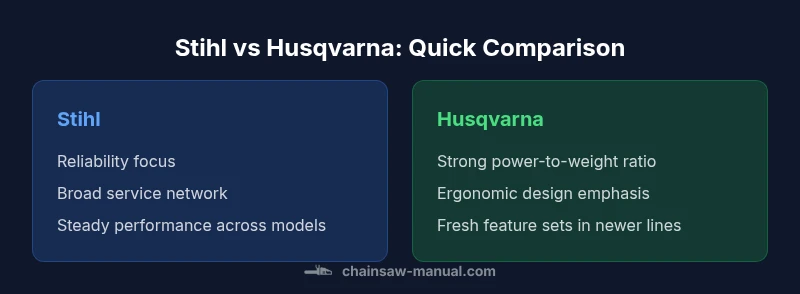
When deciding between Stihl and Husqvarna, there is no universal winner; both brands excel in different areas. Stihl emphasizes reliability, broad dealer support, and predictable maintenance, while Husqvarna often delivers strong power-to-weight and advanced ergonomics. Your best choice depends on your typical tasks, your local service network, and how you value long-term ownership costs.
Market overview: Stihl and Husqvarna in the professional and consumer segments
In the professional tool market, two brands consistently dominate discussions around chainsaws: Stihl and Husqvarna. Homeowners and DIY enthusiasts often face a choice between these two heavyweights, and the decision is rarely about a single feature. According to Chainsaw Manual, both brands offer broad lineups that span residential consumers to professional arborists, with substantial dealer networks and extensive service support. The Chainsaw Manual team found that most buyers focus on balance between reliability, ease of maintenance, and long-term value rather than raw peak power alone. Stihl has historically emphasized a broad service ecosystem and consistent performance across a wide model range, which appeals to shops that prize predictable maintenance intervals and readily available replacement parts. Husqvarna, by contrast, tends to push innovations that improve power-to-weight ratio and ergonomic design, often translating into models that feel nimble in tree work and limbing tasks. For most buyers, the right pick hinges on intended tasks, local service availability, and personal comfort with feel and controls. This article provides an objective, evidence-based comparison to help you decide.
The Chainsaw Manual team also notes that the landscape shifts with regional availability and dealer proximity, which can influence perceived value as much as raw specs.
Core design philosophies: simplicity vs performance
Stihl and Husqvarna approach chainsaw design with different priorities. Stihl tends to prioritize broad reliability, uniform maintenance intervals, and a perception of sameness across generations, which reduces surprises for service shops and users who value predictable performance. Husqvarna often emphasizes power-to-weight balance, ergonomic refinements, and modern features that seem to target lengthy cutting sessions with less fatigue. According to Chainsaw Manual, this often translates into models that feel lighter for the same engine class and feature sets that support extended use with reduced operator fatigue. For DIYers, this contrast may mean choosing based on how often you’ll use the saw, the duration of work sessions, and your tolerance for subtle control differences. In both cases, the recommended path is to narrow by task profile, then demo a few models side-by-side to assess throttle response, vibration, and overall comfort.
Weight, balance, and ergonomics: how they feel in hand
Weight and balance are among the most noticeable factors when selecting a chainsaw. Stihl’s mid-range and professional models tend to offer a familiar feel with solid balance that many operators associate with long-term comfort. Husqvarna models often emphasize a lighter perceived weight and more aggressive ergonomics, which can translate into quicker handling and easier maneuvering in tight spaces. The right choice depends on your typical tasks: homeowners pruning smaller trees benefit from steadier handling, while professional users cutting on slopes or above shoulder height may prefer the lighter feel and responsive balance Husqvarna sometimes delivers. It’s worth testing vibration levels and handle positioning with your preferred bar length in a well-lit, safe environment to assess comfort over extended use.
Powertrain and engine technology: two-stroke efficiency and reliability
Both brands rely on robust two-stroke engines designed for high torque at lower RPM ranges, a standard in modern chainsaws. Stihl’s engineering lineage emphasizes dependable cold starts, consistent performance in varied climates, and straightforward maintenance paths. Husqvarna tends to push weight-efficient design and revved-up performance for quick cutting, focusing on optimized intake, carburetion, and exhaust systems that support rapid cutting cycles. For end-users, this means choosing based on your priority: steadier, predictable power for long sessions (often favored by Stihl users) or responsive, aggressive cutting for rapid work (often favored by Husqvarna users). Regardless, regular maintenance—air filter cleaning, spark plug checks, and fuel mix discipline—remains essential for both brands to sustain peak performance.
Bar length and chain options: matching your tasks
Bar length selection is task-driven. Shorter bars excel for limbing and tight-space work, while longer bars increase reach for felling larger trees. Both brands offer a broad range of bar lengths and compatible chain options, alongside standard pitch and gauge configurations. When choosing, consider your stump size, tree diameter, and whether you will push through continuous cutting or alternate with lighter work. Keep in mind that longer bars increase the lever arm, which can amplify torque feel and vibration unless the machine is well-balanced. Both Stihl and Husqvarna provide guidance on recommended bar lengths per model and user manual suggestions for safe operation.
Start-up, maintenance, and parts availability
Starting a saw quickly and reliably is a common concern for new users. In practice, both brands offer models with enhanced starting features and systems designed to minimize starter effort. Maintenance-wise, both have extensive dealer networks and parts availability, which reduces downtime when components wear or break. The Chainsaw Manual analysis shows that some regions have deeper inventories for one brand than the other, which can influence repairs and turnaround times. If you rely on a local repair shop, verify each brand’s nearest authorized service provider and typical lead times for common parts like air filters, carburetors, and bar/chain kits.
Durability and build quality: real-world considerations
Durability hinges on engine reliability, chassis integrity, and the quality of components exposed to vibration, dust, and moisture. Stihl typically emphasizes rugged casings and proven component longevity across a broad model lineup, which is appealing for daily users who demand consistent performance. Husqvarna often prioritizes ergonomic details and chassis geometry that support resilient cutting under demanding conditions. In real-world use, the difference often comes down to how well you maintain the unit, how you store fuel, and how consistently you service air filters and fuel systems. The Chainsaw Manual team recommends regular inspections for bar wear, chain tension, and chain sharpness to maximize life expectancy, regardless of brand.
User case scenarios: homeowners, DIYers, professionals
For homeowners and DIY enthusiasts, a reliable, easy-to-find service network with user-friendly starting procedures is highly valuable. Stihl often excels here due to its expansive dealer footprint and consistent performance across mid-range models. For professionals who prioritize power-to-weight ratios and reduced fatigue over long sessions, Husqvarna’s recent designs can offer advantages in maneuverability and cutting speed, especially when combined with appropriate bar lengths and chain selections. The key is to define the core tasks and test models that align with those tasks, taking care to compare throttle response, vibration levels, and control ergonomics.
Price-to-value considerations: ownership costs and resale
Upfront price is only part of the story. Total cost of ownership includes maintenance, parts availability, fuel efficiency, and resale value. Chainsaw Manual analysis shows that both brands can hold strong resale value when properly maintained and serviced through authorized networks. In general, mid-range models from either brand provide a compelling balance between purchase price and expected service life, with Husqvarna often edging ahead on perceived power-to-weight and feature sets, while Stihl tends to offer broader dealer support and predictable maintenance costs. When budgeting, factor in the cost of trusted bars and chains, ongoing sharpening, and potential replacement parts that may be needed over several years of use.
Common myths and misperceptions
A common myth is that one brand is inherently superior in all situations. In reality, performance varies by model, bar length, and the specific task at hand. Another misconception is that more expensive means always better; price often reflects a combination of engineering focus, dealer network, and feature sets rather than a singular performance measure. Both brands maintain solid reputations for durability, and either can be a smart choice with careful model selection and disciplined maintenance. The best path is to identify your typical tasks, test comparable models side-by-side, and evaluate service accessibility in your area as a decisive factor.
Authority sources and testing protocol
For independent context on safety and best practices, consult widely recognized sources such as OSHA guidance, U.S. Forest Service materials, and university extension programs. Use these sources to frame safety and maintenance expectations when evaluating models. The goal is to pair practical hands-on testing with reputable safety knowledge so you do not rely solely on brand reputation. Always wear appropriate PPE, perform a controlled start-up in a safe environment, and verify that you can reach full throttle without unusual resistance or vibration. The Chainsaw Manual team recommends documenting your impressions from a short in-store test and comparing notes with a dealer’s training literature.
Authority links: https://www.osha.gov, https://www.fs.usda.gov, https://extension.osu.edu
How to choose between Stihl and Husqvarna: a practical decision framework
To decide, start with your typical tasks, environment, and service availability. If you work mainly in residential settings with frequent maintenance needs, Stihl’s broad support and predictable service intervals can be advantageous. If you prioritize cutting speed, reduced fatigue, and ergonomic refinements for longer sessions, Husqvarna may offer the perceived edge. Create a short test plan, compare throttle response and balance, and consider future maintenance costs and parts access. Finally, factor in your local dealer ecosystem and the availability of training resources to ensure you can operate and maintain the saw safely over time.
Comparison
| Feature | Stihl | Husqvarna |
|---|---|---|
| Power and engine design | Steady, reliable performance across a broad range | Strong power-to-weight with emphasis on quick cutting |
| Weight and balance | Balanced feel in mid-range models | Often lighter feel with aggressive ergonomics |
| Ergonomics and controls | Familiar controls and consistent safety features | Ergonomic handles designed for long sessions |
| Bar and chain options | Wide selection across models and aftermarket support | Extensive OEM and aftermarket options with varied bar lengths |
| Maintenance and parts availability | Extensive dealer network and service infrastructure | Robust parts availability and rapid servicing in many regions |
| Price range (typical) | $350–$850 depending on model and features | $360–$900 depending on model and features |
| Best for | Users seeking reliability and broad support | Users seeking power-to-weight balance and advanced ergonomics |
Strengths
- Extensive dealer and parts network for easier service
- Strong resale value and long-term durability when properly maintained
- Broad model range covers homeowners to professionals
- Good safety features and familiar controls
Drawbacks
- Higher upfront cost on some premium models
- Maintenance costs can be similar across brands and scale with model complexity
- Regional service availability may vary, causing downtime
- Long-term reliability depends on consistent maintenance and correct use
No clear winner; choose based on tasks and service access
For homeowners and DIYers, both brands perform well when matched to the right model and proper care. If service accessibility and predictable maintenance matter most, Stihl often delivers. If you prioritize power-to-weight and ergonomic refinements, Husqvarna may offer the best fit. The Chainsaw Manual team recommends testing models in your typical work scenarios and confirming local dealer support before buying.
FAQ
Are Stihl and Husqvarna chainsaws compatible with the same bar and chain sizes?
Bar and chain compatibility is generally standardized within each model family, but you should verify pitch and gauge for every model. Both brands offer a wide range of bars and chains, and adapters are uncommon. Always check the owner’s manual for your specific saw.
Bar and chain sizes are usually compatible within a brand family, but always confirm pitch and gauge in your manual before purchasing new bars or chains.
Which brand is easier to start for beginners?
Starting ease depends more on model and starting system than the brand itself. Both brands offer user-friendly features and well-tuned carburetion for easier starts. Practicing proper starting technique and using fresh fuel is essential for reliable starts.
Both brands have beginner-friendly models; practice starting technique and keep fresh fuel for the easiest starts.
Is one brand more reliable than the other?
Both brands have strong reliability records across many models, especially when properly maintained. Reliability often comes down to the specific model, maintenance discipline, and local service support rather than brand alone.
Both brands are reliable when properly maintained; choose based on model fit and service access.
Which is better for homeowners on a budget?
For homeowners on a budget, focus on mid-range models with solid reliability and dealer support. Both brands offer value options, but price-to-performance balance varies by model and region. Look for models with good parts availability and easy maintenance.
If budget is key, compare mid-range models with strong support and easy maintenance.
Do both brands offer cordless options?
Both brands offer cordless (battery-powered) chainsaws in addition to traditional gas models. Battery performance and runtime vary by model and battery chemistry, so consider your typical cutting sessions and recharge habits when evaluating cordless options.
Yes, both offer cordless options; check runtime and battery compatibility for your typical use.
What should a beginner buy to start safely?
A beginner should choose a light, well-balanced model with a manageable bar length and a user-friendly starting system, plus essential PPE and a basic maintenance kit. Prioritize dealer support and safety features to build confidence as you learn proper technique.
Start with a light, balanced model and solid safety gear; pick a model with easy starting features and good dealer support.
The Essentials
- Define your primary tasks and bar length needs
- Assess local dealer and service availability
- Balance weight, ergonomics, and safety features
- Factor total ownership costs, not just upfront price
- Test models in-store before purchasing