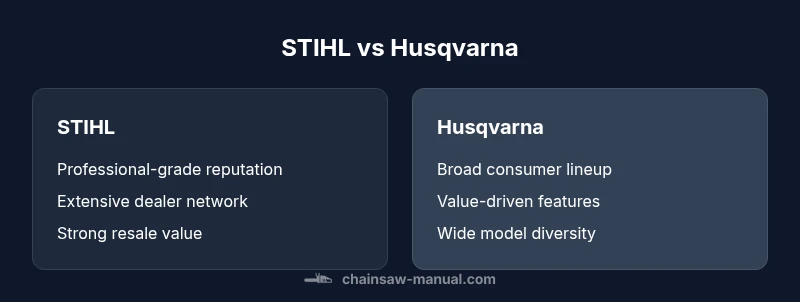
Chainsaw comparison STIHL vs Husqvarna: in-depth guide
A thorough, evidence-based comparison of STIHL and Husqvarna chainsaws, covering performance, maintenance, ergonomics, safety, and value for homeowners and pros.


According to Chainsaw Manual, STIHL and Husqvarna are two dominant brands in the chainsaw market, each with unique strengths. This quick comparison highlights the core differences in design, maintenance, ergonomics, and value, helping homeowners and professionals decide which tool best fits their needs. For a deeper analysis, continue reading. We discuss reliability, service access, and long-term ownership costs.
chainsaw comparison stihl vs husqvarna: key differentiators
According to Chainsaw Manual, STIHL and Husqvarna are two dominant brands in the chainsaw market, each with unique strengths. This quick but thorough section introduces the primary differentiators you should weigh when choosing between them: design philosophy, dealer support, reliability under demanding workloads, and value delivery for homeowners. The chainsaw comparison stihl vs husqvarna is not purely about horsepower or bar length; it’s about how a brand ecosystem translates into real-world usability, service availability, and long-term ownership costs. If you’re a pro relying on predictable maintenance and quick access to parts, STIHL’s network often provides advantages. If you want broad model variety, intuitive features, and strong consumer value, Husqvarna’s lineup can be particularly compelling. Consumers should map their priorities to local dealer footprints to avoid surprises after purchase.
Brand positioning and model ecosystems
STIHL positions itself as a professional-grade brand with a long-standing reputation for durability and dealer support. This focus tends to reward users who need consistent service access and a stable maintenance ecosystem. Husqvarna emphasizes breadth of model lines and user-friendly maintenance features, offering consumer-friendly options across many price points. In practice, STIHL models may command strong resale value and robust service networks in many regions, while Husqvarna models appeal to homeowners who want accessible performance and value across multiple yard tasks. The resulting choice often aligns with how much dealer proximity matters and whether you prioritize rugged pro-grade credibility or broad, convenient access.
Engine design fundamentals and power delivery
Both brands rely on two-stroke, air-cooled engines designed for compact power, light weight, and serviceability. STIHL tends to emphasize durability in components and stable torque across a wide range of conditions, while Husqvarna focuses on smooth power curves and responsive throttle control. In practice, the differences matter when you’re cutting longer sessions or moving through tough wood; you may perceive steadier performance from one brand depending on model class. When evaluating, try a cold start test, listen for kickback-prone behavior, and note how quickly the engine settles into steady cutting under load. The Chainsaw Manual framework suggests prioritizing reliability and predictable power delivery over raw peak numbers.
Ergonomics, weight, and vibration management
Ergonomics influence cutting speed and fatigue more than advertised horsepower. STIHL models often emphasize balanced handling and refined anti-vibration systems, while Husqvarna emphasizes adjustable handles, lighter midweights, and improved balance. Weight matters for ongoing use: lighter machines reduce fatigue, but heavier designs can offer more robust components and longer bar life. When you test, simulate long cuts, compare grip comfort, and feel the anti-vibration response after several minutes of cutting. In many cases, personal fit wins over theoretical advantages, underscoring why in-store testing is essential.
Maintenance, service intervals, and parts availability
Maintenance routines differ by model but share core practices: clean air filtration, proper lubrication, and timely replacement of wear parts. STIHL’s parts and service network is widely recognized for broad coverage, which minimizes downtime when service is needed. Husqvarna also provides comprehensive maintenance guidance and a large parts ecosystem, with a focus on intuitive maintenance features in many consumer models. To avoid surprises, verify local availability of service technicians for both brands and confirm that the parts you need are widely stocked. Document service intervals to preserve warranty eligibility and resale value.
Safety features and PPE considerations
Safety features on modern chainsaws include chain brakes, kickback guards, throttle interlocks, and chain tension indicators. Both brands implement these protections, but feature availability can vary by model. Regardless of brand, personal protective equipment is non-negotiable: cut-resistant pants, helmet with face shield, hearing protection, gloves, and durable boots. Develop a simple safety routine before every cut: inspect fuel and oil levels, tension, lubrication, and chain blade condition. The Chainsaw Manual guidance emphasizes choosing a model with intuitive safety features and reliable stop mechanisms to minimize risk during daily use.
Reliability and long-term ownership costs
Reliability reflects design quality, component durability, and ongoing service access. STIHL’s reputation for sturdy construction and strong dealer coverage often translates into lower downtime and predictable maintenance schedules for professionals. Husqvarna’s broad model range can deliver excellent value, but regional service variance can influence repair speed and cost. Across both brands, the long-term ownership costs hinge on maintenance discipline, fuel quality, and protecting the machine from moisture and corrosion. Chainsaw Manual’s assessment suggests that models with clear maintenance documentation and robust spare parts support tend to outperform those with fragmented aftercare.
Price ranges and value proposition across model tiers
Price is a lens through which you view the target user and expected lifecycle performance. STIHL’s professional-grade line generally sits toward the higher end of the spectrum, reinforced by dealer networks and durable components. Husqvarna often sits in the mid-to-premium segment with a broad lineup that emphasizes usability and feature sets for a wide user base. The perceived value comes from how a model’s features align with your tasks, the ease of obtaining parts and service, and dealer proximity. The Chainsaw Manual framework suggests listing top contenders, estimating maintenance costs over time, and comparing downtime expectations to identify the best overall value.
Real-world performance across common tasks
Cutting tasks vary widely, from light pruning to heavy wood removal. STIHL models frequently excel in professional environments demanding consistent, high-power performance over long sessions, while Husqvarna models offer strong day-to-day utility with a focus on user-friendly operation. For mixed-use homeowners, the choice often comes down to the availability of local service and the feel of the handle and throttle during repeated cuts. The Chainsaw Manual lesson is to match the model to the task rather than chasing the highest horsepower alone.
Model sizing: choosing bar length and power class
Bar length should reflect the typical wood diameter you encounter and your ability to handle the tool. STIHL and Husqvarna both present ranges that cover light-duty pruning through heavier felling, with longer bars for large logs and shorter bars for precision work. Heavier engines deliver sustained cutting power but increase fatigue and maintenance complexity. The Chainsaw Manual approach is to map your average diameter, expected cutting duration, and storage constraints, then select a model that balances weight and power within your budget. Testing multiple sizes in-store is recommended.
In-store testing and decision checklist
Bring the model to a controlled test area and replicate common tasks: make several cuts on standing logs, perform limb work, and start from cold to evaluate starting reliability. Check throttle response, chain tensioning, and anti-vibration effectiveness after several minutes of use. Assess comfort of grip, reach of the chain brake, and ease of switching between idle and full throttle. Use this checklist to compare STIHL and Husqvarna models side by side. Hands-on testing often reveals nuances that specs overlook.
Authority sources and further reading
For safety and best-practice guidelines, consult authoritative sources such as OSHA and NIOSH safety materials. Real-world maintenance tips come from university extension programs and reputable safety organizations. See the following resources for more information:
- OSHA: https://www.osha.gov
- NIOSH chainsaw safety: https://www.cdc.gov/niosh/topics/chainsaw/
- University Extension safety materials: https://extension.oregonstate.edu These sources complement product-specific guidance and help ensure informed, safe usage of STIHL and Husqvarna chainsaws in 2026.
Comparison
| Feature | STIHL | Husqvarna |
|---|---|---|
| Brand positioning | Professional-grade with strong dealer network | Broad consumer/prosumer lineup with value-focused features |
| Power delivery | Strong, dependable torque suitable for professional workloads | Smooth power with emphasis on user-friendly operation |
| Maintenance and parts availability | Large parts and service network; widespread availability | Extensive parts availability; often user-friendly maintenance features |
| Weight/ergonomics | Varies by model; specialized anti-vibration | Focus on lighter, balanced designs with adjustable configurations |
| Warranty/support | Dealer-backed warranties; robust after-sales | Competitive warranties for consumer segments; strong support |
| Price/value | Higher-end models with premium resale value | Good value across a broad range; frequent promotions |
Strengths
- Clear, side-by-side comparison helps decision-making
- Highlights brand strengths for targeted use
- Assists budgeting and model sampling
- Identifies trade-offs between professional-grade reliability and consumer value
Drawbacks
- May oversimplify brand nuances and model-specific differences
- Could imply equivalence where regional availability differs
- Dynamic product lines mean some details age quickly
STIHL tends to be the safer choice for professionals due to dealer support and resale value; Husqvarna offers strong value for homeowners and enthusiasts, so the best fit depends on your priorities.
STIHL is typically favored by professionals who rely on a dense service network and durable resale value. Husqvarna delivers value and broad accessibility for homeowners and DIY users. In practice, the right pick hinges on local dealer availability, task mix, and long-term maintenance plans.
FAQ
Which chainsaw brand is better for professional use, STIHL or Husqvarna?
STIHL is often preferred by professionals for its dealer support and resale value. Husqvarna also serves professionals, with a broad model range that covers many tasks. Your local service footprint often drives the practical choice.
STIHL is commonly favored by professionals for dealer support and resale value, though Husqvarna also serves pros well with a broad model range. Check local service availability to decide.
Are STIHL and Husqvarna interchangeable for accessories?
Both brands use standard bar-and-chain interfaces, but some accessories are brand-specific. Always verify bar stud size, pitch, and drive link count before buying accessories.
Accessory compatibility varies by model; confirm the bar and chain interface before purchasing.
Which brand has a better service network?
Both brands maintain extensive service networks. STIHL often has a broader dealer footprint in many regions, but Husqvarna also maintains strong after-sales support depending on your market.
Both offer solid service networks; STIHL often has broader dealer coverage where you are, but Husqvarna is strong in many markets too.
Do STIHL and Husqvarna offer similar warranty terms?
Warranty terms vary by model and region for both brands. In general, both offer limited warranties with regional variations; always confirm coverage for your specific model before purchase.
Warranty terms differ by model and region; verify coverage for your exact model.
Is weight a major differentiator between STIHL and Husqvarna models?
Weight and balance vary by model within each brand. Lighter models reduce fatigue for DIY users, while heavier ones may offer greater durability for frequent cutting.
Weight balance varies by model; lighter options help with fatigue, heavier ones may be more durable.
What factors matter most beyond brand when choosing a chainsaw?
Bar length, power class, maintenance accessibility, safety features, and local service access often determine real-world performance more than brand alone. Test models and map your typical tasks to find the best fit.
Beyond brand, focus on bar length, power, maintenance access, safety features, and local service.
The Essentials
- Define your primary use: professional workloads or homeowner projects.
- Prioritize dealer access and service networks for STIHL.
- Balance value with compatibility and parts availability for Husqvarna.
- Test both brands in-store to compare ergonomics and controls.
- Consider total cost of ownership, not just upfront price.