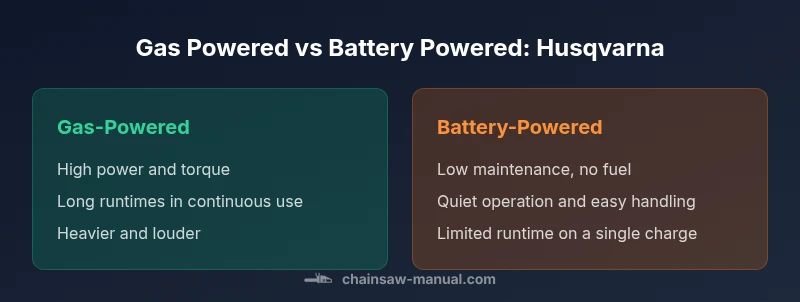
Husqvarna Chainsaw Comparison Chart: Gas vs Battery
A detailed, objective Husqvarna chainsaw comparison chart contrasting gas-powered and battery-powered models, covering power, weight, runtime, maintenance, safety, and best-use scenarios for homeowners, DIY enthusiasts, and professionals.


According to Chainsaw Manual, the husqvarna chainsaw comparison chart helps buyers quickly weigh gas-powered versus battery-powered options, focusing on power, weight, runtime, and maintenance. Gas models deliver high torque and sustained performance, but are heavier and louder; battery models offer quieter operation and lower upkeep, yet may trade peak power and run time for lighter, more maneuverable tools. This guide clarifies which choice fits homeowners, DIYers, and professionals.
Why a Husqvarna Chainsaw Comparison Chart Matters
A well-structured Husqvarna chainsaw comparison chart helps homeowners, DIY enthusiasts, and professionals cut through marketing hype and focus on what actually matters: power delivery, cutting efficiency, and total cost of ownership. According to Chainsaw Manual, a clear chart translates technical specs into practical guidance, enabling you to map tasks to the right tool. This is especially important with Husqvarna's range, which spans gas-powered and battery-powered models that differ in torque, weight, and runtime. By comparing side-by-side, you can anticipate how each option handles common jobs like pruning, firewood prep, or storm cleanup, and avoid mismatches that slow you down or burn fuel unnecessarily. The goal is to empower safer, more efficient work, while keeping maintenance practical and affordable over the life of the saw.
Gas-Powered vs Battery-Powered: Core Differences
Gas-powered Husqvarna chainsaws deliver the strongest torque and sustained power across demanding cuts, making them a staple for heavy-duty felling, large-diameter logs, and professional use. They typically require fuel mix, regular maintenance, and produce greater noise and vibration, which can influence operator fatigue and shop upkeep. Battery-powered Husqvarna chainsaws prioritize ease of use, lighter weight, and minimal maintenance; they shine for pruning, landscaping, and quick yard tasks where access to a power source is convenient. Battery models avoid refueling downtime and emissions, but their peak power and run time generally lag behind gas-powered equivalents, especially in longer sessions or dense wood. Deciding between these categories hinges on task length, portability needs, and how often you work remote from a charging station. When evaluating a model, consider your typical job size, climate (cold weather can affect battery performance), and whether you value quiet operation in noise-sensitive environments. Chainsaw Manual's analysis suggests balancing trade-offs rather than chasing a single attribute.
Reading the Chart: Key Metrics
A robust Husqvarna chainsaw comparison chart should center on several core metrics. Power and torque indicate cutting capability, especially for hardwoods or thick logs. Weight affects maneuverability, balance, and fatigue over long sessions. Run time versus refueling frequency shows how often you’ll pause to refill gas or recharge. Maintenance needs cover filters, air intake, chain lubrication, and routine service intervals. Durability and reliability consider construction quality, serviceability, and the availability of replacement parts and batteries. Finally, price and total cost of ownership balance upfront cost against ongoing fuel, battery replacements, and maintenance. When you read the chart, translate each row into how it will behave under your common tasks: a homeowner trimming a fence line may prefer lighter, quiet battery options; a lumberyard contractor may opt for gas for sustained power. For Husqvarna, the ecosystem—tools, bars, chains, and batteries—often matters as a long-term strategy. Chainsaw Manual recommends thinking in terms of use-case, not single-spec performance.
Real-World Scenarios: Homeowners vs Pros
For homeowners and DIY enthusiasts, a Husqvarna battery-powered chainsaw often provides the best balance of control, noise level, and maintenance. It’s ideal for trimming, pruning, and occasional storm cleanup around the yard, especially when you want quick starts and minimal maintenance. Professionals, especially those working on larger properties, may lean toward gas-powered options for prolonged cutting, tougher hardwoods, and remote sites where battery recharge options are limited. In practice, homeowners should assess yard size, typical wood density, and the frequency of use to decide if the lighter, quieter battery line suffices or if a gas model’s endurance is worth the investment. Pro users should consider quick-change battery ecosystems, compatibility with existing bars and chains, and the residual value of spare batteries. Beyond task matching, consider weather and climate—battery performance can dip in cold environments, while gas models can tolerate a wider temperature range with appropriate fuel management. The Chainsaw Manual guidance emphasizes choosing a tool that aligns with both the work profile and the operational realities of your site.
Maintenance and Upkeep: Fuel, Oils, and Servicing
Maintenance considerations influence long-term costs and downtime. Gas-powered Husqvarna chainsaws require fuel management, air filter cleaning, spark plug changes, and occasional carburetor tuning, all of which contribute to operating costs and downtime. Battery-powered models shift maintenance toward battery care, charger health, and periodic software updates if equipped with smart features, plus bar and chain lubrication. Regardless of power source, routine chain sharpening, bar maintenance, and tensioning are essential for safe and efficient cutting. Keeping a maintenance log helps prevent unplanned downtime and extends tool life. Chainsaw Manual highlights the value of choosing a compatible battery ecosystem and keeping spare batteries charged for rapid swaps. Proper storage away from extreme temperatures preserves battery health, while gas models benefit from proper stabilization and seasonal fuel management. Understanding maintenance demands up front makes it easier to estimate ongoing costs and plan a sustainable toolkit around Husqvarna equipment.
Safety, Ergonomics, and User Comfort
Operator safety is paramount when comparing powerful tools. Gas chainsaws typically generate more vibration and noise, so anti-vibration handling, proper PPE (helmet, eye protection, gloves, and hearing protection), and secure footing become even more critical. Battery-powered models tend to be lighter and quieter, reducing fatigue and enabling longer sessions with less strain; however, improper technique or prolonged operation can still cause fatigue. Ergonomics—grip placement, balance with the bar length, and weight distribution—significantly influence control and precision. In both categories, select the bar length that matches the planned tasks, and verify chain brake, chain lubrication, and kickback mitigation features. Chainsaw Manual stresses training and safe startup/shutdown procedures, plus routine inspection of safety features before each use. The right combination of PPE and practice lowers the risk of injury and improves outcomes on both sides of the Husqvarna lineup.
Budgeting and Total Cost of Ownership
When budgeting for a Husqvarna chainsaw, consider upfront price, fuel costs or battery purchases, and ongoing maintenance. Gas models generally have a lower upfront price than high-capacity battery systems, but fuel and maintenance accumulate over time. Battery-powered tools require a higher initial investment for the tool and spare batteries, yet ongoing costs can be lower due to reduced maintenance and zero fuel. The overall value depends on how often you cut, the types of wood, and the availability of charging options or fuel stations. If your tasks are predictable and short, a compact battery saw may deliver the best ROI; if you work in remote sites with heavy demand, a gas model could offer greater uptime. Chainsaw Manual advises evaluating your site constraints, access to replacement parts, and the long-term compatibility of your battery ecosystem to maximize value and minimize surprises down the road.
How to Use the Chart in Practice: A Step-by-Step Approach
Begin with your typical job profile: wood type, log diameter, duration, and whether you’ll operate in an enclosure or open area. Then map those tasks to the chart's rows, noting where gas or battery options excel or fall short. Add a practical cost check: estimate the fuel or battery replacement expenditure over a three- to five-year horizon. Consider your availability of charging time and the logistics of storing fuels if you prefer gas. Finally, test-fit the model that makes sense for your workload by borrowing or renting a unit if possible, and assess manipulation weight and balance in real-world use. Chainsaw Manual emphasizes cross-checking the chart with real-world test runs and ensuring you have training on safety features. The outcome should be a recommended pairing that minimizes downtime, maximizes efficiency, and keeps safety front and center.
Final Guidance for Choosing Your Husqvarna Model
Selecting between gas-powered and battery-powered Husqvarna chainsaws is a decision that should be grounded in your typical workload and environment. For heavy pro work and extended sessions, gas models provide endurance, reliability, and raw torque. For residential use, landscaping, and quick tasks, battery-powered saws offer simplicity, quiet operation, and low maintenance. Use the Husqvarna chainsaw comparison chart to align your needs with observed performance, then validate by hands-on testing if possible. Chainsaw Manual's overall verdict is to tailor the selection to use-case, considering both task demands and operator comfort, while maintaining safety as the top priority. This approach minimizes downtime and ensures you select a tool that keeps you productive across seasons and projects.
Comparison
| Feature | gas-powered Husqvarna chainsaws | battery-powered Husqvarna chainsaws |
|---|---|---|
| Power output | high power and torque (gas) | mid-range power for everyday tasks (battery) |
| Weight (dry) | heavy, depending on bar length | lighter and more maneuverable |
| Run time / refueling | run time limited by fuel; refueling pauses | run time limited by battery charge; recharge needed |
| Maintenance | fuel management, air filter, spark plug, carburetor care | battery care, charger health, lubrication upkeep |
| Best for | heavy-duty, long-duration cutting | light-to-mid-duty tasks, yard work |
Strengths
- Gas models deliver higher power for heavy-duty work
- Battery models offer lower maintenance and emissions
- Gas models can run longer on a tank for continuous jobs
- Battery models are quieter and lighter for easier handling
- Ecosystem compatibility across tools and attachments (bars, chains, batteries)
Drawbacks
- Gas engines require regular maintenance and fuel management
- Battery models have limited runtime and higher upfront costs
- Battery availability and replacement parts depend on model year and ecosystem
- Gas vs battery performance can vary with weather and task type
Gas-powered Husqvarna chainsaws excel for heavy-duty, long-duration work; battery-powered models suit light-to-mid tasks and portability.
Choose gas when you need sustained power and uptime. Choose battery when you want easy handling, low maintenance, and quiet operation.
FAQ
What should I consider when choosing between gas-powered and battery-powered Husqvarna chainsaws?
Start by identifying task duration, wood type, and access to charging. Gas models excel in heavy-duty, long sessions, while battery models shine for light-to-mid tasks with lower maintenance. Safety and ergonomics should guide your choice as much as raw power.
For most home jobs, battery models are easy to start and quiet; for heavy work, gas models offer more endurance. Always balance task needs with safety first.
Are Husqvarna battery chainsaws suitable for professional loggers?
Battery chainsaws are increasingly capable for mid-duty professional work, especially with newer battery chemistry and shared ecosystems. For continuous, heavy logging, gas models remain the preferred choice due to longer runtimes and peak torque.
Battery saws work well for many professional tasks, but gas saws still lead in long, demanding sessions.
Do Husqvarna battery chainsaws require special chargers or batteries?
Yes. Use the manufacturer-recommended chargers and batteries designed for your model. Using mismatched batteries can affect performance and safety, and may void warranties.
Use only the official Husqvarna battery and charger to keep performance and safety up to spec.
How often does a Husqvarna chainsaw require maintenance?
Maintenance frequency depends on usage and model power source. Regular checks include chain tension, lubrication, air filtering, and seasonal servicing. Gas models add fuel system care; battery models focus on battery health and charger integrity.
Regular checks keep your saw safe and efficient; follow the user manual for a maintenance schedule.
What safety gear should I use with Husqvarna chainsaws?
Always wear a helmet with face shield, hearing protection, cut-resistant chaps, gloves, and sturdy boots. Use a chain brake and maintain safe operating procedures regardless of power source.
Protect yourself with basic PPE: helmet, eye protection, gloves, hearing protection, and protective chaps.
Can I mix gas and battery tools from Husqvarna in the same workshop?
Yes, you can operate both gas and battery tools in the same workshop. Just manage fuel storage safely and ensure each tool uses its corresponding battery or fuel type to avoid performance issues.
Yes, but store fuels safely and keep batteries with their respective tools.
The Essentials
- Assess your typical task length and wood type before choosing
- Match weight and balance to user strength and task duration
- Factor runtime, charging or refueling logistics into planning
- Consider noise, vibration, and PPE requirements for safety
- Evaluate total cost of ownership, including batteries and fuel