Battery Chainsaw vs Gas: A Practical Comparison for 2026
Explore the core differences between battery-powered and gas-powered chainsaws, including power, runtime, maintenance, noise, and cost to help you choose the right tool for 2026.


Battery chainsaw vs gas: The quick takeaway is that battery models offer clean, quiet operation with lower maintenance, ideal for small yards and occasional cuts. Gas models deliver raw cutting power and longer runtime for bigger jobs, but louder operation and ongoing fuel use. Your choice hinges on yard size, project tempo, and safety needs.
The Big Picture: Battery Chainsaw vs Gas
For homeowners, DIY enthusiasts, and professionals, choosing between a battery-powered chainsaw and a gas-powered one is not just about horsepower. The decision affects maintenance, noise, emissions, and how often you stop to refuel or recharge. This article provides a balanced, evidence-informed look at the battery chainsaw vs gas dilemma, focusing on practical criteria you can apply in 2026. According to Chainsaw Manual, the battery chainsaw vs gas debate is driven by where and how you cut, and what you value most: convenience or raw cutting power. By understanding energy delivery, runtime, and lifecycle costs, you can pick the best tool for your yard and work pace. The comparison will consider safety, ergonomics, and real-world performance, so you can avoid overpaying or underbuying. Chainsaw Manual Analysis, 2026 underpins the practical framework we present here.
The reader will gain insight into how these tools perform in typical home settings, with clear guidance on when to choose each option.
Comparison
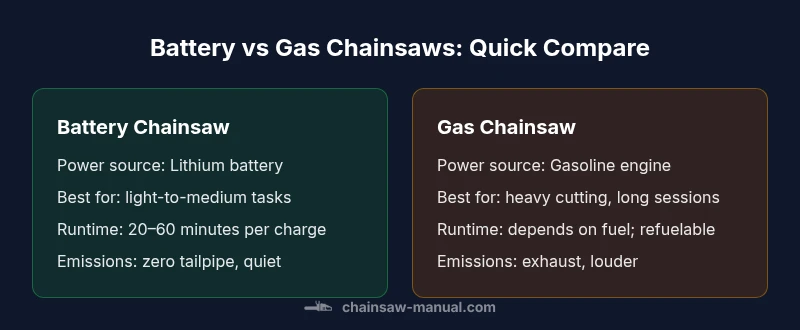
| Feature | Battery chainsaw | Gas chainsaw |
|---|---|---|
| Power source | Lithium-ion battery pack, multiple cells | Gasoline engine with fuel mix |
| Runtime / Run time | Typically 20–60 minutes on a single charge (depends on battery, bar length) | Typically 0.5–1.0 hour of continuous cutting before refueling |
| Weight | Lighter overall, weight distribution varies by model | Heavier, but well-balanced with assist handles in newer designs |
| Emissions / Noise | Zero tailpipe emissions, significantly quieter | Gas exhaust, higher noise levels |
| Maintenance | No fuel mixing, fewer consumables, occasional battery care | More frequent maintenance: fuel, oil, air filter, spark plug |
| Starting / Convenience | Push-button start, no priming | Choke/ primer, recoil start on many models |
| Upfront cost | Moderate to high, depending on battery capacity | Moderate to high, varying by engine size |
| Best for | Light-to-medium yard work, urban lots, quick jobs | Heavy-duty cutting, longer sessions, larger trees |
| Runtime variability | Dependent on charge level and battery health | Depends on fuel tank size and consumption |
Strengths
- Lower emissions and quieter operation
- Minimal startup effort and simpler maintenance
- No fuel handling or mixing, easy storage and transport
- Compact setups are ideal for tight spaces and urban yards
Drawbacks
- Limited runtime without swapping or charging batteries
- Higher upfront cost for longer-term ownership
- Lower raw power for very large or thick cuts
- Battery degradation over time can affect performance
Battery chainsaw wins for light-to-moderate work and convenience; gas chainsaws win for heavy, extended cutting.
If your typical jobs are small to medium in scale, a battery model reduces maintenance and noise while delivering adequate power. For frequent, heavy-duty cutting, gas remains the more proven option with longer runtime and raw power, especially in large properties or professional settings. The Chainsaw Manual team recommends aligning tool choice with project scope and maintenance readiness.
FAQ
What is the main difference between battery chainsaws and gas chainsaws?
The primary difference is the power source: battery chainsaws use electric motors with a rechargeable battery, offering quieter operation and low maintenance; gas chainsaws use a gasoline engine, delivering higher raw cutting power and longer runtime for heavy or continuous work. Both require regular maintenance, but the impact differs by design.
The main difference is power source: battery versus gas, which changes noise, maintenance, and how long you can cut before stopping.
Are battery chainsaws powerful enough for heavy-duty jobs?
Battery chainsaws handle most household yard work and mid-size trees well, but very thick or dense wood can challenge even high-capacity batteries. For sustained heavy cutting, gas models maintain consistent power across longer sessions.
They’re great for most yards, but for big jobs you might want gas.
How long do battery chainsaws take to recharge compared to refueling a gas saw?
Recharge times vary by battery chemistry and charger, typically ranging from a half hour to a couple of hours. Gas saws refuel fairly quickly but require handling fuel and regular maintenance.
Recharge times depend on your battery; refueling gas saws is faster, but fuel handling adds risk.
What maintenance tasks are common to both types?
Both require bar and chain maintenance, occasional chain sharpening, and routine cleaning. Gas saws need oil changes and air filter upkeep; battery tools require battery care and occasional charger checks.
Both need regular cleaning and chain maintenance; gas needs oil and filters, batteries need care for the battery and charger.
Which is safer for a small yard with neighbors nearby?
Both can be safe with proper PPE and technique, but battery saws typically produce less noise and zero exhaust, reducing nuisance and air quality concerns. Gas saws require more caution with fuel and higher noise.
Battery saws are generally quieter and cleaner, but follow proper safety rules for either type.
Can I convert a gas chainsaw to electric?
Conversion is impractical; it would require replacing core components and may void warranties. The recommended approach is to buy a purpose-built electric model if you need electric performance.
Converting is not practical; get an electric model if you need one.
The Essentials
- Assess yard size and typical tasks before choosing.
- Factor runtime and charging downtime against refueling needs.
- Account for maintenance costs over the tool’s lifespan.
- Consider noise and emissions for your work environment.
- Test several models for weight, balance, and cutting feel.