Stihl Battery Chainsaw vs Husqvarna: A Practical Comparison
An objective, in-depth comparison of Stihl battery chainsaws and Husqvarna options, covering performance, runtime, weight, price, ecosystem, and maintenance to guide homeowners and professionals.


When choosing between a Stihl battery chainsaw and a Husqvarna, consider the ecosystem, available battery packs, and typical tasks. Stihl often offers broad dealer networks and a versatile battery range, while Husqvarna emphasizes high runtime and pro-focused accessories. For most homeowners and DIYers, the choice hinges on which ecosystem you already own and the weight you can manage comfortably.
Stihl battery chainsaw vs husqvarna: ecosystem and decision criteria
Choosing between Stihl battery chainsaws and Husqvarna models starts with the ecosystem question. Both brands have robust, shop-friendly networks and widely available replacement batteries and chargers, which reduces downtime and keeps projects on track. The Chainsaw Manual team notes that the strength of each brand’s ecosystem often translates to better warranty support, faster parts replacement, and broader accessory availability. For many buyers, aligning with the ecosystem you already own—whether you have Stihl tools or Husqvarna tools—minimizes the need for extra chargers, adapters, and spare batteries. This alignment reduces total ownership friction and, over time, can lower the effective cost of ownership. In practical terms, if you already own batteries and a charger from one brand, that prior investment should influence your decision here. According to Chainsaw Manual analysis, ecosystem compatibility remains a top factor for both homeowners and professionals when evaluating the two brands.
Performance context: what matters in real use
Performance for battery chainsaws is a balance of power output, weight, and battery capacity. Stihl tends to offer a broad spectrum of tools across compact to mid-range professional models, with emphasis on steady performance and predictable behavior under load. Husqvarna often prioritizes higher runtime with larger battery packs and a focus on ergonomics and balance for prolonged use. In practice, performance is highly model- and battery-dependent. When evaluating two specific models from these brands, compare the same battery size and same chain pitch to ensure the comparison is apples-to-apples. Homeowners will value predictable starts and easy handling, while professionals will look for sustained cutting power and service support during long jobs.
Weight, balance, and feel: why these matter
Weight and balance significantly affect user fatigue, especially during long sessions. Stihl’s lightweight, compact models are designed for easy maneuverability and quick switching between tasks. Husqvarna often emphasizes a slightly longer reach and a more balanced feel, which can reduce wrist and shoulder strain on larger clear-cutting jobs. Take a hands-on test if possible: hold the machine at waist height, simulate a couple of cuts, and note how the weight shifts with an attached battery. For users with a preference for one brand’s trigger feel or handle geometry, those ergonomic traits can drive day-to-day comfort more than raw power alone.
Runtime considerations: battery strategy
Runtime is driven by battery capacity and how aggressively you cut. Both brands offer multiple battery sizes, and real-world run time scales with pack size, chain speed, and even chain brake usage. A common pitfall is assuming a larger battery always means the job is finished sooner; in practice, heavier batteries can slow you down due to fatigue or impact the tool’s balance. Plan for a mix of mid- and large-pack options if you anticipate long sessions away from a charging station. The Chainsaw Manual team recommends mapping out anticipated job lengths and summing the required runtime with a conservative buffer for charging downtime.
Maintenance and care: simplicity vs investment
Battery chain saws eliminate carburetor maintenance and fuel-related odors, which is a win for most users. However, battery care still matters: store packs properly, avoid exposing batteries to extreme temperatures, and keep charging hardware clean. Both brands provide on-tool indicators and guidance on charging practices. Regular bar-and-chain maintenance remains essential, but you’ll find detergents, lubricants, and sharpening tools largely similar in needs across brands. The practical takeaway is that maintenance complexity does not swing dramatically toward one brand; it depends on your maintenance habits and access to service centers.
Price considerations and total cost of ownership
Upfront costs for battery chainsaws often reflect the included battery and charger. Stihl and Husqvarna both offer bundles where the most affordable entry-level option includes at least one battery and a charger, but add-ons can push price higher. Over the life of the tool, battery life, replacement packs, and service frequency influence total ownership costs. The Chainsaw Manual analysis suggests that buyers who already own a compatible battery system may enjoy lower incremental costs, while brand-new buyers should compare bundle pricing and future replacement battery availability to estimate long-term value.
Noise, emissions, and environmental impact
Battery-powered chainsaws are quieter and emit no exhaust, which is a strong environmental and safety benefit for residential work and urban environments. The noise profile is mainly determined by chain speed and bar length, not engine type. Both Stihl and Husqvarna design their devices with noise reduction in mind, but differences in motor construction, bar length, and chain pitch can influence perceived noise during operation. For sensitive work areas, choosing a low-noise model from either brand can improve daily usability and neighbor relations.
Real-world use cases: homeowners, DIYers, and professionals
Homeowners often prioritize ease of use, light weight, and quick starts. In these scenarios, Stihl’s compact models or Husqvarna’s mid-range tools can be compelling choices depending on which ecosystem you already own. DIYers who tackle occasional pruning or small felling tasks may prefer a lighter setup with fast-charging options. Professionals, meanwhile, weigh sustained performance, longer runtimes, and service responsiveness. Husqvarna’s emphasis on ergonomics and larger-capacity packs can be attractive for long jobs, while Stihl’s broad service network and consistent performance remain a strong selling point. The final decision should consider the job profile, onsite power needs, and maintenance access to service centers.
How to approach a decision: a practical buying checklist
To compare Stihl battery chainsaws vs Husqvarna effectively, start with a checklist: confirm your existing battery ecosystem, define typical job length, assess weight tolerance, check charger availability, and review warranty terms. Then, compare two representative models from each brand with the same battery size and similar bar length. Finally, factor in after-sales support, dealer proximity, and accessory availability, as these hidden costs can influence overall satisfaction and uptime on the job.
What to buy now: a quick decision guide for 2026
If you are starting from scratch, choose the brand with the strongest local service network and the most readily available battery packs in your area. If you already own one brand’s batteries, it makes sense to stay within that ecosystem to minimize extra purchases. For homeowners who value quiet operation and simple maintenance, either brand offers compelling options; for long-term pro work, prioritize machines with comfortable handles, well-balanced design, and reliable service options. The Chainsaw Manual guidance is to map your usage, compare two practical models side-by-side, and then select the option that aligns with your battery ecosystem and workload expectations.
Comparison
| Feature | Stihl battery chainsaw | Husqvarna battery chainsaw |
|---|---|---|
| Battery ecosystem | Stihl: broad, widely supported battery ecosystem with multiple pack options | Husqvarna: extensive battery system with scalable packs and accessories |
| Typical weight with mid-range battery | Generally lighter in compact models | Balanced design with emphasis on ergonomics for mid-to-large packs |
| Runtime guidance (with same battery size) | Runtime scales with battery size; performance varies by model and task | Runtime scales with battery size; performance varies by model and task |
| Charging time and accessories | Varies by charger model; multiple charging options available | Varies by charger model; fast-charging options available |
| Price context (entry bundles) | Typically higher upfront when bundled with batteries | Typically higher upfront when bundled with batteries |
| Best for | Users seeking broad dealer support and a versatile ecosystem | Users prioritizing long runtime and ergonomic balance |
Strengths
- Low emissions and quiet operation compared to gas engines
- No fuel mixing or engine maintenance, simpler starts
- Modular battery ecosystems allow quick power swaps
- Wide availability of models across light to mid-range tasks
Drawbacks
- Higher upfront cost for battery, charger, and extra packs
- Runtime depends on battery size; multiple packs may be needed for long jobs
- Power parity with gas models may be limited on heavy-duty tasks
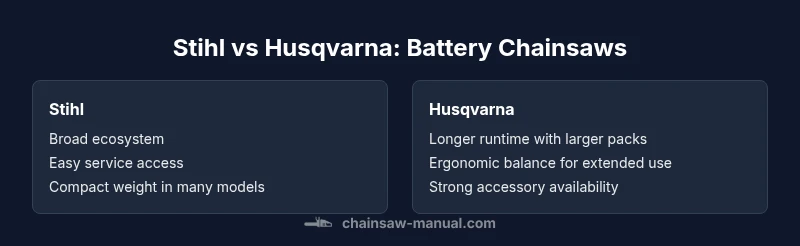
Stihl generally benefits from ecosystem breadth and service access; Husqvarna often wins on ergonomic design and long runtime with larger packs
Choose Stihl if you value dealer support and ecosystem versatility. Choose Husqvarna if you need longer runtime and a well-balanced tool for extended use.
FAQ
Are Stihl and Husqvarna batteries interchangeable?
No. Batteries are designed to work within each brand’s own ecosystem. Mixing packs across brands can lead to reduced performance and potential warranties issues. Always use the specified battery and charger for the tool.
Batteries aren’t interchangeable between Stihl and Husqvarna. Use the right battery and charger for each tool to avoid performance issues.
Which brand is better for homeowners?
Both brands offer user-friendly options for homeowners. The choice often comes down to weight, ergonomics, and the nearby service network. If you already own batteries from one brand, it makes sense to stay within that ecosystem.
For homeowners, either brand works well; pick the one that feels lighter and more comfortable, and consider service proximity.
How should I plan for runtime with a battery chainsaw?
Plan around the battery size and the task length. Larger batteries extend run time but add weight. Carry a spare pack if you expect sessions beyond the charge window, and schedule charging breaks to stay productive.
Plan around battery size and task length; carry extra packs for longer jobs.
Do these brands require more maintenance than gas models?
Maintenance is simpler overall for battery chainsaws—no carburetor or fuel mixing. Regular bar-and-chain maintenance remains important, and battery care is essential to maximize lifespan.
Battery chainsaws require less maintenance than gas models, but still need regular bar-and-chain upkeep and proper battery care.
What should I consider when buying a battery chainsaw now?
Evaluate runtime needs, weight, battery availability, charger options, warranty terms, and service support in your region. Compare two equivalent models from each brand to see which fits your tasks best.
Consider runtime, weight, batteries, and service before buying; compare equivalent models side-by-side.
Is one brand clearly better for heavy-duty pros?
Both brands offer capable pro-oriented models, but differences in ergonomics and battery pack options may influence choice for long-duration work. Pro users should assess service coverage and battery availability for their typical work sites.
For pros, evaluate ergonomics, service reach, and battery availability; both brands have strong pro options.
The Essentials
- Match your battery ecosystem to minimize extra purchases
- Assess runtime need based on typical job length and battery size
- Weight and balance influence comfort for long sessions
- Consider service network and spare parts availability