Difference Between Chainsaw and Buzzsaw: A Practical Guide
Explore the key differences between a chainsaw and a buzzsaw, covering design, use cases, safety considerations, and maintenance for homeowners and professionals.


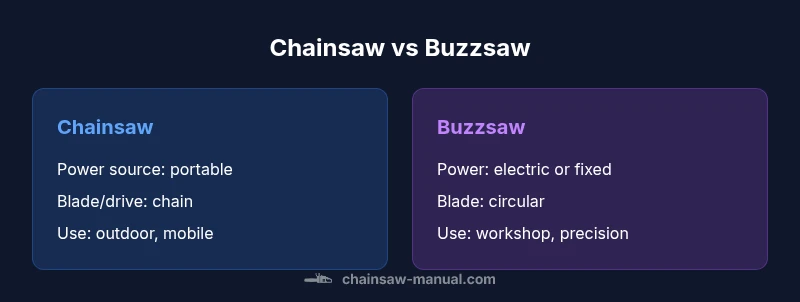
Chainsaw vs buzzsaw hinges on design intent and work context: a portable chain-driven saw for outdoor tasks versus a fixed circular saw in a shop for precise crosscuts. This comparison explains when to use each tool, highlights safety considerations, and guides homeowners and professionals toward safer, more efficient decisions. Understanding these differences helps you select the right tool for the job and improve outcomes.
What you need to know about the difference between chainsaw and buzzsaw
The difference between chainsaw and buzzsaw is not just blade geometry. It reflects each tool's core design and ideal environment. The Chainsaw Manual team notes that a chainsaw is built for mobility, variable field conditions, and tasks like felling or limbing, while the buzzsaw specializes in controlled, straight cuts in a workshop. By framing the distinction around environment, cutting action, and typical workloads, readers can predict which tool aligns with their project. This context is essential for homeowners and professionals who must balance safety, efficiency, and results on real jobs.
Core design differences: chain drive vs circular blade
At a high level, the chainsaw uses a connected chain that loops around a bar, delivering rapid, slicing cuts as the engine runs. A buzzsaw uses a circular blade mounted on a table or stand, delivering a high-speed, uniform cut with each pass. The Chainsaw Manual analysis shows how the drive system shapes maintenance needs, vibration behavior, and cut quality, with chainsaws demanding more frequent bar-and-chain care and buzzsaws emphasizing blade sharpness and alignment.
Power, drive, and portability considerations
Power delivery defines where each tool shines. Chainsaws are commonly gasoline or battery-powered for field work, with a compact footprint that supports accessibility in tight spaces. Buzzsaws are usually electric in workshop environments, designed for consistency and repeatable cuts. The difference in power sources influences run time, noise, and maintenance schedules, as noted by Chainsaw Manual.
Cutting action and resulting outcomes
A chainsaw advances along the wood with a retracting chain, producing rougher edges but handling irregular stock and larger trees. A buzzsaw uses a stationary disk blade that slices across the wood, yielding cleaner faces ideal for cabinetmaking and carpentry. Expect faster feed rates from buzzsaws in controlled setups, while chainsaws remain flexible for diverse material conditions.
Safety, PPE, and common hazards
Kickback is a central safety concern for chainsaws, driven by chain speed and bar length. Buzzsaws reduce some outdoor kickback risk but introduce fixed-position hazards and flying debris. PPE should include eye protection, hearing protection, cut-resistant chaps or pants, gloves, and sturdy boots for both tools. Safety standards advocate clean workspaces, guards, and regular maintenance checks before each use.
Real-world use cases: where each tool excels
For outdoor tasks like felling, limbing, or clearing brush, a chainsaw is the practical choice. For exact crosscuts, rips, and repetitive framing or cabinet work, a buzzsaw is preferable. Your locale, project scale, and stock dimensions guide which tool delivers the best balance of speed and accuracy.
Maintenance and upkeep: what to expect
Chainsaws require routine bar-and-chain maintenance, fuel system care, and chain tension adjustments. Buzzsaws emphasize blade sharpening, wheel alignment, and dust management. Both tools benefit from proper storage, cleaning after use, and periodic inspections of guards, switches, and power cords. The Chainsaw Manual team emphasizes following manufacturer guidelines for lubrication and replacement intervals.
Performance benchmarks and reliability considerations
Performance depends on motor power, blade condition, and blade geometry. Chainsaws excel in heavy outdoor cutting with stock variability, while buzzsaws deliver repeatable, accurate cuts on uniform stock. Chainsaw Manual analysis suggests that matching blade condition and bar length to the task enhances reliability and reduces the risk of injury.
Cost, availability, and lifecycle planning
Prices and availability vary by brand, model, and region, with chainsaws offering broader outdoor capabilities and a wider price range. Buzzsaws offer solid value in workshop-based tasks, with good replacement-part availability for blades and bearings. Consider lifecycle costs—fuel or battery maintenance for chainsaws versus electrical reliability and blade wear for buzzsaws—to forecast long-term value.
Common myths and misconceptions
A frequent myth is that one tool replaces the other in every scenario. In reality, the best approach is to match capability to job conditions and safety requirements. Another misconception is that buzzsaws are universally safer; both tool types demand respect for kickback and debris hazards when used improperly.
Authority sources and practical safety resources
For safety guidance and best practices, consult authoritative sources such as OSHA and university extension materials. See for reference: https://www.osha.gov/SLTC/chain-saw-safety/index.html, https://www.britannica.com/technology/chainsaw, and credible extension publications for proper technique and PPE recommendations. These resources help validate the practical guidance in this article.
Quick-start decision framework
Use a simple decision framework: ask where youll be cutting, the stock characteristics, and whether you need mobility or fixed precision. If you require outdoor mobility and rugged stock handling, choose a chainsaw. If you need controlled, precise crosscuts in a workshop, opt for a buzzsaw. Always prioritize safety training and manufacturer guidelines.
Comparison
| Feature | Chainsaw | Buzzsaw |
|---|---|---|
| Power source | Gasoline or battery (portable) | Electric (typical workshop) |
| Portability | High mobility for field work | Low mobility; desk/tabletop or fixed setup |
| Blade/drive system | Chain drive around a bar | Rotary circular blade on a fixed mount |
| Cutting action | Reciprocating chain cutting | Rotary, cross-cut slicing |
| Typical use case | Outdoor felling, limbing, brush clearing | Cross-cutting, edging, framing in shop |
| Safety concerns | Kickback risk, bar/chain hazards | Fixed-position hazards, guards and PPE |
| Maintenance focus | Bar/chain tension, fuel system, oiling | Blade sharpening, alignment, dust control |
| Price/value | Broad price range based on power and features | Generally lower upfront cost for basic models in workshop |
Strengths
- High versatility for outdoor work and remote sites
- Excellent cross-application capability in field conditions
- Wide model availability and service networks
- Clear maintenance paths for mobile tools
Drawbacks
- Higher kickback risk with improper use
- Buzzsaw requires fixed space and cannot roam outdoors
- Gas engines require fuel, maintenance, and storage discipline
- Electric buzzsaws may need adapters and stable power supply
Chainsaw is usually the better all-around tool for outdoor tasks; buzzsaw excels for precise, repeatable cuts in a workshop.
For outdoor felling and limb work, choose a chainsaw. For accurate crosscuts and cabinet-style work, a buzzsaw delivers superior precision with appropriate safety.
FAQ
What is the difference between a chainsaw and a buzzsaw?
A chainsaw is a portable tool with a moving chain designed for outdoor tasks like felling and limbing, while a buzzsaw is a fixed or bench-mounted circular saw intended for precise cross-cuts in workshop settings. The two differ in design, power delivery, and typical job sites.
A chainsaw is portable with a moving chain for outdoor work; buzzsaw is fixed and uses a circular blade for precise workshop cuts.
Can a chainsaw replace a buzzsaw for workshop tasks?
While a chainsaw can perform some rough crosscuts, it cannot match the precision and repeatability of a buzzsaw for clean cabinet-grade cuts. Use the chainsaw for outdoor work and emergencies, and the buzzsaw for finishing-grade finishes.
A chainsaw isn't a perfect substitute for a buzzsaw in the shop when you need precise cuts.
What safety gear should I wear when using either tool?
Always wear cut-resistant pants or chaps, eye and ear protection, gloves, a helmet with face shield, and sturdy boots. Ensure guards are in place and that you follow manufacturer guidelines for PPE.
Wear proper PPE like eye protection, hearing protection, gloves, and sturdy boots.
Which tool is more cost-effective over time?
Cost-effectiveness depends on usage. Chainsaws offer outdoor versatility but require fuel and maintenance; buzzsaws have lower ongoing fuel needs but cost for blades and repair can accumulate. Consider workload and maintenance lifetime.
It depends on how you use them; both have ongoing costs to consider.
Are there regulatory or safety standards I should follow?
Yes. Follow OSHA guidelines on chainsaw safety and local PPE requirements. Also consult manufacturer manuals for bar oil, blade resources, and safety guards.
Check OSHA safety guidelines and your tool's manual for safety rules.
What is the typical maintenance focus for each tool?
Chainsaws require chain tensioning, bar oil checks, and fuel system maintenance. Buzzsaws require blade sharpening, wheel alignment, and dust management within a stable shop environment.
Maintain the chain and bar on a chainsaw; sharpen and align the buzzsaw blade.
The Essentials
- Opt for chainsaw for mobility and rugged outdoor work
- Choose buzzsaw for precision in fixed workshops
- Prioritize safety training and PPE for both tools
- Match blade or chain condition to the job for best results