Circular Saw to Chainsaw: A Thorough Tool Comparison for Safe Use
An objective comparison of circular saws and chainsaws, focusing on performance, safety, maintenance, and use cases to help homeowners, DIYers, and professionals choose the right tool based on task and budget.


Circular saws and chainsaws are built for different tasks and should not be treated as interchangeable. A quick comparison shows circular saws excel at precise, guided cuts in controlled environments, while chainsaws deliver raw power and mobility for outdoor timber work. For homeowners and professionals evaluating which tool to acquire, the decision hinges on the typical job type, safety requirements, and maintenance commitments.
Why the circular saw to chainsaw comparison matters
When you’re choosing between a circular saw and a chainsaw, the decision should be driven by the job at hand, not by popularity or price alone. The phrase circular saw to chainsaw captures the core distinction: two tools designed for very different tasks. According to Chainsaw Manual, the best tool for you is the one that aligns with your most common cutting scenarios, your workspace constraints, and your willingness to invest in training and maintenance. For many homeowners, DIY enthusiasts, and professionals, this comparison helps map the spectrum from precision, guided indoor work to rugged, outdoor timber processing. By understanding each tool’s intent, you can avoid overbuying, underusing, or compromising safety. Keep in mind that tool choice also shapes your PPE requirements, setup time, and the long-term costs of blades, oil, and sharpening services. The goal is a decision that improves efficiency while reducing risk on real-world jobs.
Core design differences that shape performance
At a high level, circular saws and chainsaws differ in their primary mechanism, intended use, and ergonomics. A circular saw uses a fixed blade mounted under a shoe and typically relies on a straight-edge guide, making it ideal for precise crosscuts, rips, and bevels in board stock or plywood. Chainsaws rely on a rotating chain around a bar, designed for sustained outdoor cutting, limbing, and felling tasks. This fundamental difference governs speed, control, and the type of work each tool handles best. The circular saw’s light frame and motor provide cleaner, more accurate cuts when you can control the cut line with a guide or fence. The chainsaw’s long reach and high chain speed enable rapid material removal on uneven surfaces and natural timber, but demand steadier handling and stronger kickback awareness. In practice, the choice comes down to your typical material, environment, and safety tolerance.
Cutting tasks and material handling: a task-by-task map
To translate design into decision, map typical jobs to tool capabilities. For straight, narrow, or panel cuts in a workshop or jobsite with stable work surfaces, the circular saw shines. It can produce precise cuts with consistent depth control when paired with a guide rail or jig. For outdoor work like pruning, bucking, or felling small trees, the chainsaw delivers more power and mobility, especially when debris and long logs are involved. When accuracy matters on thick stock, the circular saw with the right blade can still perform, but it will take longer and may require repositioning. Finally, for rough-cut framing or heavy timbers where a quick pass is sufficient, the chainsaw becomes the practical choice. Each tool has trade-offs in depth of cut, surface finish, and material compatibility that should inform your buying decision.
Ergonomics, balance, and control in real-world use
Ergonomics play a central role in the effectiveness of either tool. A circular saw is typically lighter, with a compact footprint and shoulder-friendly balance when used with a stable work surface. This setup supports longer, precise cuts with less fatigue in a controlled environment. A chainsaw emphasizes reach and mobility, allowing you to stand and cut from varying angles without a fixed bench. However, the weight distribution and kickback potential require active training and constant awareness of the chain’s position. For a safe, comfortable experience, invest in anti-vibration handles, proper stance, and consistent maintenance on both tools. Remember that working in outdoor weather, dust, and debris adds another layer of safety planning than indoor operations.
Safety implications and PPE for each tool
Safety is the most important factor when deciding between a circular saw and a chainsaw. With the circular saw, eye protection, hearing protection, a dust mask or respirator for fine particles, and appropriate gloves are essential, along with a sturdy work surface and guides to stabilize the cut. Chainsaws require more extensive PPE due to higher kickback risk and forceful cutting: cut-resistant chaps or pants, a helmet with face shield, gloves with good grip, sturdy boots, and hearing protection. Chain brakes, chain catchers, and properly tensioned bars are critical safety features to understand and test before use. Training or supervised practice is strongly recommended for both tools, especially when starting with a new blade type or a larger-diameter stock. Chainsaw Manual emphasizes that a safety-first mindset reduces injuries and equipment damage over time.
Maintenance, consumables, and long-term costs
Maintenance is a key part of total ownership for both tools. A circular saw typically requires blade changes for different materials, periodic belt or motor checks in corded models, and consistent cleaning to prevent dust buildup in the motor housing. The chainsaw demands more frequent attention: chain tensioning, regular sharpening, bar and drive sprocket inspection, and fuel/oil mixing or bar oil replenishment. Consumables include blades for the circular saw, chains, bars, and bar oil for the chainsaw. Long-term costs factor in blade replacements, sharpening services, and potential downtime for repairs. Chainsaw Manual notes that planning for maintenance budgets early helps prevent unexpected downtime and extends tool life.
Practical scenarios and decision guides
In a workshop setting with accurate guides and a fixed workbench, the circular saw is often the most efficient choice for precise panel cuts, woodworking projects, and cabinetry. Outside, where timber is irregular and gravity is a factor, a chainsaw handles the bulk work more efficiently. If your typical job involves both indoor precision and occasional outdoor tasks, a hybrid approach may be worth considering—such as owning a compact circular saw for substrate cuts and a lightweight chainsaw for pruning and light bucking. When deciding, weigh the job mix, space constraints, and whether you value speed over precision or vice versa. A well-structured decision framework helps ensure you invest in the tool that truly fits your workflow.
How to evaluate your needs before buying: a practical checklist
Create a simple checklist to quantify your needs. List typical materials (e.g., plywood, dimensional lumber, logs), room constraints (indoor or outdoor, space for a workbench), and common projects (furniture vs framing). Score each tool’s fit for the tasks on your list, then adjust for safety requirements and maintenance tolerance. Consider rent-to-buy scenarios for occasional use, and benchmark blade costs and replacement intervals. Finally, review local regulations and noise restrictions that may favor one tool over the other in residential environments. Chainsaw Manual recommends pairing your checklist with hands-on trials at a reputable hardware store or rental center to validate your choice.
Common misperceptions and myths debunked
Many people assume that any powered saw can do everything. The reality is more nuanced: circular saws provide accuracy with flat-stock work and guided cuts, while chainsaws excel in outdoor, high-volume cutting. Some beginners fear chainsaws due to kickback or complexity; with proper training, PPE, and a calm workflow, chainsaws become safe and powerful allies for timber work. Conversely, some assume circular saws can handle all rough timber tasks; this is rarely efficient or safe when dealing with large logs or dense material. By separating myths from practical capability, you can make a well-informed decision that aligns with your actual needs.
Comparison
| Feature | Circular Saw | Chainsaw |
|---|---|---|
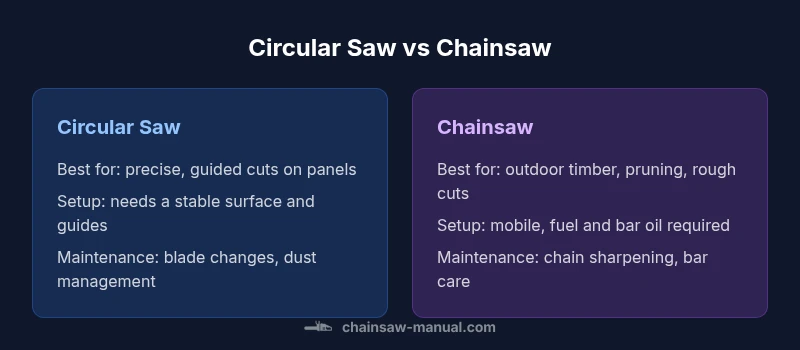
| Cutting tasks | Precision, guided cuts in boards and panels | Outdoor timber, pruning, and rough-cutting |
| Portability | Lightweight, bench-based setup possible | Fully portable, requires fuel and handling space |
| Power and speed | Lower power, consistent blade speed, clean finishes | High power, rapid material removal, varied log sizes |
| Safety considerations | Guarded blade, lower kick risk with proper technique | Kickback risk, chain brake, PPE mandatory |
| Maintenance needs | Blade changes and dust management | Chain sharpening, bar maintenance, fuel/oil management |
| Best use scenarios | Indoor precision work, cabinetry, subflooring | Outdoor timber work, forestry, pruning |
Strengths
- Clear guidance on task suitability helps prevent poor tool choices
- Emphasizes safety practices and PPE requirements for both tools
- Highlights maintenance routines and long-term costs
- Assists budgeting by clarifying use-case economics
Drawbacks
- May oversimplify edge cases requiring specialized equipment
- Does not substitute hands-on testing with your specific material
- Prices and availability vary by region and brand
Use the circular saw for precision indoor tasks and the chainsaw for outdoor, heavy-duty timber work
The Circular Saw to Chainsaw comparison shows distinct strengths for each tool. Choose the circular saw when accuracy and clean finishes matter; opt for the chainsaw when you need mobility and power outdoors. Chainsaw Manual emphasizes prioritizing safety training and maintenance in either case.
FAQ
What is the main difference between a circular saw and a chainsaw?
Circular saws are designed for precise, straight cuts on fixed stock using guides, while chainsaws are portable and built for outdoor cutting of timber. The main distinction is intended use and control requirements. Understanding this helps prevent misapplications and safety risks.
Circular saws excel at precise indoor cuts with guides, while chainsaws are for outdoor timber work and mobility. Safety and task fit are the keys to choosing wisely.
Which tool is safer for beginners?
Both require proper PPE and training. Circular saws are generally easier to control on a flat, guided surface, but chainsaws demand more awareness of kickback and chain management. Start with guided practice and seek instruction for either tool.
Both tools need training and PPE. Circular saws are easier to start with on a guided cut; chainsaws require more careful handling and training.
Can I use a circular saw to cut logs?
A circular saw can cut logs if you use the correct blade and support, but it’s typically slower and less efficient than a chainsaw for large-diameter or irregular logs. For outdoor bulk cutting, a chainsaw is usually the better choice.
You can cut small logs with a circular saw, but a chainsaw is faster and safer for large or irregular logs.
What maintenance does each tool require?
A circular saw needs blade changes, guard checks, and dust management. A chainsaw requires chain sharpening, proper chain tension, bar maintenance, and fuel/bar oil management. Regular maintenance extends tool life and safety.
Keep blades sharp and guards in good shape for the circular saw; sharpen the chain and oil the bar for the chainsaw.
Is PPE mandatory with both tools?
Yes. Eye and ear protection, gloves, and sturdy footwear are essential for both tools. Chainsaws require additional PPE like chain brakes and cut-resistant chaps. Always follow manufacturer safety guidance.
Always wear eye and ear protection and sturdy footwear. Chainsaws demand extra protection like chaps and a helmet.
Which is more affordable upfront?
Circulas saws often have a lower upfront price, while chainsaws can be pricier due to power, bar length, and required safety features. Consider long-term costs for blades, chains, and maintenance when budgeting.
Circular saws usually cost less upfront, but chainsaws can cost more upfront plus upkeep. Consider long-term blade and chain costs.
The Essentials
- Assess task type to determine the right tool
- Prioritize safety PPE for both tools
- Plan blade, chain, and maintenance needs upfront
- Consider indoor vs outdoor work environments
- Budget for long-term costs and accessory requirements