Hand Saw vs Chainsaw: What's the Difference?
what's the difference between a saw and a chainsaw? This in-depth guide clarifies definitions, power sources, applications, safety, and maintenance to help you choose the right tool for DIY and professional tasks.


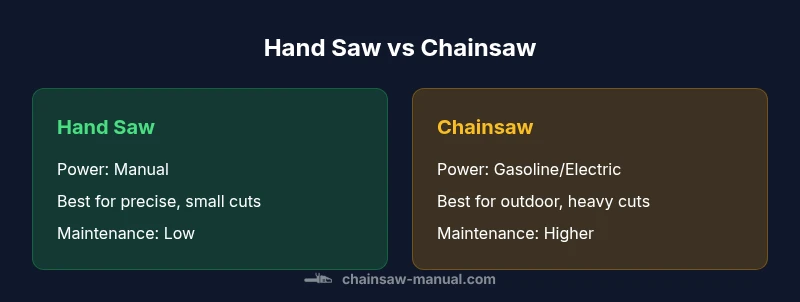
In short, a hand saw is a manual tool best for precise, small cuts, while a chainsaw is a motorized device designed for fast, heavy outdoor cutting. The difference is powered cutting versus manual effort, with safety considerations and maintenance needs. For most DIY yard tasks, choose the chainsaw for speed or the hand saw for delicate work.
what's the difference between a saw and a chainsaw
What’s the difference between a saw and a chainsaw? The answer hinges on how power is delivered, how cutting happens, and what each tool is designed to accomplish. According to Chainsaw Manual, the term saw is broad, encompassing hand sawing tools and many kinds of powered saws used for different materials. A chainsaw, by contrast, is a single, motorized tool that uses a rotating chain to aggressively cut through wood. This distinction matters when you evaluate projects, safety requirements, and maintenance needs. In practical terms, you’ll reach for a hand saw for precise, small work or finish cuts, and a chainsaw for fast, outdoor cutting and larger material removal. The Chainsaw Manual team emphasizes that choosing the right tool reduces fatigue and injury risk while improving outcomes. Regarding the phrase you might hear in workshops—what’s the difference between a saw and a chainsaw—it is mostly about power, control, and intended use.
- Key point: hand saws are manual or simple electric tools; chainsaws are engine- or battery-powered cutting machines.
- Safety note: even a hand saw can cause injuries if misused, but a chainsaw carries higher kickback and torque risks that demand PPE and training.
- Practical takeaway: know your task size, environment, and comfort level before selecting a tool.
wordCount":null},
Comparison
| Feature | Hand Saw | Chainsaw |
|---|---|---|
| Power source | Manual (human-powered) or simple electric | Gasoline, corded electric, or battery-powered (varying performance) |
| Cutting speed | Slow and steady; effort-dependent | Very fast; motor-assisted with high chain speed |
| Cutting capacity | Limited by blade length and user reach | Large-diameter cuts possible with longer bars |
| Best for | Fine finishes, precise joints, indoor/bench work | Heavy outdoor work, storm cleanup, lumber processing |
| Weight | Light to moderate; typically 1–6 lb for small saws | Moderate to heavy; 8–20+ lb depending on model |
| Maintenance | Low to moderate; blade care, simple lubrication | Higher; fuel/oil mix, chain tensioning, bar/chain maintenance |
| Safety considerations | Lower kickback risk with proper technique | Significant risk; PPE required; training recommended |
| Typical cost range | $10–$60 (manual or small hand saw); some power saws $100–$200 |
Strengths
- Low ongoing cost and quiet operation (hand saw)
- No fuel or emissions, minimal setup
- Excellent precision for small cuts
- Chainsaw offers rapid material removal for outdoor tasks
- Versatile for a range of outdoor challenges when needed
Drawbacks
- Physically demanding for large or dense wood (hand saw)
- Limited to smaller projects and slower progress
- Safety risk with chainsaws requires PPE and training
- Higher upfront and upkeep cost for chainsaws
- Noise and fuel considerations with motorized tools
Chainsaw excels for speed and heavy outdoor work; a hand saw shines on precision and portability
Use a hand saw for delicate, precise cuts and indoor projects where noise and fatigue must be minimized. Choose a chainsaw for outdoor, large-diameter tasks where speed and efficiency matter, while prioritizing proper safety gear and training.
FAQ
What is the primary difference between a hand saw and a chainsaw?
The primary difference is power delivery: hand saws are manual or simple electric tools, while chainsaws are motorized. This affects speed, effort, and safety. The choice depends on task size, environment, and user capability.
The main difference is that hand saws require human effort, while chainsaws run on an engine or battery, delivering speed and power for outdoor work.
Can a hand saw handle large logs or thick branches?
Hand saws can cut large logs, but it takes significantly more time and effort. For thick branches or storm cleanup, a chainsaw is usually the practical choice to save time and reduce fatigue.
A hand saw can cut large logs, but it's slow; for big jobs, a chainsaw is usually the better tool.
Is a chainsaw safe to use around the home and garden?
Chainsaws require PPE, training, and careful handling. Always maintain a safe stance, clear the cutting path, and follow the manufacturer’s maintenance schedule to minimize kickback and injury risk.
Yes, but with proper safety gear and training; use caution and follow the manual.
Are electric chainsaws as effective as gas-powered ones?
Electric chainsaws are convenient for light to medium tasks and produce fewer emissions, but gas-powered models typically offer more torque and run longer between recharges, making them suitable for heavy cutting.
Electric chainsaws are great for light work; gas models handle bigger jobs and longer use.
What maintenance should I perform before starting a chainsaw project?
Check chain tension, sharpen or replace dull teeth, ensure bar oil is sufficient, and inspect the handle and chain brake. Proper lubrication and air filter cleaning also help longevity and performance.
Check the chain, oil levels, and safety brakes before you cut.
The Essentials
- Choose hand saw for precision and indoor tasks
- Choose chainsaw for outdoor, heavy cutting tasks
- Prioritize safety gear and training with chainsaws
- Consider total cost and maintenance when deciding
- Balance task size with tool ergonomics for best results