Is Chainsaw Oil the Same as Motor Oil? A Practical Guide
Explore whether chainsaw oil and motor oil are interchangeable, why the right lubricant matters for performance and safety, and how to choose the right oil for your saw.


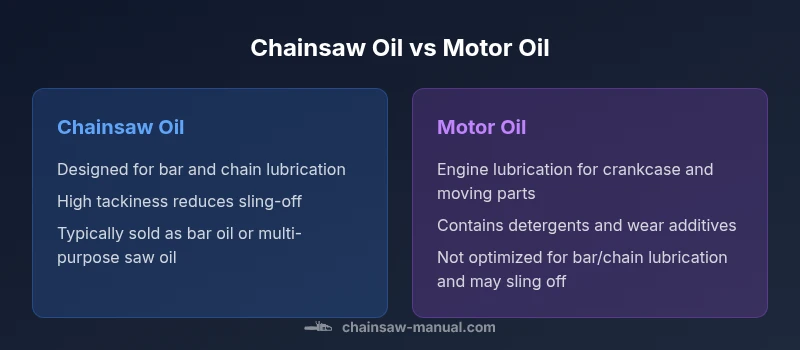
Is chainsaw oil the same as motor oil? In short, no. Chainsaw oil is specially formulated for bar-and-chain lubrication, with tackiness designed to cling to moving parts and resist sling-off. Motor oil, by contrast, is engineered for engine internals and may contain additives that aren’t optimal for the chain. According to Chainsaw Manual, using the wrong oil can reduce lubrication effectiveness and increase wear, especially under hot, dusty conditions.
The Core Question: is chainsaw oil the same as motor oil?
The concise answer to the core question—is chainsaw oil the same as motor oil—depends on how you use each lubricant. The phrase "is chainsaw oil the same as motor oil" often comes up when a user runs dry or tries to simplify their inventory. This article explains why the two oils are designed for different environments and how those design differences affect performance, wear, and safety. From a practical standpoint, treating the two as interchangeable is usually not advisable, even in emergency situations. The Chainsaw Manual team emphasizes using dedicated bar-and-chain oil for lubrication in normal operation, and motor oil is generally not a substitute except in dire circumstances. When you choose the correct lubricant, you protect cutting efficiency, reduce chain wear, and minimize fling-off, which improves operator safety and job quality.
Understanding bar oil and engine oil: key definitions
Bar oil (often labeled as chainsaw oil or saw oil) is formulated to stay on the bar and chain, providing a stable lubricating film as the chain rotates at high speeds. It typically contains tackifiers—chemicals that increase viscosity at the surface to reduce sling-off—and is designed to resist throwing off during operation. Engine oil, or motor oil, is engineered for internal combustion engines, focusing on cooling, cleaning, and protecting engine components under varied temperatures and pressures. While both oils reduce metal-to-metal contact, their base formulations, viscosity profiles, and additive packages are optimized for very different tasks. Understanding these definitions helps avoid misuse and explains why one oil type isn’t a perfect substitute for the other.
Composition matters: additives, viscosity, and tackiness
A core reason why you should not substitute is in the additive package. Chainsaw oils prioritize tackiness to cling to the chain and bar during rapid motion and pumping actions, while minimizing residue buildup in the oiling system. They also have lower aromatic content to reduce smoke and odor emissions when the saw heats up. Motor oils, conversely, contain detergents, anti-wear additives, and combustion-related additives designed to protect engine components from sludge, varnish, and wear, not to optimize sling-off resistance. Viscosity is another critical difference: bar oil is formulated to maintain a lubricating film on moving parts under high-speed operation and external conditions, whereas motor oil focuses on lubrication across engine bearings at a wide range of temperatures. Misalignment in viscosity and tackiness can lead to poor lubrication, increased wear, and greater heat in the chain drive.
How temperature and friction affect lubrication
Chainsaw operation generates high friction in a compact space, with rapid changes in speed and heat. Bar oil’s formulation supports a stable film even as the chain cuts into wood, while resisting heat-induced thinning that would expose metal surfaces. Motor oil may thin too quickly at operating temperatures, reducing film strength and allowing metal-to-metal contact. Dust and debris also complicate lubrication: saw oils are designed to shed particulate matter more readily, whereas engine oils can form deposits that, over time, reduce lubrication efficiency. For maintenance and safety, using the right oil helps maintain cutting efficiency and reduces kickback risk that can arise from inconsistent chain lubrication.
Manufacturer guidance and warranty considerations
Most chainsaw manufacturers specify bar-and-chain oil for the lubrication system and advise against using motor oil as a replacement in routine operation. Using engine oil can void warranties and lead to wear that isn’t covered by warranty terms. Even in emergency situations where you have no saw oil, many guides emphasize substituting with the closest compatible bar oil rather than engine oil to minimize risk. In some cases, if you’re forced to improvise, you should avoid long-term operation and replace with proper saw oil as soon as possible. The guidance from Chainsaw Manual stresses aligning with the manufacturer’s lubrication recommendations to maintain performance and warranty protection.
Practical guidelines for choosing oil
Choosing the right oil starts with your saw’s manual. Look for a product labeled as bar oil or saw oil, designed to stay on the bar and chain and to provide the necessary tackiness. In cold climates, select a low-temperature viscosity option that still adheres to the film you need as the chain turns. In hot environments, consider a thicker film to resist sling-off without gumming the bar. For mixed-use tools, consider multi-purpose bar oils that balance tackiness with clean burning and minimal residue. If you work in dusty environments or attach to wood-processing operations, opt for saw oils that are formulated to resist moisture intrusion and maintain film strength under load. Always store oils in a cool, dry place and keep containers clean to avoid contamination.
Emergency scenarios: running out of oil and what to do
Running out of saw oil is not ideal, but you may face a temporary shortage. In such cases, use the closest compatible bar oil if possible, avoiding motor oil due to its different tackiness and additive profile. Do not run motor oil for more than a brief, emergency interval, and plan to replace with proper chainsaw oil as soon as you can. This approach minimizes risk to the bar and chain while reducing potential for debris buildup. After using substitute oil in a pinch, inspect the chain and bar for wear or residue, and consider a wipe-down or cleaning to remove any unfamiliar film before resuming normal operation.
Common myths and misconceptions debunked
A prevalent myth is that any lubricant will suffice as long as it’s oil-based. In reality, the mechanical design of a chainsaw requires a very specific oil to ensure proper lubrication of the bar and chain, with parameters tuned for sling-off resistance, film strength, and environmental compatibility. Another misconception is that engine oil’s detergents will help clean the chain; this can lead to increased deposits and residue. Finally, some users believe synthetic engine oils are universally better; for chainsaw lubrication, select a product proven for bar-and-chain use, as some synthetic engine oils may not provide the same tackiness or film persistence on moving parts.
Step-by-step: selecting and using the correct oil for your saw
- Check your owner’s manual for the recommended oil type and viscosity. 2) Choose a bar oil that advertises tackiness, film strength, and resistance to sling-off. 3) Confirm the oil is compatible with your climate and typical load. 4) Fill the oil reservoir and perform a test run on a safe, controlled surface to observe lubrication behavior. 5) Monitor the chain and bar for signs of wear, residue, or unusual heat, and replace oil with the correct product if needed. 6) Schedule regular lubrication system maintenance, including cleaning oil passages and inspecting seals to prevent leaks.
Maintenance and inspection to ensure proper lubrication
Maintenance begins with a clean reservoir and a leak-free system. Regularly inspect the oil cap seal and oil pump for signs of wear or buildup. Check chain tension and sharpness, since a dull chain can require more force and put additional strain on lubrication. Clean the bar groove and oil holes to prevent clogs that block oil delivery. If you notice unusual wear or residue, switch to fresh bar oil and consider a thorough cleaning or professional inspection. Keeping a log of lubrication changes helps track performance and anticipate when a service is due. Chainsaw Manual recommends periodic audits of feed rate, oil pressure, and chain movement to ensure consistent lubrication quality.
Safety considerations when handling oils and lubricants
Always wear gloves when handling oils to reduce skin exposure, and keep containers closed when not in use to avoid contamination. Store oils upright to prevent leaks and protect from temperature fluctuations that could degrade performance. Dispose of used oil and filters according to local regulations. Keep oil away from heat sources to avoid fumes or combustion hazards. When filling the reservoir, do so slowly to prevent bubbles that could disrupt the oil flow. Finally, ensure proper ventilation during maintenance to minimize inhalation of fumes, and avoid mixing incompatible chemicals with oil products.
Final guidance: what to remember about oil choices
The core takeaway is simple: use the oil your saw’s manufacturer recommends for bar and chain lubrication. Chainsaw oil is designed for a different purpose than motor oil and typically offers better tackiness and film retention on the moving chain. Motor oil can’t reliably substitute for saw oil in most situations and may risk decreased life for the bar, chain, and drive components. Keep a labeled inventory of the correct bar oil for your model and climate, and replace any substitute with the proper product as soon as possible to maintain performance and safety.
Comparison
| Feature | Chainsaw oil (bar/chain oil) | Motor oil (engine oil) |
|---|---|---|
| Lubrication scope | Bar/chain lubrication | Engine crankcase lubrication |
| Additives | Tackifiers; designed for sticking to moving parts | Detergents and anti-wear additives for engines |
| Viscosity/tackiness | Optimized for film retention on rotating parts | Not optimized for bar/chain lubrication; variable viscosity |
| Foaming tendency | Low foam design for sling-off resistance | Engine oils may foam in certain conditions |
| Recommended use | Specifically for chainsaws; bars and chains | Engine lubrication; not intended for bar/chain lubrication |
Strengths
- Designed for bar-and-chain lubrication with high tackiness and film strength
- Reduces sling-off and keeps oil on the chain during operation
- Helps protect the bar and chain in tough cutting conditions
Drawbacks
- Motor oil is not optimized for bar/chain lubrication and can leave residues
- Using the wrong oil can void warranties and increase wear over time
- Substitutes in normal use increase the risk of improper lubrication and damage
chainsaw oil generally outperforms motor oil for bar-and-chain lubrication; use motor oil only in emergency or as a last resort.
The Chainsaw Manual team recommends sticking with saw oil for regular operation to maximize lubrication efficiency, minimize wear, and protect warranty terms. Motor oil should only be used temporarily if no saw oil is available, and the saw should be serviced with proper oil as soon as possible.
FAQ
Is chainsaw oil the same as motor oil for all chainsaws?
No. Chainsaw oil is specifically formulated for bar-and-chain lubrication with tackifiers and film properties optimized for moving parts on a saw. Motor oil serves engine lubrication and is not tailored for chainsaw use. Always follow the manufacturer’s guidance for your model.
No. Chainsaw oil is designed for the bar and chain, while motor oil is for engines. Follow your saw’s manual for the right oil.
Can I use motor oil if I run out of saw oil?
In an emergency, you may substitute with the closest compatible bar oil rather than motor oil. Do not operate long-term with motor oil, and replace with proper saw oil as soon as possible.
If you run out, use a close bar oil substitute and replace with proper oil soon.
What happens if I mix chain oil with engine oil?
Mixing types can create residues, poor lubrication, and inconsistent film strength. It’s best to avoid mixing and use the correct oil for each application.
Mixing oils can mess up lubrication and cause wear.
What are the key additives in chainsaw oil?
Chainsaw oils include tackifiers to stay on the moving chain and anti-wear components without excessive detergents that could cause buildup in the bar oil passages.
Look for tackifiers and film-forming additives designed for bar-and-chain use.
Is synthetic saw oil better than mineral oil?
Synthetic saw oils can offer stable viscosity and good film strength, but compatibility with your bar and oiling system matters. Always verify compatibility with your saw’s manual.
Synthetics can help, but check the manual for compatibility.
How should I store and dispose of chainsaw oil?
Store upright in a cool, dry place away from heat. Dispose of used oil and containers according to local regulations to protect the environment.
Store cool and dry, and follow local rules for disposal.
The Essentials
- Always use bar/oil designed for chainsaws.
- Expect higher tackiness and film strength from saw oil.
- Motor oil is not a suitable long-term substitute for bar/chain lubrication.
- Keep an emergency supply of proper chainsaw oil in your toolkit.