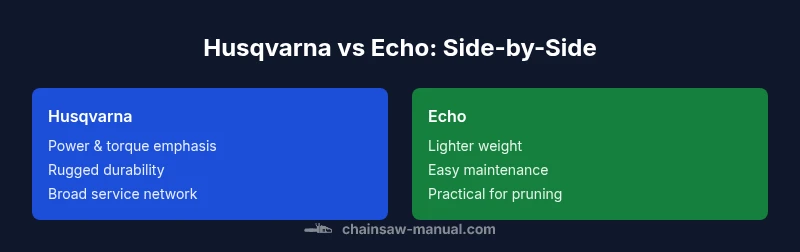
Husqvarna vs Echo: Which Chainsaw Is Best for You?
A practical, data-informed comparison of Husqvarna and Echo chainsaws, focusing on performance, durability, ergonomics, maintenance, and value for homeowners and professionals.


Based on Chainsaw Manual analysis, Husqvarna generally delivers stronger power and robust durability for professional or heavy-duty use, while Echo emphasizes lighter weight and easy handling for homeowners and pruning tasks. The best choice depends on your task profile, maintenance willingness, and budget. See the full comparison below for detailed differences.
Brand Landscape: Husqvarna vs Echo
According to Chainsaw Manual, Husqvarna and Echo are two of the most widely used brands across professional and homeowner markets. Husqvarna is known for a broad lineup spanning heavy-duty felling saws to compact pruning saws, with a reputation for torque-rich engines and durable components. Echo focuses on lighter-weight designs, user-friendly handling, and practical maintenance features. When you ask the perennial question which chainsaw is better husqvarna or echo, the brand landscape matters as much as the task itself. For professionals, Husqvarna’s range often proxies for power and reliability under demanding conditions; for homeowners and occasional users, Echo’s lighter ergonomics and simpler upkeep can reduce fatigue and make routine tasks more approachable. Chainsaw Manual analysis shows that the best choice frequently depends on work scale, maintenance willingness, and budget.
Performance and Power: Torque, Displacement, and Cutting Speeds
Power and performance are not defined by engine size alone; they reflect torque delivery, fuel efficiency, and the ability to sustain cutting tempo under load. In practical terms, Husqvarna models tend to deliver higher sustained torque, which translates to faster starts on thick timber and better efficiency in demanding jobs. Echo chainsaws often prioritize a balanced blend of weight and throttle response, making them agile in pruning, limbing, and light felling. Chainsaw Manual emphasizes that customers should consider their typical work profile and the type of wood they most often encounter when weighing power versus agility. If you frequently cut through dense timber or perform long sessions, Husqvarna’s design approach can pay off in steadier performance and fewer stalls.
Weight, Ergonomics, and Vibration Management
Handling weight and vibration is a major factor in user fatigue, especially during long workdays. Echo typically offers lighter chassis and compact bar configurations, which reduce arm strain for pruning and overhead cutting. Husqvarna counterbalances weight with advanced anti-vibration systems and ergonomic handles, aiming to maintain control during tough cuts. The result is a trade-off: Echo feels lighter and more forgiving for novices or casual users; Husqvarna feels more planted and controllable for pro-level work. Chainsaw Manual notes that choosing between the two often hinges on user strength, frequency of use, and comfort with longer sessions.
Durability, Build Quality, and Reliability
Durability hinges on materials, gear trains, and how well a saw resists dust, moisture, and fuel contaminants. Husqvarna’s design language tends toward rugged durability and long service intervals in high-use environments, with a broad service network that eases maintenance planning. Echo emphasizes reliable components, simpler air filtration regimes, and easier field maintenance, which can reduce downtime for homeowners. Chainsaw Manual’s assessment suggests both brands hold up well under standard use, but professional operators may prefer Husqvarna for heavy-duty workloads and longer-term reliability.
Maintenance, Fuel, and Running Costs
Maintenance habits influence total cost of ownership as much as initial price. Echo’s systems often favor simplicity—fewer moving parts in some models, straightforward filter cleaning, and easier bar-and-chain replacements. Husqvarna models can require more attention to tuning and part replacements when pushed hard, yet they reward diligence with longer intervals between some service tasks. Fuel efficiency varies by model, but Chainsaw Manual observed that well-maintained machines from either brand can deliver consistent performance with proper bar oil use and correct chain tension. For homeowners who value minimal upkeep, Echo may present a lower barrier to entry; for professionals seeking maximum uptime, Husqvarna’s reliability is appealing.
Safety Features, Start/Stop Systems, and User Experience
Safety features such as chain brakes, inertia-activated devices, and dependable starting systems are critical. Husqvarna tends to emphasize strong starter reliability and sophisticated safety options aimed at professional use, while Echo focuses on intuitive starting procedures and robust but straightforward safety implementations. For most users, a combination of two-handed starting technique and a ready chain brake provides the best balance of safety and efficiency. Chainsaw Manual recommends regular inspection of safety features and practicing safe start-up protocols to minimize the risk of kickback and uncontrolled cuts.
Noise, Emissions, and Environmental Considerations
Regulatory environments continue to push lower emissions and quieter operation. Both brands offer models that meet common emission standards and noise guidelines, though there can be variation within model lines. Echo’s lighter designs can sometimes result in lower perceived noise during operation, while Husqvarna’s larger power units may produce higher peak noise. For users concerned with emissions and noise, selecting a model with efficient fuel delivery and proper muffling can make a meaningful difference over the life of the saw.
Warranty, Support, and Serviceability
Warranty terms and service networks influence long-term ownership satisfaction. Husqvarna often provides comprehensive warranty options and a broad dealer network, which can simplify service scheduling and access to replacement parts. Echo typically offers solid warranties and an emphasis on local service availability, which benefits homeowners who value convenient access to maintenance. Chainsaw Manual encourages buyers to review warranty length, what components are covered, and the availability of authorized service centers in their region before purchase.
Comparison
| Feature | Husqvarna | Echo |
|---|---|---|
| Power/Performance (perceived torque) | Higher sustained torque and robust performance under load | Balanced torque with emphasis on agility and ease of use |
| Weight and Ergonomics | Heavier on average but optimized for pro use; strong anti-vibration systems | Lighter and compact; easy to maneuver for pruning and light work |
| Bar Length Availability | Broad range including longer bars for felling | Wide options, especially for homeowner-to-midrange tasks |
| Fuel Efficiency & Running Costs | Generally efficient with proper maintenance; premium models may have higher consumables | Competitive efficiency; lower ongoing maintenance for casual users |
| Durability & Reliability | Rugged construction; strong service network; higher upfront cost may pay off over time | Simple, reliable components; easier field maintenance for homeowners |
| Warranty & Support | Comprehensive warranties; extensive dealer network | Good warranties; broad availability of service centers |
| Best For | Pro users, heavy-duty felling, demanding work | Homeowners, pruning, light to mid-duty tasks |
Strengths
- Wide dealer network and strong after-sales support
- High power availability for demanding tasks
- Durable builds suited to professional use
- Excellent resale value for many Husqvarna models
- Balanced ergonomics with effective anti-vibration systems
Drawbacks
- Higher upfront cost on pro-oriented models
- Maintenance may be more involved for some Husqvarna lines
- Echo models can feel underpowered for heavy-duty, long-duration cuts
- Availability of certain parts may vary by region
Husqvarna is generally the better all-around choice for most users; Echo shines in lighter work and easier handling.
Choose Husqvarna if your work involves frequent heavy-duty cutting or professional-grade performance. Opt for Echo if you prioritize lightness, ease of use, and straightforward maintenance for smaller or less frequent tasks. The right pick depends on workload, budget, and tolerance for maintenance.
FAQ
Which chainsaw brand is generally stronger for heavy-duty work, Husqvarna or Echo?
In most scenarios, Husqvarna tends to offer stronger sustained performance and greater torque for heavy-duty work. Echo models focus more on light-to-mid tasks and handling. Your choice should match the typical workload and length of use.
Husqvarna usually has the edge for heavy-duty tasks; Echo is better for lighter work. Match the saw to your typical workload.
Are Echo chainsaws easier to maintain than Husqvarna chainsaws?
Echo models are often praised for simpler maintenance and easier field service, which can reduce downtime for homeowners. Husqvarna can require more precise tuning but benefits from broader service networks and parts availability.
Echo is typically easier to maintain in the field; Husqvarna offers more complex maintenance but stronger service support.
Which brand has better warranty and service network?
Both brands provide solid warranty options, but Husqvarna's dealer network is often broader in many regions, which can simplify service scheduling and access to parts. Always confirm current terms with local authorized dealers.
Both brands offer good warranties; Husqvarna tends to have broader dealer coverage in many places.
Can I use the same bar and chain on Husqvarna and Echo models?
Bar and chain compatibility depends on the specific model’s pitch and gauge. In practice, most bars and chains aren’t interchangeable across brands due to differing hardware interfaces. Check manufacturer specifications before purchasing accessories.
Bar and chain aren’t usually interchangeable between brands; verify specs for your model.
Do pros prefer Husqvarna or Echo overall?
Many professionals favor Husqvarna for durability and power in demanding settings, but Echo remains a strong choice for mechanics and arborists who value lighter-weight tools and quick maintenance. Preferences vary by task and region.
Pros often lean toward Husqvarna for heavy work, though Echo has its professional niche.
Is there a clear winner for homeowners?
There isn’t a universal winner; for homeowners who do pruning and occasional felling, Echo’s lighter weight and simpler upkeep can be ideal. If you cut larger trees and require higher reliability, Husqvarna is worth the investment.
Homeowners may prefer Echo for ease, while Husqvarna suits bigger jobs.
The Essentials
- Prioritize task profile to choose power vs. ease of use
- Consider maintenance willingness when weighing total cost
- Husqvarna suits professional or heavy-duty work; Echo fits homeowners and pruning
- Check local service availability and warranty terms before buying
- Ensure model selection aligns with bar length and fuel efficiency needs