troy bilt chainsaw vs stihl: an objective comparison
A practical, unbiased guide comparing troy bilt chainsaw vs stihl across build quality, performance, safety, maintenance, and value for homeowners, DIYers, and pros.


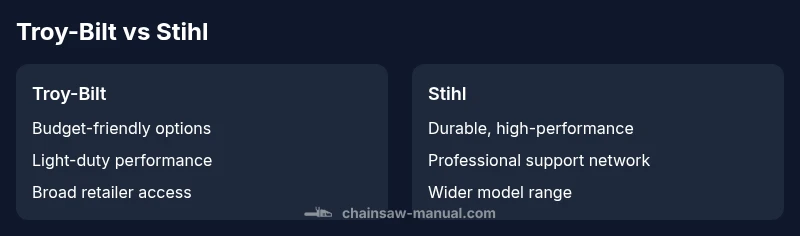
For homeowners and DIYers, Troy-Bilt offers budget-friendly, easy-to-use options that cover light-duty tasks, while Stihl targets heavier, more frequent cutting with durable components and a broader service network. In practice, choose Troy-Bilt for light yard work and value, and Stihl for reliability under regular use or professional projects. This quick comparison helps align your task load with the right brand and model.
troy bilt chainsaw vs stihl: key differences
Choosing between Troy-Bilt and Stihl depends on how you plan to use the saw, your budget, and your tolerance for maintenance. In this troy bilt chainsaw vs stihl comparison, we examine core differences in design philosophy, intended user base, and long-term value. According to Chainsaw Manual, the Troy-Bilt line is designed to be affordable and accessible for homeowners and DIYers who tackle seasonal yard tasks. Stihl, by contrast, emphasizes durability, efficient performance, and dealer networks that support heavy or frequent use. This article focuses on practical, safety-first guidance for homeowners, DIY enthusiasts, and professionals. We cover build quality, power profiles, maintenance needs, safety features, warranties, and total cost of ownership. By the end, you’ll understand which brand aligns with your project scope and whether you should lean toward a Stihl for serious work or start with a Troy-Bilt for lighter tasks. The Chainsaw Manual team notes that parts availability and service networks can significantly influence long-term satisfaction.
wordCount”:0},
Brand positioning and target users
Troy-Bilt chainsaws are typically marketed toward homeowners, weekend warriors, and DIYers who want functional tools at an attainable price. The emphasis is on ease of use, straightforward maintenance, and short-term value. Stihl, by contrast, positions many of its chainsaws for professional arborists and serious enthusiasts who perform regular cutting, limb removal, and forest work. This divergence in positioning matters when you consider longevity, residual value, and dealer support. Chainsaw Manual analysis shows that the choice often boils down to how often you cut, where you operate, and whether you need a robust service network. If reliability and resale are priorities, Stihl’s brand reputation and nationwide service points can offset higher upfront costs. If you prioritize upfront affordability and simple DIY maintenance, Troy-Bilt offers compelling options. The Chainsaw Manual Team emphasizes evaluating your typical workload and storage conditions to decide which brand best matches your needs.
wordCount":0}
Build quality and materials: who lasts longer
Both brands use standard materials for consumer-grade chainsaws, but build quality and component stiffness differ in key areas. Stihl models generally emphasize machined components, refined anti-vibration systems, and higher-grade bar-and-chain assemblies, which contribute to smoother operation during extended sessions. Troy-Bilt models tend to prioritize cost-effective plastics, simpler throttle assemblies, and lighter frames to keep prices down. According to Chainsaw Manual Analysis, 2026, durability expectations align with intended use: home-lis tasks reward reliability and predictable maintenance; professional-grade use rewards rugged parts and dealer-backed service. For homeowners who only prune and buck small branches, Troy-Bilt’s lighter chassis can reduce fatigue; for pro users, Stihl’s heavier-duty components can translate into longer service life under repeated stress.
wordCount":0}
Power, speed, and cutting performance
Power and cutting performance are rarely identical across brands; the Troy-Bilt range typically covers light- to mid-duty work, using smaller displacement engines and simpler carburetion, which translates to adequate cutting for small limbs and routine yard cleanup. Stihl, meanwhile, offers engines and drive systems designed for more demanding tasks, including larger bars and more robust chain management. The practical takeaway is to match your expected workload with the model family: light pruning and seasonal cleanup usually fit Troy-Bilt, while continuous, harder workloads benefit from Stihl’s more proven performance reservoir. This section also discusses how bar length, chain quality, and recoil resistance influence daily work and overall productivity. Chainsaw Manual notes that choosing the right balance between weight and power is essential for user safety and accuracy.
wordCount":0}
Maintenance, spare parts availability, and service network
Maintenance schedules and parts availability strongly shape the long-term value of either brand. Troy-Bilt models often benefit from broad retail distribution, easy access to basic replacement parts, and consumer-friendly maintenance routines suitable for DIY enthusiasts. Stihl models typically come with a more extensive official service network, more durable components, and dealer-backed warranties that encourage regular service and parts replacement. Chainsaw Manual Analysis, 2026 highlights that service accessibility can dramatically affect uptime and resale value, especially in remote areas. For homeowners, the simplicity of Troy-Bilt maintenance is appealing; for professionals, the assurance of a broad service network and high-quality parts with Stihl can offset higher upfront costs.
wordCount":0}
Safety features and ergonomic considerations
Safety features such as chain brakes, kickback reduction, anti-vibration handles, and chain catch devices are standard across modern chainsaws. Troy-Bilt models focus on intuitive controls and lighter weight to reduce fatigue during home tasks, while Stihl models emphasize refined ergonomics and more sophisticated anti-vibration systems to support longer sessions. Operator comfort matters because it affects control and cuts quality. Chainsaw Manual emphasizes checking for non-slip handles, balanced weight distribution, and responsive braking systems on any model you evaluate. Both brands typically include protective features appropriate to their market positioning, so your choice should consider how often and for how long you’ll be cutting, plus the importance of quick service if a safety-related part needs replacement.
wordCount":0}
Price, value, and total cost of ownership
Price differences are a major factor in deciding between Troy-Bilt and Stihl. Troy-Bilt commonly targets the budget-friendly end of the market, delivering solid basic capability with lower upfront costs. Stihl generally sits in the mid-to-premium range, reflecting its durability, performance, and dealer support. Total cost of ownership should consider not just purchase price but maintenance, parts availability, and service costs over time. Chainsaw Manual analysis suggests owners should forecast potential repair needs, frequency of use, and downtime costs when evaluating value. For casual or light-duty use, Troy-Bilt often delivers better immediate value; for frequent use or professional contexts, Stihl’s reliability and service network can justify the premium.
wordCount":0}
Practical decision framework: homeowners vs professionals
If your workload consists of trimming, light felling, and routine yard cleanup, a Troy-Bilt tends to satisfy most homeowner needs with less initial investment. If you’re a professional or a dedicated DIYer who works on larger trees, frequent cutting, or job-site conditions that demand reliability, Stihl is typically the safer long-term bet. The decision framework below helps you align your selection with your tasks: (1) estimate annual cutting hours, (2) assess required bar length and power, (3) map out service availability in your region, (4) weigh warranty terms, and (5) consider resale value. The Chainsaw Manual team recommends prioritizing service accessibility and spare parts availability alongside upfront cost to reduce total ownership risk. This approach minimizes the chance you buy a tool that becomes a frequent headache instead of a dependable workhorse.
wordCount":0}
How to decide: quick decision guide
In two steps, identify your core needs, then map them to the brand strengths. Step one is workload: light-duty homeowners should lean Troy-Bilt for budget and simplicity; step two is service: if you have reliable dealer support nearby, Stihl makes a strong case for durability and long-term performance. Use the accompanying comparison table and FAQ to validate your choice before purchasing.
wordCount":0}
Comparison
| Feature | Troy-Bilt chainsaw | Stihl chainsaw |
|---|---|---|
| Power source and range | Gas-powered, budget-friendly options | Gas-powered to professional-grade options |
| Weight and handling | Lighter, easier for casual use | Heavier but optimized for long-use comfort |
| Bar length options | Short to mid-length selections | Wide range from compact to long bars |
| Maintenance complexity | Simple maintenance; widely available parts | More involved maintenance; extensive dealer support |
| Warranty and support | Retailer-backed warranty, accessible returns | Dealer-backed warranty with expansive service network |
| Best for | Homeowners, occasional yard work | Professionals and heavy-duty DIY projects |
| Price range | Budget-friendly to mid-range | Mid- to premium-priced models |
Strengths
- Affordable entry options for homeowners
- Wide retailer availability and easy access to parts
- User-friendly maintenance for casual users
- Clear warranty coverage on common models
- Lightweight designs reduce fatigue for small properties
Drawbacks
- Lower power and durability on budget Troy-Bilt models
- Higher upfront cost for most Stihl models
- Maintenance frequency can be higher on some Troy-Bilt lines
- Dealer network access can vary by region for Troy-Bilt
Stihl generally excels for frequent, demanding use; Troy-Bilt suits budget-conscious homeowners for light-duty tasks
Choose Stihl if you need reliable performance and robust dealer support for regular cutting. Pick Troy-Bilt for budget-friendly, lighter tasks and straightforward maintenance, especially when service access is limited.
FAQ
Which is better for heavy-duty cutting: Troy-Bilt chainsaw or Stihl?
Stihl generally handles heavy-duty cutting better due to higher-reliability components and stronger power delivery. For occasional heavy tasks, Troy-Bilt may suffice, but expect more frequent maintenance on budget models.
For heavy-duty cutting, Stihl is the safer choice due to durability and performance.
Are Troy-Bilt chainsaws reliable enough for regular use?
Troy-Bilt can be reliable for light to moderate regular use, especially with proper maintenance and timely part replacements. For daily professional workloads, many users prefer brands with broader service networks.
For regular professional use, reliability varies by model.
Do both brands have similar safety features?
Yes, both brands include standard safety features like chain brakes, kickback protection, and anti-vibration handles. Model-specific features can vary, so compare the exact options.
Both have key safety features, check your model for specifics.
Can you interchange parts between Troy-Bilt and Stihl?
Parts are generally brand-specific and not interchangeable. Always use the recommended parts for your model to maintain performance and safety.
Parts are not interchangeable between brands.
Which has better dealer support?
Stihl typically offers a broader, nationwide dealer network with more frequent service options. Troy-Bilt relies more on major retailers for service, which can vary regionally.
Stihl usually has broader dealer support.
The Essentials
- Match task intensity to brand capabilities
- Consider total cost of ownership, not just upfront price
- Stihl offers professional-grade performance; Troy-Bilt is budget-friendly
- Ensure dealer support and parts availability in your region
- Assess maintenance needs before purchase