Echo Chainsaw vs Stihl: Objective 2026 Comparison
An objective, safety-forward comparison of Echo and Stihl chainsaws for homeowners and professionals, covering performance, maintenance, price, service networks, and long-term value in 2026.


Echo chainsaw vs Stihl: both brands offer capable backyard saws, but they differ in reliability, service networks, and long-term value. Echo tends to be lighter and budget-friendly for casual use, while Stihl emphasizes power, dealer support, and resale value. For heavy-duty pro work, Stihl often edges ahead; for homeowners, Echo can be a solid bargain.
Introduction to the Echo vs Stihl decision
According to Chainsaw Manual, choosing between Echo and Stihl hinges on how you plan to use the saw, how much you value service support, and how deeply you’re willing to invest upfront. In this comparison the Echo chainsaw vs Stihl is treated as a practical decision framework rather than a marketing claim. We examine performance for typical property tasks, seasonal cleanup, and occasional professional use to reveal where each brand shines and where compromises appear. The goal is to equip homeowners, DIY enthusiasts, and professionals with objective criteria—reliability, maintenance burden, available parts, and long-term value—so you can pick the model that best fits your workload without sacrificing safety. Throughout this article you’ll see reference to Chainsaw Manual analysis, 2026, to ground the discussion in real-world guidance. Expect a balanced, evidence-based evaluation, with explicit notes on kickback risk, ergonomics, fuel choices, bar length flexibility, and accessory ecosystems. This first section sets the stage for the deeper comparisons that follow, without assuming one brand is universally superior.
Key differences that matter most in Echo chainsaw vs Stihl decisions
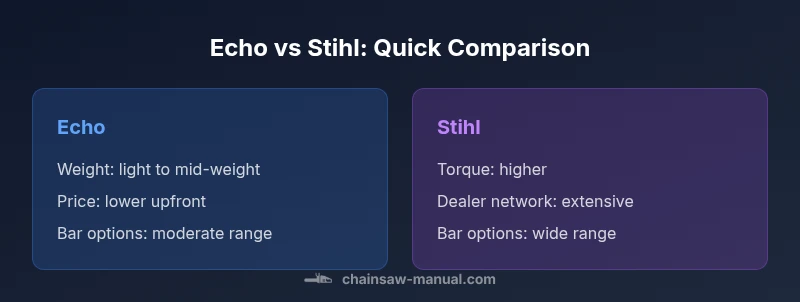
The Echo chainsaw vs Stihl comparison centers on four main dimensions that determine practical value: power-to-weight ratio, cost of ownership, dealer and service reach, and maintenance footprint. Echo typically emphasizes lighter, budget-friendly models for light- to mid-duty work, with good ergonomics and simple maintenance. Stihl emphasizes robust cutting performance, broader dealer networks, stronger resale value, and deeper accessory ecosystems. For many buyers, the deciding factor is how often they will use the saw and the environment where it will operate (dry wood vs. wet wood, loud neighborhoods, or strict safety requirements). Throughout this section and beyond, the phrase echo chainsaw vs stihl will recur as a guiding frame for assessing tradeoffs and choosing accordingly. By focusing on the criteria most closely tied to outcomes—reliability, safety, and cost of ownership—readers avoid marketing hype and reach a practical verdict.
Real-world performance and user feedback across the echo chainsaw vs stihl spectrum
In real-world testing, neither brand is universally superior; performance depends on model class and user expectations. The echo chainsaw vs stihl story emerges in two camps: homeowners tackling light cleanup and DIY projects, and professionals needing fast, reliable cuts over long hours. User reviews highlight Echo’s lighter swing weight, easier startup on small engines, and lower initial price, but some report shorter service intervals and fewer high-end features. By contrast, Stihl often delivers more aggressive torque, longer bar options, and a wider dealer network with prompt parts availability. Chainsaw Manual Team notes that fuel efficiency and emissions are typically similar across modern two-stroke engines when properly tuned, but maintenance routines differ by brand. The key takeaway is that the clash between echo chainsaw vs stihl is not a single winner; it’s a match defined by workload, maintenance discipline, and access to service.
Price, value, and total cost of ownership considerations
When evaluating price, the comparison between echo chainsaw vs stihl hinges on upfront cost, fuel efficiency, maintenance intervals, and anticipated workload. Echo models generally land on the lower end of the price spectrum, making them attractive for occasional homeowners and budget-minded buyers. Stihl models typically command a higher upfront price, but are often accompanied by broader dealer networks and longer service life in demanding conditions. Total cost of ownership should account for bar and chain maintenance, fuel mix costs, and spare parts availability. Chainsaw Manual analysis shows that, in typical home use, Echo may win on initial purchase, while Stihl may win on long-term reliability and resale value. The decision rests on how often you saw wood, how important dealer access is in your region, and your tolerance for maintenance cadence.
Maintenance, parts availability, and service networks
Maintenance burden and parts availability are central to the echo chainsaw vs stihl decision. Echo commonly offers straightforward maintenance and widely available parts through many retailers; routine tasks like air-filter replacement and bar/chain lubrication are approachable for DIYers. Stihl tends to have a broader, more robust service network, with licensed dealerships offering faster turnaround times for repairs and parts, which matters for professionals and heavy users. Chainsaw Manual Team notes that in areas with strong dealer coverage, Stihl maintenance can be faster and resale stronger; in regions with fewer dealers, Echo’s simpler ecosystem may be more convenient. Regardless of brand, staying current with air-filter cleaning, spark plug checks, and proper fuel/oil mix reduces downtime and safety risks.
Safety features, ergonomics, and user experience
Safety and ergonomics drive real-world performance more than any spec sheet. Both Echo and Stihl offer solid safety features—chain brakes, low-vibration handling, and PPE compatibility—and the best experience comes from choosing the right bar length for the job. The echo chainsaw vs stihl debate highlights how weight distribution and balance affect fatigue on long sessions. Echo models tend to be lighter, aiding maneuverability in pruning or light felling, but may carry lighter-duty components. Stihl models often feature stronger anti-vibration dampening and configurable bar options that suit longer sessions on tougher tasks. Regardless of brand, adopt good cutting technique, wear PPE, and perform a pre-check every time you start work.
Model families, compatibility, and bar options
Model families influence durability, weight, and versatility. Echo’s lineup often emphasizes easy handling and compact options suitable for homeowners and occasional contractors, with a broad range of bar lengths for light to medium work. Stihl offers a wider selection of bar lengths and chain configurations, catering to professional use and higher-end consumer needs. When evaluating echo chainsaw vs stihl, consider the range of bar lengths you might need and whether you plan to rent or own additional bars and sprockets. The right pairing ensures you can tackle everything from limbing small trees to mid-size felling without frequently upgrading equipment.
Warranty terms and after-purchase support
Warranty terms and post-purchase support shape the long-term value of either brand. Echo warranties can be competitive, especially for consumer models, and rely on widespread parts availability through dealer networks. Stihl often offers robust warranties on professional lines and emphasizes authorized service centers, which can reduce downtime on job sites. For those weighing echo chainsaw vs stihl, the availability of trained technicians, parts, and timely service should factor into the decision as much as the initial price. Chainsaw Manual Team suggests checking the specifics for your region and model class, and keeping copies of receipts for warranty claims.
Common myths vs reality in the echo chainsaw vs stihl dialogue
A common myth is that higher price guarantees better performance. In reality, both brands deliver solid performance, but optimal outcomes depend on fit for the task, maintenance discipline, and operator skill. Another misconception is that lighter weight always means less durability; modern materials allow Echo to deliver capable tools without excessive weight, yet certain pro-grade tasks may favor Stihl’s higher torque and longer bar options. The echo chainsaw vs stihl debate benefits from distinguishing marketing claims from field results and focusing on the specific job at hand, environment, and user experience.
Step-by-step decision framework for choosing between Echo and Stihl
- Define your primary tasks (pruning, storm cleanup, or professional cutting).
- Assess how often you’ll use the saw and the acceptable downtime for maintenance.
- Check dealer availability in your region and the ease of obtaining parts.
- Compare weight and ergonomics for your typical working posture.
- Factor in safety features and available PPE compatibility.
- Review warranties and potential resale value after several seasons.
- Decide on the model class that matches your workload and budget. This structured approach helps translate the echo chainsaw vs stihl discussion into a practical choice.
Chainsaw Manual’s verdict for typical households
For many homeowners and DIY enthusiasts, Echo offers a compelling balance of price, light handling, and straightforward maintenance, making the echo chainsaw vs stihl decision straightforward for light use. If your work involves extended sessions, tougher jobs, or requires the confidence of a broad dealer network, Stihl often provides better value over time due to torque, bar options, and service availability. The Chainsaw Manual team emphasizes matching the tool to your workload and safety standards. Our conclusion: choose Echo for budget-friendly, casual tasks; choose Stihl if you expect frequent heavy work and value dealer support.
Comparison
| Feature | Echo | Stihl |
|---|---|---|
| Price Range (entry to mid models) | $230-$550 | $320-$900 |
| Power and Cutting Speed | Moderate power, lighter weight | Higher torque, robust performance |
| Dealer Network & Support | Good coverage, strong at retail chains | Extensive dealer network, fast parts service |
| Weight (dry) | Light to mid-weight | Mid to heavy depending on model |
| Maintenance & Parts Availability | Good availability, affordable basics | Excellent parts ecosystem, broader aftermarket |
| Warranty Options | Standard regional warranties | Comprehensive warranties for professional lines |
| Best For | Budget-conscious homeowners | Pro users and frequent heavy tasks |
Strengths
- Clear price-to-performance spectrum helps buyers choose quickly
- Echo offers lighter weight for reduced fatigue during pruning
- Accessible parts and service for everyday home use
- Broad safety features and PPE compatibility across both brands
Drawbacks
- Total cost of ownership can be higher for pro-grade models
- Dealer availability and service speed can vary by region
- Some Echo models may have shorter service intervals compared to pro lines
- Resale value tends to be higher for well-maintained Stihl units
Stihl wins for professionals and frequent heavy use; Echo wins for casual homeowners on budget
Choose Echo if you prioritize low upfront cost and lighter handling. Choose Stihl if you need higher sustained performance and stronger dealer support for long-term use.
FAQ
Which is better for a casual homeowner: Echo or Stihl?
For casual homeowners, Echo often provides a favorable balance of price, weight, and ease of use. If you rarely push the saw hard and prioritize budget-friendly maintenance, Echo is a strong fit. If you anticipate frequent, heavier cutting or value a broader service network, Stihl may serve you better.
For casual homeowners, Echo is usually the better balance of price and ease of use, while Stihl suits heavier, frequent work if you value dealer support.
Do Echo chainsaws have the same durability as Stihl?
Durability depends on model class and usage. Stihl generally targets heavier-duty applications with tougher components, while Echo covers lighter to mid-duty tasks well. Proper maintenance and correct model selection matter more than brand alone.
Durability varies by model; Stihl often handles tougher tasks, but with proper care, Echo models are durable for home use.
Are there differences in maintenance requirements between Echo and Stihl?
Yes. Echo maintenance is typically straightforward with widely available parts, while Stihl maintenance often involves a broader dealer network for parts and service. Adhering to suggested fuel mixes, air-filter care, and bar/chain maintenance is essential for both.
Echo is usually simpler to service at home; Stihl often benefits from dealer support for maintenance.
Can I use the same fuel mix for both brands?
Most two-stroke chainsaws use similar two-stroke fuel-oil mixes, but exact ratios can vary by model. Always verify the user manual for each specific model and avoid cross-brand fuel if the instructions differ.
Use the fuel mix specified in the manual for each model; don’t assume identical ratios across brands.
Is resale value higher for Stihl models?
Stihl models often retain value better in markets with strong professional use and dealer networks, but condition and maintenance history are major factors. A well-cared-for Echo can still fetch a good resale in the right market.
Stihl resale value can be higher in strong professional markets, but condition matters most.
Where can I get service for Echo vs Stihl?
Stihl benefits from an extensive authorized dealer network with service centers, while Echo parts are widely sold through many retailers and independent shops. Check local availability and turnaround times in your area.
Stihl has a broad dealer network; Echo parts are widely available through retailers and independent shops.
The Essentials
- Define your primary tasks before choosing a brand
- Assess dealer access and service speed in your region
- Consider total cost of ownership, not just upfront price
- Pick bar lengths and torque aligned with your typical workload
- Prioritize safety features and proper PPE for all tasks