Pruning Chainsaw vs Chainsaw: A Practical Guide
A comprehensive, data-informed comparison of pruning chainsaws vs standard chainsaws. Learn core differences, use cases, safety considerations, maintenance, and how to choose the right tool for pruning tasks.


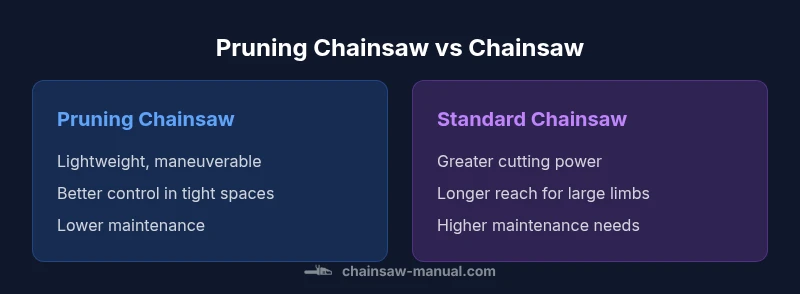
The pruning chainsaw and a standard chainsaw serve different pruning and general cutting roles. For branch pruning, a pruning-specific model is easier to control, lighter, and safer in tight spots, while a traditional chainsaw offers raw power for larger limbs. Your choice depends on tree size, access, and safety priorities. Consider blade length, weight, fuel type, and maintenance when deciding.
Pruning chainsaw vs chainsaw: what sets them apart
According to Chainsaw Manual, the pruning chainsaw is optimized for light-to-moderate pruning tasks, delivering precise cuts with excellent maneuverability in confined spaces. A traditional chainsaw, by contrast, emphasizes raw power, longer reach, and broader cutting capability. This fundamental distinction shapes everyday use, maintenance, and safety considerations. For homeowners and professionals alike, recognizing the design intent behind pruning chainsaws vs chainsaws helps set realistic expectations about performance and trade-offs. Chainsaw Manual's team emphasizes that choosing the right tool starts with your most frequent jobs: small branches, shrubs, and shaping versus big limbs, rough cuts, and trunk work. Understanding this helps you avoid overbuying or underusing a tool that doesn’t fit your workload.
Core design differences that influence performance
The pruning chainsaw typically features a shorter bar and lighter overall weight, designed for agility in tight spots. The chain has a milder pitch and a lower kickback profile, helping beginners and seasoned users maintain control during frequent pruning. In contrast, a standard chainsaw uses a longer bar, higher power output, and heavier chassis, enabling rapid removal of large limbs but demanding greater operator focus and technique. Weight distribution and balance also influence how comfortable each tool feels during extended pruning sessions. Chainsaw Manual notes that the right balance reduces fatigue and improves precision, especially on uneven terrain. Power sources range from gas to electric, with battery-powered variants closing the gap on portability and noise.
Safety considerations when choosing between them
Safety is central to any pruning task. Pruning chainsaws typically offer safer handling for intimate work around shrubs, fences, and landscape features due to lighter weight and shorter bars. Kickback risk remains a concern for all chainsaws; prioritize anti-kickback chains, proper guard placement, and consistent chain tension. For larger, thicker limbs, a standard chainsaw may be safer if you have ample operator experience, a clear retreat path, and a plan to manage kickback. Always wear ANSI-rated PPE, use a stable stance, and keep bystanders clear. Chainsaw Manual emphasizes training and routine maintenance as critical safety factors that reduce accidental injuries.
Use-case scenarios: pruning, trimming, limb removal
In urban pruning and ornamental trimming, a pruning chainsaw shines. It excels at shaping hedges, reaching through dense foliage, and performing delicate cuts without overwhelming the branch. For rough clearing, storm cleanup, or felling, a standard chainsaw offers the power and reach needed to complete tasks quickly. Homeowners with mixed landscapes may benefit from owning both tools or opting for a versatile model with adjustable bar lengths and adaptable chains. The key is to match the tool to the dominant task and reserve the other for specialized jobs to maximize efficiency and safety.
Performance metrics: speed, torque, balance
Performance evaluation centers on weight, balance, and control rather than raw speed alone. Pruning chainsaws favor maneuverability and precise control, trading some cutting speed for easier handling in tight spots. Standard chainsaws prioritize torque and bar length, enabling faster chunk removal for larger limbs but requiring steadier hands and better situational awareness. Balancing the tool to your height, stance, and task reduces fatigue and enhances accuracy. Chainsaw Manual notes that users often underestimate how much weight and leverage change cutting behavior over long pruning sessions.
Maintenance and consumables: oil, chains, bar care
Maintenance needs differ. Pruning chainsaws typically require lighter lubrication, easier chain tension checks, and simpler bar maintenance. Standard chainsaws demand more frequent chain sharpening, tension adjustments, and bar inspection due to higher cutting loads. Regardless of model, proper chain oiling, cleaning after use, and regular inspections extend life and consistency. Chainsaw Manual advises keeping a spare chain in good condition and choosing a quality bar and chain that fit your typical task profile to avoid unexpected downtime.
Price, warranty, and total cost of ownership
Pricing for pruning-focused models generally sits lower than heavy-duty, long-bar systems, making them approachable for homeowners. Traditional chainsaws with longer bars and higher power often come with a higher upfront cost and longer maintenance intervals, reflecting their capabilities. Warranty terms commonly hinge on usage, maintenance clout, and storage conditions. When evaluating total cost of ownership, consider fuel, bar/chain replacements, and service intervals. Chainsaw Manual recommends mapping out expected tasks over a season to avoid investing in capabilities you won’t utilize regularly.
How to read specs and compare models
Key specifications include bar length, chain pitch and gauge, power source, and weight. Shorter bars reduce reach but increase control, while longer bars boost cutting capacity. Pitch and gauge influence chain compatibility with the bar and drive sprocket. Power sources affect noise, emissions, and running costs. Always review safety features, such as chain brake, low-kickback chains, and anti-vibration handles. When pruning, prioritize models with comfortable grips, balanced weight distribution, and accessible maintenance points.
Practical buying guide: step-by-step decision framework
- List your typical tasks: light pruning, hedge shaping, or heavy limb removal. 2) Assess access and terrain: tight spaces call for shorter bars and lighter weight. 3) Choose a primary tool and consider adding a secondary if needed. 4) Check safety features and PPE compatibility. 5) Compare warranties and service networks. 6) Factor ongoing costs: oil, chains, and maintenance supplies. This structured approach helps you select a tool that remains effective over years of use.
Final decision framework: when to buy which tool
If pruning is your core activity, a pruning chainsaw should be your go-to tool. If you frequently encounter large wood or require longer reach, a standard chainsaw becomes indispensable. For mixed usage, consider a hybrid or variable-bar model that balances control with cutting power. Always pair your choice with proper training and PPE to maximize safety and performance.
Comparison
| Feature | pruning chainsaw | standard chainsaw |
|---|---|---|
| Best use case | Light pruning, shaping, and maneuverable cuts | Heavy-duty cutting, larger limbs, and felling |
| Bar length range | 6-12 inches | 14-20 inches |
| Weight | Lightweight and balanced | Heavier, more robust |
| Safety considerations | Lower kickback risk; easier control in tight spaces | Increased kickback risk with longer bars; requires solid technique |
| Maintenance effort | Lower maintenance; simpler chain systems | Higher maintenance; frequent sharpening and tensioning |
| Price range | $100-$400 | $350-$900 |
| Best for | Home pruning, hedges, and shaping | Limb clearance, storm cleanup, and heavy wood |
Strengths
- Enhanced maneuverability for pruning tasks
- Lower weight reduces user fatigue
- Better balance improves accuracy and safety
- Quicker startup and easier maintenance for casual use
Drawbacks
- Limited reach for tall trees
- Reduced power for thick limbs
- Potential underperformance on heavy-duty tasks
Pruning chainsaw is the smarter default for pruning-heavy work; standard chainsaw remains essential for heavy-duty cuts.
Choose pruning chainsaw for most pruning tasks. If you frequently encounter thick wood or need longer reach, pair with a traditional chainsaw.
FAQ
Is a pruning chainsaw better for long pruning sessions than a full-size chainsaw?
Generally yes. Pruning chainsaws are lighter and more maneuverable, reducing fatigue during extended pruning tasks. They still require proper technique and PPE. For very long sessions, take breaks and assess comfort to prevent strain.
Generally yes. They’re lighter and easier to handle, but take breaks to avoid strain.
Can I prune with a regular chainsaw without compromising safety?
You can, but it demands more control, technique, and PPE. For small branches, a pruning chainsaw often feels safer and more efficient. If you already own a standard chainsaw, ensure you have training and keep a safe working distance.
You can, but it needs more control and safety. Training helps a lot.
Which tool is safer for beginners?
A pruning chainsaw is typically safer for beginners due to its lighter weight and reduced kickback potential. Start with lighter tasks and always use PPE, maintain proper stance, and work with training material. Progress to larger cuts as confidence and technique improve.
Usually safer for beginners because it’s lighter and easier to control.
Do pruning chainsaws require different blades than standard chainsaws?
Not fundamentally, but many pruning chainsaws use chains designed for cleaner, slower cuts and better control. Some models offer interchangeable bars suitable for pruning versus heavier cutting. Always follow manufacturer guidance for blade and chain compatibility.
They often use similar chains, but some pruning models favor different configurations for control.
What about battery-powered vs gas pruning chainsaws?
Battery-powered pruning chainsaws provide quieter operation and easier starting, suitable for light pruning. Gas models deliver more sustained power for larger limbs but require more maintenance and noise. Choose based on typical tasks, noise tolerance, and maintenance willingness.
Battery models are quiet and easy; gas models are powerful but louder and need more upkeep.
The Essentials
- Prioritize task type when choosing tools
- Opt for a pruning-focused model for regular pruning
- Balance safety features with experience level
- Account for maintenance needs in ongoing costs
- Consider a combined approach for mixed landscapes