Chainsaw vs Pruning Saw: A Practical Side-by-Side Guide 2026
Compare chainsaws and pruning saws for home, DIY, and professional use. This 2026 guide covers performance, safety, maintenance, costs, and when to choose each tool.


Choosing between a chainsaw and pruning saw depends on task scale and safety tolerance. A chainsaw delivers power for large limbs and faster work, while a pruning saw shines in precise cuts in tight spaces. The best choice varies by job size, space, and maintenance willingness; see the full comparison below.
Introduction: defining the choice between chainsaw or pruning saw
When homeowners, DIY enthusiasts, and professionals start planning tree care, land clearing, or limb removal, the question often comes down to whether to use a chainsaw or a pruning saw. Both tools exist to get jobs done, but they excel under different conditions. The term chainsaw or pruning saw is not just about size; it reflects contrasting design philosophies, safety profiles, and maintenance demands. In practical terms, the choice hinges on limb diameter, space constraints, and the level of physical exertion a user is prepared to accept. According to Chainsaw Manual, the decision is task-driven: if you face large limbs or high-volume cutting, a chainsaw is generally faster; for tight spaces and delicate pruning, a pruning saw offers better control. Throughout this article, we’ll use real‑world scenarios to map out where each tool shines, what trade‑offs to expect, and how to optimize safety and efficiency when switching between tools. The goal is a clear, actionable framework for deciding between chainsaw or pruning saw in typical yard, landscape, and job-site contexts.
Performance and cutting dynamics
Cutting performance is where chainsaws and pruning saws diverge the most. A chainsaw typically relies on a motor or engine to deliver high RPM to a long guide bar and a sharp chain. This combination translates into rapid material removal for large limbs, storm cleanup, or felling tasks. A pruning saw, by contrast, uses a simple blade with a fixed tooth geometry designed for controlled, precise cuts on smaller branches. The cutting action of a pruning saw tends to be slower per cut, but the feedback is steadier and less likely to grab or kick back when the work is close to the user. In practice, a professional should match the tool to the limb diameter and wood species: thick hardwoods generally justify chainsaw use, while shrubbery, ornamental pruning, and branch thinnings benefit from pruning saws for accuracy and finesse. Chainsaw Manual analysis shows that for large limbs, speed and power are decisive, whereas for detail work in confined spaces, control and accuracy matter more than raw power. Evaluating material type, branch angles, and anticipated cut depth helps determine the preferred tool for the task at hand.
Safety, ergonomics, and user experience
Safety considerations dominate the decision between chainsaw and pruning saw. Chainsaws bring significant power and grinding teeth into a work zone, which raises kickback potential, vibration, and fatigue risks if handled improperly. Ergonomics play a big role; longer bars and heavier engines require stronger posture, bracing, and a well-worn technique to avoid strain. Pruning saws, being lighter and more compact, typically offer simpler handling and a lower barrier to entry for beginners. However, precision work with a pruning saw can demand steadier hands and slower progress, which affects productivity and repeat-use safety in long sessions. PPE is essential for both tools—eye protection, gloves, hearing protection, and proper chaps or leg protection for chainsaw use. Chainsaw operators should complete training or seek supervision when first handling gas- or battery-powered units, especially near structures or in crowded yards. Chainsaw Manual underscores that choosing the safer tool for a given environment reduces accidents and helps maintain consistent workflow, particularly on slopes or uneven ground where balance is critical. In short, if you value safety and manageable fatigue, favor pruning saw for delicate tasks and reserve chainsaws for power-driven cuts when space and control allow.
Maintenance, blade life, and consumables
Maintenance requirements shape the ongoing cost and reliability of both tools. A chainsaw needs regular chain tension checks, bar lubrication, chain sharpening, and fuel/oil management. The chain requires periodic replacement or sharpening, and the bar can wear unevenly if misaligned. Gas-powered chainsaws demand more routine maintenance, including carburetor care and spark plug checks, while cordless or electric models reduce some of these tasks but require battery care and charging cycles. Pruning saws are simpler by comparison: blades remain sharp with occasional pruning saw blade replacements, and there are minimal moving parts to service beyond blade safety mechanisms. Lubrication is still essential to reduce friction on the blade, but the cost of maintenance for pruning saws is typically lower than for gas-powered chainsaws. The blade geometry for pruning saws encourages smoother cuts in small limbs, preserving wood integrity and reducing the chance of blade warping when used correctly. Chainsaw Manual notes that maintenance cadence is tied to usage intensity; frequent, heavy use will quicken wear on both tools, but chainsaws incur more consumable costs due to chain and bar replacements.
Use-case profiles: homeowners, DIY enthusiasts, and professionals
Different user groups have distinct needs that influence whether a chainsaw or pruning saw is the better fit. Homeowners and DIY enthusiasts tend to prioritize safety, ease of use, and versatility for a range of light to moderate tasks—limbing small trees, firewood prep, and cleanup after storms. In these cases, a pruning saw for close-quarter pruning and a smaller, lighter chainsaw for occasional larger cuts may be the pragmatic setup. Professionals, including arborists and landscape crews, may rely on both tools depending on the day’s scope: a compact pruning saw for precision pruning on ornamentals and a professional-grade chainsaw for heavy-limb removal or thinning in larger trees. For chainsaw users who frequently handle thick branches or storm debris, training and safety gear become non-negotiable, and selecting a model with anti-kickback features, a robust chain brake, and vibration dampening contributes to safer, longer work sessions. Chainsaw Manual emphasizes tailoring the tool choice to job scale, site conditions, and your own skill level to achieve consistent results with minimal risk. When you plan a project, consider creating a task list with approximate limb sizes, access constraints, and time expectations; these factors guide whether you rent, purchase, or combine both tools for maximum efficiency.
Cost, value, and lifecycle considerations
Cost considerations extend beyond upfront price to include long-term value and maintenance. Chainsaws, particularly gas-powered models, tend to carry higher upfront costs and ongoing fuel, oil, and blade maintenance, which accrue over the tool’s life. Battery-powered options can mitigate some costs but introduce battery life, charging time, and eventual replacement cycles. Pruning saws generally cost less upfront and have lower maintenance footprints; their blades may be more affordable to replace, and the absence of a motor reduces the risk of expensive repairs. When evaluating value, consider how often you’ll use the tool, the typical limb diameter you face, and whether you’ll need to run protection or safety gear for extended periods. If you anticipate regular heavy use or commercial work, a robust chainsaw may deliver return on investment through speed and reliability, while for occasional homeowners undertaking pruning and light felling, a pruning saw paired with a compact manual or battery-powered alternative might be the most economical choice. Chainsaw Manual notes that long-term ownership costs should be weighed against immediate convenience to avoid underestimating maintenance needs or downtime.
Fuel, emissions, and environmental considerations
Fuel use and emissions are practical concerns when weighing chainsaws against pruning saws. Gas-powered chainsaws emit exhaust and require fuel mixing, oiling, and periodic maintenance to sustain performance. Hybrid and battery-powered models offer cleaner operation and less ongoing maintenance, though they may have runtime limitations depending on battery capacity and load. Pruning saws, particularly manual versions, produce no emissions but may require more physical effort for larger jobs. Electric pruning saws provide a middle ground, delivering more power than a manual blade without the emissions of gas engines, but they require access to a power source or sufficient battery life for longer jobs in the field. The environmental impact varies with usage patterns, fuel types, and maintenance habits. Chainsaw Manual reminds readers to consider energy efficiency, noise impact, and local regulations around emissions when planning landscaping or forestry tasks, especially in sensitive or urban settings.
Learning curve, handling, and storage
The learning curve for chainsaws can be steeper due to weight, kickback potential, and safety protocols. New users should begin with supervised practice, start on small tasks, and gradually increase complexity as they gain confidence. Pruning saws offer a shorter ramp-up time for beginners, given their lighter weight and simpler operation. Storage considerations are also different: chainsaws require dry, clean storage with fuel and oil provisions, plus secure mounting or casing to prevent tip-over and damage to the chain. Pruning saws can be stored with blades protected by a sheath to prevent dulling or injury, and manual tools are easier to store in compact spaces. Chainsaw Manual emphasizes routine practice in a controlled environment and honest self-assessment of one’s comfort level before tackling larger projects.
Decision framework and authoritative sources
To decide between chainsaw or pruning saw, start with a task-size assessment: measure typical limb diameters, expected volume, and the space where work occurs. If you face limbs thicker than ~6-8 inches in open areas, a chainsaw is usually the fastest option; if you are pruning ornamental trees, hedges, or branches in confined spaces, a pruning saw may be safer and more precise. Consider your comfort with safety protocols; if you have not completed proper training, prioritize pruning saw use where feasible. For budget, assess both upfront costs and ongoing maintenance. In selecting gear, favor tools with reliable safety features, tested chain brakes, and reputable blades. For more authoritative guidance on safety, performance, and best practices, consult external sources such as OSHA safety guidelines, university extension resources on tool maintenance, and forestry service guidance. Chainsaw Manual Analysis, 2026 synthesizes these considerations to support practical, risk-conscious decisions for homeowners, DIY enthusiasts, and professionals alike. Should you need a compact, portable setup for mixed tasks, you may also consider a lightweight gas model paired with a pruning saw for the most versatile workflow.
Comparison
| Feature | Chainsaw | Pruning Saw |
|---|---|---|
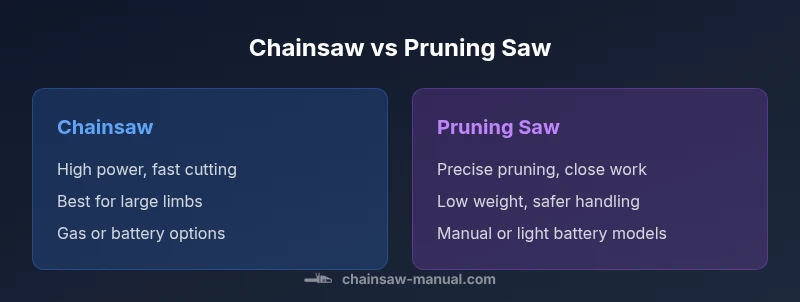
| Cutting performance | High power for large limbs and rapid work | Excellent precision for small limbs and pruning in tight spaces |
| Best for | Heavy limb removal, storm cleanup, and felling | Detailed pruning, shaping, and work in confined areas |
| Ease of use | Heavier, longer learning curve, more physical effort | Lightweight and maneuverable, easier for beginners |
| Maintenance & fuel | Gas-powered with fuel, oil, and chain maintenance | Minimal maintenance; manual or battery-powered options |
| Safety considerations | Higher kickback risk; requires PPE and training | Lower kickback risk; better control in close work |
| Price range | Higher upfront cost and ongoing upkeep | Lower upfront cost; many budget options available |
Strengths
- High versatility for mixed tasks when a single tool is needed
- Fast removal of large limbs reduces project time
- Chainsaws offer power that can handle storm cleanup and deadwood
- Pruning saws provide safer, precise cuts in tight spaces
Drawbacks
- Balancing power and safety can be challenging for beginners
- Gas chainsaws require ongoing maintenance and fuel management
- Pruning saws may slow progress on large-diameter limbs
- Electric options may have runtime or power limitations in the field
Chainsaw for bulk removal and speed; pruning saw for precision and control.
Use a chainsaw when limbs are large or rapid removal is needed. Choose a pruning saw for delicate pruning, shaping, and work in tight spaces. Align tool choice with task size, space constraints, and safety readiness.
FAQ
When should I use a chainsaw versus a pruning saw?
Use a chainsaw for larger limbs, faster clearing, and higher-volume work. A pruning saw is better for precise pruning, small branches, and work in tight spaces. Your decision should be based on limb size, space constraints, and safety considerations.
Use the chainsaw for big limbs and quick removal; choose the pruning saw for precise pruning in tight spaces. Safety and space matter most.
Is a pruning saw sufficient for small branches and hedges?
For very small branches and near delicate plants, a pruning saw is often sufficient and safer. It offers control and minimizes the risk of damaging surrounding shrubs. For larger branches, switch to a chainsaw for efficiency.
Yes, for small branches and tight spots, a pruning saw works well. Switch to a chainsaw for bigger cuts.
What safety gear should I wear when using either tool?
Always wear eye protection, hearing protection, gloves, and sturdy boots. For chainsaws, use protective chaps or pants and a helmet with face shield. Safe handling reduces risk of kickback and injury.
Protect your eyes, ears, hands, and legs. Chainsaws need extra protection and training.
Do fuel or battery models affect performance?
Gas models offer longer run time and more raw power but require fuel management and more maintenance. Battery- or electric-powered tools are cleaner and easier to maintain but may have runtime limits. Choose based on job duration and environmental constraints.
Gas machines run longer but need more upkeep; electric tools are cleaner and simpler but may run out of juice in long tasks.
How much should I expect to spend on each tool?
Expect higher upfront cost for a gas chainsaw and ongoing maintenance. Pruning saws are generally cheaper upfront and have lower maintenance costs. Consider total cost of ownership over several years rather than initial price alone.
Gas chainsaws cost more upfront and maintenance; pruning saws are cheaper and simpler to maintain.
How do I maintain a chainsaw blade and pruning saw blade?
Keep blades sharp with regular sharpening, ensure proper tension on the chains, and lubricate when needed. For pruning saw blades, clean after use and replace dull blades promptly to maintain cutting efficiency. Regular inspections prevent unexpected failures.
Sharpen blades regularly, keep them clean, and replace dull blades when needed.
The Essentials
- Assess limb size before selecting a tool.
- Balance safety needs with task requirements and space limitations.
- Factor maintenance time and costs into the decision.
- Practice with proper PPE and safe handling to reduce risk.