When to Use Hedge Trimmer vs Chainsaw: A Practical Guide
Compare hedge trimmers and chainsaws to decide when to use each tool for pruning, shaping, or heavy cutting. This analytical guide covers safety, maintenance, scenarios, and decision factors for homeowners and professionals.


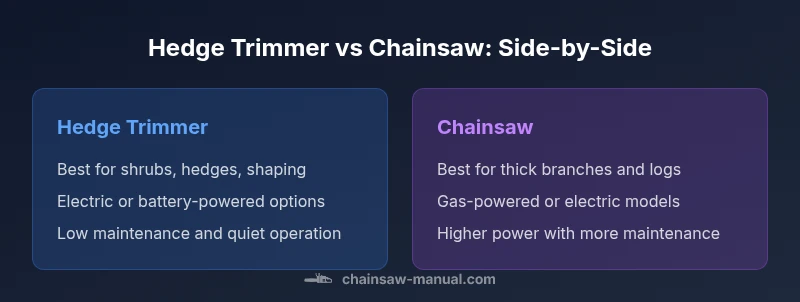
For most outdoor limb work, use a hedge trimmer for shrubs and light branchwork, and reserve a chainsaw for thick limbs and logs. The hedge trimmer shines on pruning, shaping, and quick trims, while the chainsaw delivers power for felled branches, rough cuts, and wood processing. In short: hedge trimmer for small-diameter work; chainsaw for heavy cutting.
Defining the Roles: Hedge Trimmer vs Chainsaw in Home Outdoor Work
Outdoor landscape maintenance often requires two very different performers in your shed: the hedge trimmer and the chainsaw. Understanding when to use hedge trimmer vs chainsaw is the core question homeowners face during pruning, shaping, cleanup, and light forestry tasks. A hedge trimmer excels at neat edges and bushy frames, while a chainsaw tackles thick limbs, rough cuts, and wood processing. The decision hinges on branch size, the required finish, and the safety context. According to Chainsaw Manual, starting with a task map helps prevent tool damage and user injury by aligning the job with tool capability. In this guide, we’ll compare the two tools across common yard tasks, safety considerations, and maintenance demands so you can select the right instrument for the moment. We’ll also discuss misapplications that lead to extra work, downtime, and avoidable hazards. This context sets the stage for practical, hands-on guidance you can apply this season. The aim is to empower homeowners to work efficiently without compromising safety or quality. Using the right tool for the job reduces cleanup, speeds completion, and lowers the risk of accidents on ladders, slopes, or uneven ground. 2026 is shaping how homeowners approach tool selection.
When to Use a Hedge Trimmer
Hedge trimmers are optimized for shaping and maintaining the visual form of shrubbery, hedges, and topiary. They excel when you need straight lines, even facades, or a tidy silhouette along borders and driveways. In seasonal pruning, a hedge trimmer can remove dead wood and reduce plant density with precision without the heavier torque of a chainsaw. When deciding to bring a hedge trimmer into a task, look for branches up to a manageable diameter and a layout that benefits from uniform cuts and rapid edges. Modern electric and cordless hedge trimmers offer good performance for most residential landscapes with minimal maintenance. For sculpted hedges, layered borders, or fast edging, a hedge trimmer minimizes risk while delivering consistent aesthetics. In addition to pruning, hedge trimmers can manage groundcover and low-growing ornamentals where a chainsaw would be overkill.
When to Use a Chainsaw
Chainsaws are the workhorse for heavy cutting, including thick branches, storm debris, felled trees, and rough shaping where substantial material is removed. They deliver high torque and cutting power that enables rapid progress on limbs well beyond what a hedge trimmer can handle. When you encounter branches that exceed the safe capacity of a trimming blade, a chainsaw becomes the practical choice. Use it for clearing fallen limbs after a storm, processing firewood, or creating rough cuts on timber. Electric chainsaws offer quieter operation with lower emissions for smaller tasks, while gas-powered models provide maximum power for larger jobs in less than ideal terrain. The key is to respect kickback risks and maintain control when guiding the chain through tough wood. In professional contexts, chainsaws often pair with protective chaps and face shields to mitigate injury risk during demanding tasks.
Key Differences in Power, Reach, and Control
Power: Hedge trimmers prioritize steady, controlled cuts with moderate force ideal for shaping shrubs; chainsaws prioritize high torque and aggressive wood removal for thick branches. Reach: Hedge trimmers are typically shorter, reducing swing speed risk in tight spaces, while some chainsaws offer longer bars for extended reach but require stronger stance and positioning. Control: Hedge trimmers provide precise angular control for neat lines, whereas chainsaws demand tighter handling skills due to heavier torque and sharper teeth. Maintenance: Hedge trimmers require blade care and occasional motor service; chainsaws require fuel handling, oiling, chain sharpening, and bar maintenance. Safety: Hedge trimming generally carries lower kickback risk but still demands eye and hand protection; chainsaws carry higher risk of kickback and entanglement, requiring full PPE. Price and lifespan: Hedge trimmers are often cheaper upfront and lighter to own; chainsaws can be pricier but deliver greater longevity with proper maintenance.
Safety Considerations and PPE
Safety is non-negotiable with both tools. For hedge trimmers, wear safety glasses or a face shield, hearing protection if using gas-powered models, gloves, and sturdy footwear. Chainsaws demand more robust PPE: chain-saw specific chaps or cut-resistant pants, a face shield, hearing protection, gloves, and non-slip boots. Maintain a clear work area, secure footing, and avoid cutting overhead unless you have a stable ladder setup and a partner to spot you. Before starting either tool, inspect for loose fasteners, damaged blades, or fuel/oil leaks. In windy conditions or on uneven terrain, reassess whether the job can be done safely. Always follow manufacturer guidelines and local regulations for PPE and operation. The Chainsaw Manual team emphasizes prioritizing safety and proper technique; misusing either tool increases the likelihood of accidents and injuries.
Maintenance and Longevity: Hedge Trimmer vs Chainsaw
Maintenance is a major factor in tool longevity and performance. Hedge trimmers require blade lubrication, periodic blade sharpening, and routine motor care. Electric models typically demand less maintenance but still benefit from cleaning after use to prevent sap buildup and corrosion. Chainsaws require regular bar oiling, chain tension checks, sharpening, and fuel/oil mix maintenance where applicable. Gas-powered chainsaws demand more routine service, including spark plug checks and air filter cleaning. Battery-powered hedge trimmers require proper charging practices and storage to maximize life. With both tools, keeping blades clean, rust-free, and sharp reduces effort and improves cut quality. Chainsaw maintenance, though more involved, pays dividends in reliability for heavy projects, while hedge trimmer maintenance keeps shrub work efficient and precise. Chainsaw Manual analyses indicate that well-maintained equipment outlasts cheaper replacements, especially in demanding climates.
Real-World Scenarios: Yard Cleanup, Landscaping, and Forestry Tasks
In a typical suburban yard, you might trim hedges on a weekly schedule, then address storm debris in off-season cleanup. For shaping and topiary, a hedge trimmer speeds up the process, enabling quick, clean lines along borders and entrances. If a limb is too thick or the branch diameter exceeds the tool’s capacity, switch to a chainsaw to prevent damage to the blade or slippage that could harm the user. In larger properties, you may perform a combination approach: hedge trimming for the ornamental sections and chainsaw work for the rough cleanup after a storm, felling a fallen tree, or processing logs for firewood. In professional contexts, operators often carry both tools to adapt to variable workloads and terrain, ensuring efficiency and safety across tasks. Always plan the sequence, starting with the lighter work to reduce hazard exposure before tackling heavier cuts.
Price, Availability, and Tool Lifespan
Hedge trimmers generally come in cheaper, lighter forms and are widely available in corded, cordless, and occasional gas variants. Chainsaws span a wider price range depending on power, bar length, and engine type, with higher upfront costs but potential longer service life when properly maintained. Availability is typically strong for both tools, with a broad ecosystem of replacement blades, bars, chains, and batteries. If you’re evaluating long-term value, a durable chainsaw will often justify its cost through reliable performance on heavy jobs, while a reliable hedge trimmer is a strong value for frequent pruning and edging. Chainsaw Manual analysis suggests that tool selection correlates with reduced downtime and longer intervals between major replacements, provided you follow maintenance best practices and safety protocols.
The Decision Tree: Quick Framework for Your Next Project
- Assess branch size and job type: shrubs and shaping or light pruning? 2) If light work, choose hedge trimmer; if thick limbs or wood, opt for chainsaw. 3) Consider location and space: tight spaces favor hedge trimmers; open areas with debris favor chainsaws. 4) Evaluate safety risk: ensure you have appropriate PPE and a stable stance. 5) Factor in maintenance and fuel considerations: electric hedge trimmers are easier to manage than gas-powered chainsaws in smaller yards. 6) Decide on storage and portability: cordless tools save space in smaller sheds. 7) Plan for future tasks: keep both tools if your property includes significant landscaping and occasional tree work.
Environmental and Efficiency Impacts
Noise and emissions are practical considerations. Hedge trimmers, especially electric models, produce less noise and zero direct emissions, which matters for dense neighborhoods and early-morning jobs. Chainsaws generate more noise and combustion byproducts, but their efficiency for large tasks can reduce overall time spent on cleanup and forest management. Choosing the right tool reduces hours spent on the project and minimizes the number of tool switches you must perform on a single job. Efficient tool selection aligns with responsible yard maintenance, improving results while lowering stress on the operator and the surrounding environment.
Common Mistakes to Avoid
Avoid overmatching your task to the wrong tool: don’t try to prune heavy branches with a hedge trimmer, and don’t attempt fine trimming with an overbearing chainsaw. Skipping PPE or rushing work on sloped or unstable ground increases risk. Using dull blades increases effort and reduces control, while neglecting maintenance shortens tool life. Finally, failing to plan for storage and transport leads to damage and accidents arising from improper handling. The goal is a safe, deliberate workflow that respects the limits of each device and the operator’s skills.
How to Store and Transport Safely
Store tools in a dry, secure location away from children and pets. For hedge trimmers, run through a quick blade-cleaning routine and shield the blades. For chainsaws, drain fuel if storing long-term, clean the bar and chain, and inspect for loose parts before transport. Use a protective case or blade cover, and secure the equipment during transit to prevent movement and damage. Regular maintenance checks should occur before and after storage to ensure readiness for the next job.
Comparison
| Feature | Hedge Trimmer | Chainsaw |
|---|---|---|
| Power Source | Electric/Battery (cordless options available) | Gas-powered or Electric (corded) |
| Typical Use Case | Shrubs, hedges, shaping, edging | Thick branches, felled limbs, wood processing |
| Delivery Power | Moderate torque suitable for pruning | High torque for heavy-duty cutting |
| Safety Risk | Lower kickback risk, simpler handling | Higher kickback risk, requires careful control |
| Maintenance Needs | Blade maintenance, occasional motor care | Fuel/oil management, chain sharpening, bar oil |
| Price Range | $40-$300 | $150-$900 |
| Best For | Hedges, topiary, edging | Limbing, storm debris, rough cuts |
Strengths
- Quieter operation and lower safety risk for light pruning
- Faster for hedge shaping and edging tasks
- Lower upfront cost and simpler maintenance
- No need for fuel handling with electric models
Drawbacks
- Limited cutting capacity for thick limbs
- Less suitable for heavy wood processing
- Electric models depend on outlet or battery life
- Hedge trimmers can be damaged by dense, multi-branch growth
Hedge trimmer is ideal for pruning and shaping; chainsaw is best for heavy limb work.
Choose hedge trimmer for shrubs and edging, and save the chainsaw for thick branches and wood processing. The Chainsaw Manual team emphasizes matching tool capability to task size and safety requirements to maximize efficiency.
FAQ
When should I choose a hedge trimmer over a chainsaw?
Choose a hedge trimmer for shaping, pruning, and lightweight branch work where precision and speed are priorities. Opt for a chainsaw when you encounter thick limbs or rough, bulky wood that requires substantial removal.
Choose hedge trimmer for shaping; chainsaw for thick branches. This keeps you safe and efficient.
Can I use a hedge trimmer for small branches?
Yes, for small to moderate branches, a hedge trimmer can work well, especially if the branches are within the tool’s cutting capacity and you’re aiming for a neat finish.
Yes, small branches are fine for a hedge trimmer when you want a clean look.
What PPE should I wear when using either tool?
Always wear eye protection and hearing protection; gloves and sturdy footwear are essential. Chainsaws require additional protection like cut-resistant chaps and a face shield due to higher kickback risk.
Eye and ear protection are mandatory; use protective chaps for chainsaws.
How often should I service a hedge trimmer vs a chainsaw?
Service depends on use, but clean blades after every session, lubricate moving parts, and check for wear. Chainsaws demand more frequent fuel/oil maintenance, chain sharpening, and bar care.
Clean after each use and check wear; chainsaws need more frequent fuel and chain maintenance.
Are cordless options viable for both tools?
Cordless hedge trimmers are practical for many homeowners, offering mobility and quiet operation. Cordless chainsaws exist but vary in runtime and power, making them best for lighter heavy-cut tasks.
Cordless work for hedges is common; for chainsaws, consider task size and battery life.
What’s the best practice for storage and transport?
Store in a dry place, clean blades, and protect with covers. Transport safely with blades secured; drain fuel from gas models if storing long-term.
Store clean and dry, cover blades, and secure during transport.
The Essentials
- Assess branch size before choosing a tool
- Use hedge trimmer for shrubs, topiary, and edging
- Reserve chainsaw for thick limbs and wood cuts
- Always wear appropriate PPE and follow safety guidelines
- Maintain tools regularly to extend lifespan