Pruning Chainsaw vs Reciprocating Saw: A Practical Guide
An analytical, practical comparison of pruning chainsaws and reciprocating saws for pruning tasks, covering cut quality, safety, efficiency, and best-use scenarios for homeowners, DIYers, and professionals.


TL;DR: In pruning tasks, the pruning chainsaw generally delivers cleaner cuts, safer control, and better wood handling; the reciprocating saw excels in rough cuts, irregular shapes, and multi-material cleanup. For precise pruning of live branches, choose the chainsaw; for demolition or cleanup where materials vary, the reciprocating saw offers versatility.
Pruning Tools Compared: Key Roles and Definitions
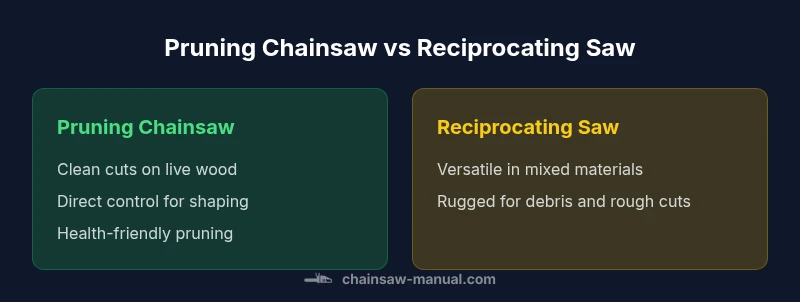
Pruning chainsaw vs reciprocating saw is a common comparison for homeowners and professionals evaluating the best tool for pruning tasks. A pruning chainsaw is designed to deliver clean, directional cuts in live wood, with a balance of power, blade length, and chain stability that favors controlled pruning. A reciprocating saw uses a push-pull blade action that excels at rapid sizing, rough cuts, and handling irregular material or deadwood. When you weigh the two options, you must consider the project context, wood species, limb diameter, and workspace. According to Chainsaw Manual, safety-first decisions should prioritize the right tool for the job to minimize damage to living trees and reduce operator risk. In many pruning scenarios the choice hinges on cut quality versus versatility. If you need precise shaping, a pruning chainsaw generally wins for clean edges and wood health. If your pruning involves mixed debris or non-wood material, a reciprocating saw offers multi-material flexibility that can save time and effort. As you read further, note that the two tools complement each other in certain tasks, which is why many professionals carry both to a job site.
This article uses real-world pruning tasks to illuminate where each tool excels, and where one tool may introduce unnecessary risk or damage. You’ll see practical guidance, with examples, safety notes, and decision criteria you can apply to decide between pruning chainsaw vs reciprocating saw for your specific job. For new or seasoned operators, the goal is consistent: maximize control, minimize harm to wood, and finish pruning with solid, healthy growth in mind.
For human readers to understand the differences between tools and their suitability for pruning tasks, the article emphasizes practical guidance rather than theoretical speculation.
Comparison
| Feature | Pruning Chainsaw | Reciprocating Saw |
|---|---|---|
| Cut Capacity (branch diameter) | Handles larger live-wood pruning more cleanly | Better for smaller, irregular, or deadwood cuts |
| Blade/Attachment Versatility | Fixed bar/chain designed for wood cuts | Interchangeable blades suited to metal, plastic, wood, and debris |
| Control and Handling | Sharper control for directional pruning | More versatility in awkward angles or tight spaces |
| Power Source and Runtime | Gas or high-capacity cordless options; consistent output | Cordless or corded options with varying runtime depending on battery or power source |
| Safety Features | Chain brake, low kickback bars, guide bar geometry optimized for pruning | Vibration management varies by blade and handle design; may require more caution with dense debris |
| Best Use Case | Live-wood pruning, shaping, branch removal with clean cuts | Rough cuts, mixed-material cleanup, demolition prep, fast sizing |
Strengths
- Cleaner cuts on live wood with better tree health impact
- Greater precision in shaping and thinning
- Excellent control in tight spaces and near delicate branches
- Versatile options for battery-powered or gas-powered models
Drawbacks
- Higher skill and setup for safe operation
- Reciprocating saw can cause rougher cuts or bark damage if misused
- Reciprocating saws may produce more vibration and fatigue in long sessions
- Chainsaws require additional PPE and chain maintenance
Pruning chainsaw is generally the better choice for high-quality pruning on live wood; reciprocating saws excel when versatility and rough cuts are needed.
Choose the chainsaw for precise pruning and tree health preservation. Opt for the reciprocating saw when your pruning involves mixed materials, debris, or space constraints where a multi-purpose tool reduces trip counts and overall job time.
FAQ
When is a pruning chainsaw preferred over a reciprocating saw?
For live wood pruning where clean edges and tree health matter, the pruning chainsaw is typically preferred. It provides smoother cuts and better limb control. For shredding or cutting through mixed debris, a reciprocating saw is often more efficient.
Choose the chainsaw for live-wood pruning to keep growth healthy and edges neater; use the reciprocating saw when you’re cutting through mixed debris or rough shapes.
Can you use a reciprocating saw for pruning small branches?
Yes, you can prune small branches with a reciprocating saw, especially in tight spots or where live-wood cuts are less critical. However, expect rougher edges and potential bark damage if not careful.
Yes, you can, but it's usually not ideal for fine pruning.
What safety considerations are critical when pruning with these tools?
Always use PPE, maintain awareness of kickback risk, and ensure proper blade or chain tension. Keep a stable stance and avoid cutting over your body. Regularly inspect blades and bar oil to prevent accidents.
Wear PPE, stay aware of kickback, and keep blades well-maintained for safer pruning.
Should I opt for cordless, corded, or gas-powered options?
Cordless models offer mobility but finite runtime; corded tools provide consistent power for extended work; gas-powered options usually deliver the most torque for tough pruning but require more maintenance and fumes management.
Cordless is handy for small jobs, corded for longer tasks, gas for power and durability.
What maintenance matters most for pruning tools?
Regular blade or chain sharpening, proper lubrication, tension checks, and bar cleaning are essential. Baseline maintenance reduces injuries and ensures cleaner cuts.
Keep blades sharp and lubricated, and check tension and cleanliness before each use.
Is one tool faster than the other for pruning tasks?
Speed depends on the task. A chainsaw can cut quickly through live wood with precision, while a reciprocating saw can size and shape debris rapidly when working with mixed materials.
Speed depends on material and task; chainsaw for clean cuts, reciprocating saw for mixed debris.
The Essentials
- Use the pruning chainsaw for clean, precise cuts on live wood
- Reserve the reciprocating saw for mixed-material pruning and rough cuts
- Prioritize safety gear and proper technique for both tools
- Carry both tools when pruning diverse job-site conditions