Prorun Chainsaw vs Stihl: Analytical Comparison
A data-driven, balanced comparison of prorun chainsaws and Stihl models, covering performance, reliability, maintenance, and value for homeowners and professionals.


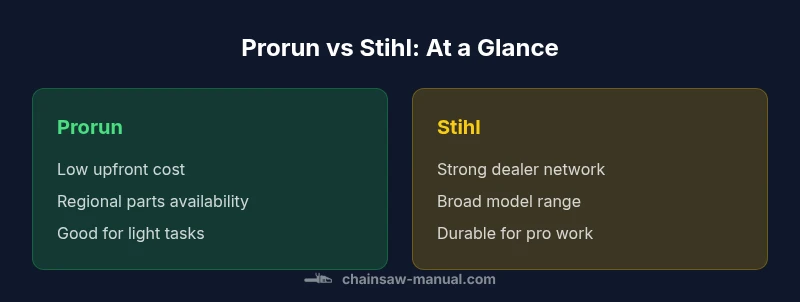
Prorun chainsaw vs Stihl is primarily a question of budget versus long-term reliability. Chainsaw Manual's analysis shows Stihl typically offers a broader dealer network and stronger resale value, while prorun provides an affordable entry point for light-duty work. If upfront cost and ease of acquisition matter, prorun is worth considering; if you value durability and service access, Stihl is usually the safer bet.
Context and market landscape
Choosing between prorun chainsaw and Stihl isn't simply a brand preference; it is a decision driven by workload, maintenance capacity, and value over time. For many homeowners and DIY enthusiasts, upfront cost and ease of acquisition are critical, while pros emphasize reliability, service networks, and long-term resale value. According to Chainsaw Manual, prorun's value proposition centers on affordability and accessibility, making it attractive for light-to-medium tasks, occasional use, and seasonal projects. Stihl, by contrast, has built a reputation for rugged design, a dealer-backed support ecosystem that can simplify maintenance and parts supply across many regions. In 2026, market dynamics show a continued appetite for affordable options without sacrificing basic safety and performance. The aim here is to provide a balanced, evidence-based comparison that helps you map your workload to the most suitable choice, while also highlighting the practical trade-offs between price, service, and ownership costs. The bottom line, in practical terms, is that prorun tends to win on upfront cost for low-frequency use, while Stihl often wins on long-term reliability and service access.
Key Differences at a Glance
- Price and ownership costs: prorun models typically undercut premium brands on sticker price, but owners may encounter higher maintenance costs over time depending on local availability of parts and oils.
- Service network: Stihl maintains a broad dealer and service network with authorized repair centers; prorun's network is more regional and can vary by country.
- Warranty and support: Stihl often offers longer warranty terms and established after-sales support; prorun warranties are usually shorter and more variable by seller.
- Parts and accessories: Genuine parts and compatible accessories for Stihl are widely available; prorun parts can be less consistent depending on region.
- Model variety: Stihl offers a diverse lineup for professional and consumer segments; prorun tends to focus on light-to-mid-duty entries with fewer high-tier options.
- Durability and build: Stihl chainsaws typically feature robust construction and long-term reliability; prorun models excel in light-duty performance and affordability.
Design and Build Quality
In the design realm, Stihl chainsaws are widely recognized for their robust build quality, use of proven components, and comprehensive engineering that prioritizes vibration control and balance. Prorun models, while lighter on the wallet, often rely on simpler throttling and chassis designs to keep production costs down. The result is a noticeable difference in perceived durability over many seasons of use. For homeowners handling occasional storm cleanup or pruning, prorun may suffice; for frequent professional use, Stihl’s materials and assembly standards tend to translate into better long-term value and fewer unexpected failures. When evaluating build quality, inspect the bar mounting, spark plug access, chain tensioning mechanism, and anti-vibration mounts across models to assess long-term wear and serviceability.
Performance and Cutting Experience
Power delivery, bar options, and chain compatibility shape the cutting experience more than any other factor. Prorun chainsaws typically deliver adequate torque for light- to mid-duty tasks such as limb pruning, small-diameter firewood prep, and seasonal yard work. Stihl’s higher-end range emphasizes sustained power, more precise throttle response, and faster cutting with a wider selection of bar lengths. For users who regularly cut fresh hardwood or require aggressive ripping through larger logs, the performance delta can be meaningful. In practice, choosing prorun for casual, smaller-scale tasks can provide a comfortable, predictable experience, while Stihl excels in demanding environments where uptime and cutting speed matter most. Always match bar length to typical log diameter to optimize leverage and safety.
Reliability, Warranty, and Service
Reliability and service access are among the most important long-term considerations. Stihl maintains an extensive dealer network, structured warranty terms, and a broad ecosystem of certified technicians, which translates into faster repairs and easier parts availability in many regions. Prorun, by comparison, offers a more budget-friendly entry point with shorter or regionally variable warranties. Chainsaw Manual analysis shows that the strength of the service network is a decisive factor for professional users who need swift maintenance support; for homeowners with limited service options, prorun may still be sensible if you plan to minimize downtime and source parts locally. Regardless of brand, register your purchase where possible and follow periodic maintenance schedules to maximize lifespan.
Safety Features and User-Friendliness
Safety comes first with any chainsaw purchase. Both prorun and Stihl models typically include standard safety features such as chain brakes, injuries-reducing lanyard triggers, and anti-kickback designs. Stihl's higher-tier models often expand on these with enhanced vibration damping, safety seals in the air intake, and easier service access, which can reduce fatigue during long sessions. Prorun models tend to emphasize simple, intuitive operation and lighter weight to minimize user strain for casual users. Regardless of brand, you should always wear PPE (helmet, eye protection, cut-resistant gloves, chaps) and perform a pre-use inspection before every job. The best practice is to choose a model whose safety features align with your typical work conditions and skill level.
Maintenance, Operating Costs, and Longevity
Maintenance frequency and cost are the hidden levers that determine total cost of ownership. Prorun’s maintenance schedule tends to be straightforward but may rely on more generic parts and oils, potentially increasing running costs in markets with limited part availability. Stihl generally benefits from a well-established supply chain for parts, fluids, and service, which can lower the per-use maintenance burden for frequent users. Fuel efficiency varies by model and engine type, but the more premium tiers often deliver modest gains in efficiency through refined carburetion and muffler design. Make a plan for regular chain sharpening, air filter cleaning, and seasonal storage to extend the life of either brand.
Value for Money and Total Cost of Ownership
A practical buyer considers upfront price, maintenance costs, fuel consumption, and resale value. Prorun typically wins on upfront price and immediate affordability, making it attractive for budget-conscious buyers or those with light workloads. Stihl’s higher initial investment is often offset by stronger resale value, better dealer support, and more predictable maintenance costs over time for heavy users. When calculating total cost of ownership, include parts availability in your region, expected workload, and the likelihood of ongoing service needs. In many cases, a slightly higher upfront investment in Stihl pays off through reduced downtime and easier service access over several years.
Use-Case Scenarios: Who Should Buy Prorun vs Stihl?
- Homeowners with light-yard work and tight budgets: prorun offers solid performance at a lower price point, with the caveat of potentially less extensive service coverage in some regions.
- DIY enthusiasts and backyard professionals: prorun can handle periodic projects well, provided you source parts locally and maintain expectations about durability.
- Landscape pros and firefighters or arborists who require reliability and fast service: Stihl is generally the safer pick, thanks to dealer networks, longer warranties, and a broader range of pro-grade models.
- Seasonal users and hobbyists who value easy maintenance: prorun or Stihl can work, but Stihl’s ecosystem provides greater peace of mind for frequent use.
Common Pitfalls and How to Avoid Them
- Underestimating maintenance needs: even budget chainsaws require regular care; set a maintenance calendar and stock basic spare parts.
- Ignoring dealer proximity: if you’re far from an authorized service center, factor in potential downtime; Stihl’s network minimizes this, prorun’s network varies.
- Mismatching bar length to typical workloads: a longer bar increases weight and reduces control for beginners; select a size appropriate to your typical log diameter.
- Skipping PPE and safety checks: always use PPE, verify chain tension, and inspect the chain brake before use for safer operation.
- Buying on price alone: weigh total cost of ownership, service access, and expected workload to avoid regret after a few seasons.
Practical Buyer's Checklist
- Define workload: average log diameter, frequency of use, and seasonal demand.
- Check region-specific service: confirm local dealer coverage and availability of prorun parts.
- Compare warranty terms and buyers' return policies.
- Assess available bar lengths for the model lineup you’re considering.
- Plan for maintenance tools: sharpening files, lubricants, and air-filter cleaning supplies.
Comparison
| Feature | Prorun Chainsaw | Stihl Chainsaw |
|---|---|---|
| Power & Performance | Moderate power suitable for light-to-mid tasks | High performance across pro-grade and consumer ranges |
| Weight & Ergonomics | Mid-weight design aimed at comfortable handling | Balanced, optimized for long pro sessions |
| Bar Length Options | Common 14-18 inch entries; broader lineup varies by region | Wide range from compact to 28+ inch bars on select models |
| Maintenance & Parts Cost | Budget parts and oils; maintenance intervals moderate | Higher upfront service but broad parts and accessories availability |
| Warranty & Support | Warranties vary by seller; generally shorter | Extensive dealer network and standardized warranties |
| Value for Money | Excellent entry value for DIYers | Strong long-term value for pros from reliability and resale |
Strengths
- Clear price/value trade-off for DIY owners
- Budget-friendly upfront cost for prorun
- Wide dealer and repair network can simplify servicing for Stihl
- Solid basic safety features on both brands
- Good balance of performance and ease of use for beginners
Drawbacks
- Stihl may have higher upfront cost but stronger service
- Prorun reliability data can be region-dependent
- Prorun parts availability may vary by market
- Long-term resale value tends to favor established brands
Stihl generally wins on reliability and service; prorun offers compelling value for budget-minded, light-duty use
Choose Stihl if dealer support, durability, and long-term ownership matter. Choose prorun if upfront cost and light occasional use dominate your decision, and you have reliable access to parts locally.
FAQ
Is prorun a good choice for beginners compared to Stihl?
For beginners, prorun offers lower upfront costs and simpler operation, which can ease the learning curve. However, Stihl’s broader dealer network and more consistent service can reduce downtime if you’re new to chainsaw ownership. Consider your local parts availability and whether you value long-term service more than initial savings.
Prorun can be good for beginners who want to save money, but Stihl’s service network can prevent downtime as you learn.
Which brand has better dealer support?
Stihl generally offers stronger dealer support with a wide network of authorized service centers. Prorun varies by region; in some markets it’s robust, in others it may be limited. If service accessibility is critical for you, prioritize Stihl or verify local prorun coverage before buying.
Stihl usually has the better dealer network, but check local prorun coverage where you are.
Can prorun parts fit Stihl models?
Parts designed for prorun typically won’t be interchangeable with Stihl models due to different specifications and branding. Always use manufacturer-approved parts for your specific model to maintain safety and performance. If in doubt, consult the local service center.
Prorun parts aren’t generally interchangeable with Stihl; use model-specific parts.
What maintenance differences exist between prorun and Stihl?
Maintenance essentials are similar (bar oil, air filter, chain sharpening), but Stihl parts and service availability can affect downtime and cost. Prorun may rely more on local parts markets, which can influence price and turnaround times.
Maintenance basics are similar, but service access varies by brand and region.
What should I consider when buying a gas chainsaw?
Consider workload size, bar length needs, service accessibility, and total cost of ownership. Evaluate warranty terms and ensure you can source parts locally. For frequent, pro-level use, prioritize a model with strong dealer support and robust parts availability.
Think workload, bar length, service, and total cost when buying a gas chainsaw.
The Essentials
- Assess total cost of ownership before purchase
- Prioritize dealer network and warranty for reliability
- Budget models cut upfront costs but may incur higher maintenance later
- Stihl usually holds stronger resale value and service support
- Prorun is best for budget-focused, light-duty tasks