Proyama Chainsaw vs Stihl: An Analytical Side-by-Side
A rigorous, evidence-based comparison of Proyama and Stihl chainsaws, examining performance, safety, maintenance, service networks, and value to help homeowners and professionals decide which tool fits their needs.


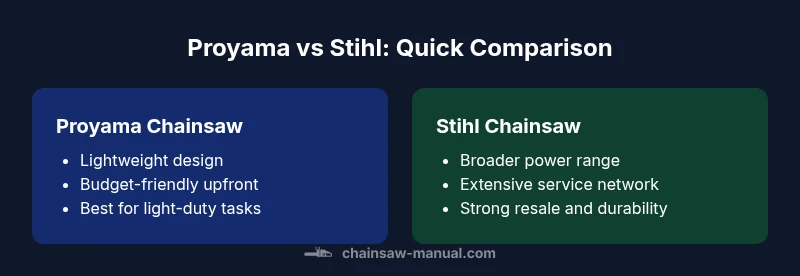
Proyama chainsaw vs stihl: In most scenarios, Stihl delivers broader service networks, proven reliability, and stronger resale value, making it the safer long-term choice. Proyama offers budget-friendly, lightweight options suited to casual DIY tasks. The best pick depends on usage frequency, willingness to invest in service, and whether you prioritize upfront savings or long-term support.
Market positioning and decision criteria
When evaluating proyama chainsaw vs stihl, homeowners and professionals should begin with three core axes: performance range, safety and ergonomics, and ownership factors like service, parts, and training. According to Chainsaw Manual, the most important decisions revolve around the size of tasks you tackle, how often you use the saw, and how readily you can access certified service. Stihl typically emphasizes dealer support, a broad model range, and established after-sales networks that minimize downtime on busy projects. Proyama, by contrast, targets budget-conscious buyers and beginners with lighter, simpler designs. These general trends set the backdrop for model picks, while local market variation and model-specific features can tilt the balance in favor of one brand or the other. The goal here is a practical, no-nonsense comparison that aligns tool choice with work style, safety habits, and maintenance willingness.
Performance and power delivery
Performance is the first practical difference many buyers notice between proyama chainsaw vs stihl. Stihl models commonly offer a broader power envelope and smoother startup behavior, which translates into easier felling, quicker limbing, and more confident cuts on demanding wood. Proyama models tend to be lighter and simpler, often adequate for light-to-moderate yard work, pruning, and small-diameter wood. The trade-off is that you might sacrifice some responsiveness under heavy loads. For most homeowners performing occasional tasks, this is acceptable, provided you choose the right size for the job and maintain sharp chains. Across real-world tasks, prioritize starting reliability, throttle response, and comfort during extended use, not just peak power.
Build quality and durability
Durability and build quality are major differentiators between proyama chainsaw vs stihl. Stihl’s construction tends to emphasize robust engine housings, corrosion-resistant components, and proven seals that resist heat and dust in professional environments. Proyama often focuses on cost-efficiency, featuring simpler plastics and lighter alloys. For casual yard work, the lighter weight and easier maneuverability of Proyama can reduce user fatigue. In contrast, sustained professional use usually rewards the reliability and long-term value of a Stihl, where heavy-duty cycles and frequent service are more common. Regardless of brand, inspect bar retention, chain tension stability, and anti-vibration performance before purchasing to ensure long-term comfort and safety.
Safety features and ergonomics
Safety is non-negotiable when choosing between Proyama chainsaw vs stihl. Stihl models frequently incorporate advanced ergonomics, safer chain brakes with inertia activation, and enhanced anti-vibration systems that protect hands during extended cuts. Proyama models may provide essential safety features but with fewer refinements or fewer ergonomic adjustments. A key decision factor is how you balance comfort during prolonged work with the need for precise control. Look for features like a reliable chain brake, automatic oiling for consistent lubrication, and a secure, non-slip handle design. Remember that proper PPE remains crucial regardless of brand.
Maintenance, repairs, and parts availability
Maintenance demands and parts availability swing the decision toward the brand with the broader service network. Stihl benefits from an extensive dealer and parts ecosystem, which translates to faster, more predictable repairs and easier access to replacement bars and chains. Proyama can be more challenging to service in remote areas, and some parts may take longer to source. Chainsaw Manual notes that a well-supported brand reduces downtime and keeps you cutting, especially during peak seasons. Regardless of choice, commit to a regular cleaning schedule, proper chain sharpening, and annual inspections of the air filter and spark plug for best results.
Service networks and warranties
Service networks and warranty terms significantly affect long-term ownership. Stihl’s longstanding dealer presence often translates to shorter repair times and easier warranty processing in many regions. Proyama, while offering competitive warranties on select models, may depend more on regional distributors and online parts availability. Chainsaw Manual recommends verifying local coverage before purchase: confirm nearby service centers, chain and bar parts availability, and whether there are authorized repair technicians in your area. A ready-to-go network can save you time and money during adverse situations at job sites.
Pricing, value, and total cost of ownership
Pricing dynamics between proyama chainsaw vs stihl reflect a common industry pattern: upfront affordability versus long-term value. Proyama tends to be budget-friendly, with lighter designs and fewer premium features. Stihl models often command higher upfront prices but typically offer stronger durability, broader service options, and better resale value. The total cost of ownership therefore depends on usage frequency, maintenance habits, and how quickly you can access service. Chainsaw Manual’s analysis suggests that for frequent use by professionals, the long-term savings from reduced downtime and easier servicing can offset higher initial costs. For casual homeowners, the lower upfront price of Proyama may be more appealing if long-term service is readily accessible and the tasks are light.
Models, categories, and suitability
Both brands cover a range of tasks, but model families differ in emphasis. Stihl typically presents a strong lineup for professional logging, professional arborists, and heavy-duty home use, with sizes and features that cater to frequent, demanding work. Proyama tends to favor entry-level, compact, and mid-range models suitable for homeowners, DIY projects, and occasional use. The best fit depends on your target tasks: if you cut larger trees or work daily, Stihl offers a more scalable path. If most jobs are trimming and small-diameter wood, Proyama can deliver adequate performance at a lower price point while keeping maintenance reasonably simple.
Real-world usage scenarios
In real-world scenarios, the choice between proyama chainsaw vs stihl hinges on your work cadence. Homeowners with a yard care routine, occasional storm cleanup, and budget constraints might prefer Proyama for its light weight and lower upfront costs. Professionals or serious hobbyists who log many hours annually typically lean toward Stihl for reliability, service ease, and better long-term value. The best decision aligns with your expected task mix, travel time to service centers, and whether you value speed of service over initial savings.
Common myths and misconceptions
Myth: A lower price always means a worse tool. Reality: price reflects features, durability expectations, and service networks. Myth: Bigger engines always cut faster. Reality: cutting efficiency depends on torque management, chain sharpness, and operator technique. Myth: Service networks aren’t important if you buy online. Reality: local service access can dramatically affect downtime and repair speed. Distinguishing facts from myths helps you select a model that matches your work style and maintenance discipline.
Practical buying tips and decision flow
To decide between proyama chainsaw vs stihl, start with task sizing: small yards and light pruning point toward Proyama; large trees and frequent use favor Stihl. Check dealer proximity, parts availability, and warranty terms in your area. Test handling, balance, and vibration in-store, then compare models with similar saw lengths and bar options. Use a simple decision flow: define tasks, verify service access, estimate maintenance frequency, and weigh upfront cost against long-term value. Chainsaw Manual recommends documenting your criteria and revisiting it after test cuts to ensure alignment between expectations and real-world performance.
What to test in-store or on-site
When you compare proyama chainsaw vs stihl in a showroom or at a job site, perform several checks. Start the saw and observe starting ease, throttle response, and idle stability. Examine the chain tensioning system, bar retention, and anti-vibration controls. Evaluate cooling consistency during a sustained cut, and ensure the chain brake engages smoothly. Bring your PPE to assess grip comfort, weight distribution, and maneuverability. Finally, request a demonstration on a sample log or a practice cut to experience the difference in ergonomics between the two brands.
Comparison
| Feature | Proyama Chainsaw | Stihl Chainsaw |
|---|---|---|
| Performance and power | Mid-range, adequate for light-to-moderate tasks | Broader power envelope and robust performance |
| Durability and build | Simpler design, reliable for basics | Rugged construction with long service life |
| Safety features | Essential safety features | Advanced safety features and ergonomics |
| Service network | Limited regional coverage | Extensive dealer network |
| Maintenance & parts | Parts availability-variable in some areas | Wide aftermarket parts and service coverage |
| Price range | Budget-friendly upfront | Premium price with stronger long-term value |
| Best for | Budget DIY and light-duty tasks | Professional and frequent users needing reliability |
Strengths
- Lower upfront cost for Proyama models
- Lightweight designs may reduce user fatigue
- Simple maintenance suitable for beginners
- Broader selection in entry-level segments available to beginners
Drawbacks
- Potentially limited service network and parts availability
- Lower long-term resale value
- Limited high-end performance for heavy-duty tasks
- Possible higher maintenance frequency for budget models
Stihl is generally the stronger all-around choice for frequent use; Proyama is a viable option for budget-minded DIYers.
Choose Stihl if you need reliability, service access, and better long-term value. Choose Proyama for lower upfront costs on light-duty tasks, provided local service support is adequate.
FAQ
Which brand offers better value for homeowners, Proyama or Stihl?
For homeowners performing occasional yard work, Proyama offers lower upfront costs but may require more frequent maintenance and limited regional service. Stihl generally provides stronger long-term value due to dealer support and parts availability, which can reduce downtime. Your decision should reflect how often you cut, where you live, and how much you value quick service.
For homeowners, Proyama is cheaper upfront, but Stihl often pays off with better service and durability over time.
Can Proyama chainsaws handle heavy-duty cutting?
Proyama models are typically aimed at light-to-moderate tasks. For heavy-duty forestry work or frequent professional use, Stihl’s higher-end models are usually better suited due to stronger power delivery and more durable components. If your workload is occasional and light, Proyama can be adequate.
Proyama works for light tasks; for heavy work, look to Stihl.
How important is the service network when buying a chainsaw?
A strong service network minimizes downtime during repairs and makes parts easier to obtain. Stihl typically offers broader dealer coverage and quicker support, which matters if you rely on your saw for regular work. If you live far from a dealer, confirm local service availability before buying.
Service access matters a lot; check local dealer coverage before you buy.
What safety features should I prioritize when choosing between these brands?
Prioritize a reliable chain brake with inertia activation, good anti-vibration for comfort, and secure grip ergonomics. Look for durable chain tensioning and proper PPE compatibility. Safety features vary by model; compare similar lines within each brand to gauge which offers the best protection for your use.
Focus on chain brake, anti-vibration, and grip safety features.
Are there hidden costs with Proyama chainsaws?
Budget models can incur higher maintenance frequency or longer wait times for specific parts. If you must travel to reach service centers or sources for replacement bars and chains, those costs can add up. Weigh these potential costs against upfront savings when evaluating total value.
Lower upfront cost but watch for maintenance and parts access.
The Essentials
- Choose Stihl for reliability and service access
- Consider Proyama for lower upfront cost on light tasks
- Verify local dealer coverage before buying
- Prioritize safety features and ergonomics
- Balance maintenance needs with long-term value