Husqvarna Electric Chainsaw vs Milwaukee: A Practical Buying Guide
A detailed, safety-focused comparison of Husqvarna electric chainsaws and Milwaukee cordless models to help homeowners, DIYers, and pros decide which fits yard tasks, budget, and safety needs.


For most homeowners weighing power, portability, and price, the Husqvarna electric chainsaw vs Milwaukee showdown tilts toward Husqvarna for steady plug‑in power and simple maintenance, while Milwaukee emphasizes cordless convenience and battery flexibility. If you need long runtimes and consistent performance near an outlet, Husqvarna is typically the safer bet; for true portability and quick task setup, Milwaukee shines. Consider your yard size, task mix, and access to outlets to decide.
Power sources and performance profiles
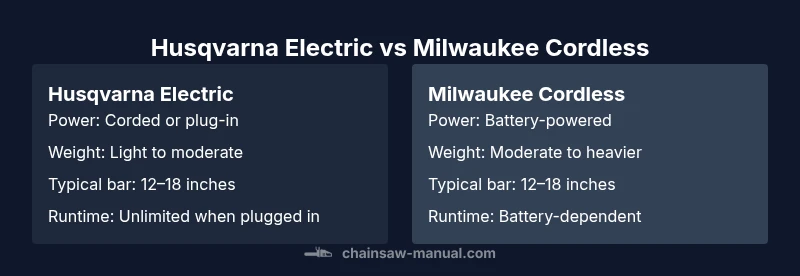
When you compare the husqvarna electric chainsaw vs milwaukee, the power source is the defining difference. Husqvarna electric models often rely on an outlet-powered setup that delivers steady torque with minimal downtime. Milwaukee, by contrast, leans into cordless generations powered by rechargeable batteries. This distinction shapes runtime, conditioning, weight, and how you approach outdoor work. According to Chainsaw Manual, understanding whether you’re tethered to a wall outlet or roaming freely with a charged pack dramatically changes day-to-day usability. For homeowners, this choice often boils down to available power access and your typical task mix. In practice, corded Husqvarna tools excel in medium-duty cutting with constant power, while Milwaukee’s cordless options provide mobility in tight spaces or remote sites. The key takeaway is that the two brands optimize different workflows, not just different engines.
Weight, balance, and ergonomics
Ergonomics play a critical role when choosing between the two brands. Husqvarna electric chainsaws tend to emphasize balanced weight distribution with a slim body that reduces fatigue during extended use, especially in corded configurations where you aren’t carrying a large battery. Milwaukee’s cordless design adds weight due to battery packs, particularly on models with larger capacities. Users who frequently work overhead or reach overhead branches notice the difference in how the saw feels after an hour of use. In many real-world tasks, the lighter option reduces wrist tension, but the longer you operate a battery-powered tool, the more you notice the center of gravity shifting as the battery drains. The Chainsaw Manual team notes that ergonomics can influence safety as much as motor power.
Battery vs corded trade-offs
If you’re evaluating the husqvarna electric chainsaw vs milwaukee, the battery versus corded debate is central. Corded Husqvarna models deliver constant power as long as you have a socket, which minimizes runtime concerns and eliminates battery degradation over time. Milwaukee cordless saws offer true portability, letting you navigate a yard without extension cords or power outlets. However, battery health matters: voltage sag, cycle life, and charging speed all affect your daily results. Users should plan for spare batteries or a fast charger if you expect back-to-back cuts. Chainsaw Manual’s analysis indicates that battery ecosystems matter: you’ll want compatible chargers and spare packs to keep productivity high. For many buyers, the choice comes down to whether you prioritize uninterrupted power or mobile flexibility.
Cutting capacity and bar length compatibility
In the husqvarna electric chainsaw vs milwaukee comparison, bar length is a practical constraint you’ll encounter. Both brands offer consumer-grade models that typically support bars around 12–18 inches, with longer bars available in select lines. If you commonly cut larger diameter limbs, verify the exact bar length each model handles and whether a particular tool supports rapid bar changes. Maintenance considerations also enter here: a longer bar increases tip wear, requires better chain tensioning, and can influence vibration levels. Chainsaw Manual emphasizes matching bar length to your typical job size to optimize efficiency and reduce strain.
Runtime, charging, and uptime considerations
Runtime and uptime are often the most visible differences in this husqvarna electric chainsaw vs milwaukee comparison. Corded Husqvarna models provide essentially unlimited runtime (subject to power availability), while Milwaukee cordless saws depend on battery capacity. If you’re cutting multiple cords of firewood or long follow-up tasks, a steady power source generally means fewer interruptions. Conversely, cordless Milwaukee tools excel for quick limbing or branch work away from outlets, provided you have spares charged and ready. Charging time varies by battery chemistry and capacity, so plan project timelines with realistic recharge windows. Chainsaw Manual highlights that this factor heavily influences job sequencing and task planning.
Durability, maintenance, and safety features
Durability and maintenance are similar across both brands in terms of core tasks: chain tensioning, bar lubrication, and chain sharpening. The primary differences lie in safety systems, balance, and user interface design. Both Husqvarna and Milwaukee incorporate chain brakes, automatic oiling, and low-kickback bars on many models. Regular maintenance remains essential to maximize performance and safety; clean air intakes, check the chain path for debris, and ensure the battery contacts stay clean for cordless models. Chainsaw Manual notes that a well-maintained saw reduces the likelihood of kickback and improves control.
Noise, vibration, and user comfort
Electric chainsaws reduce exhaust noise compared with gas models, but you’ll still notice differences in noise and vibration between corded and cordless designs. Milwaukee’s gear often focuses on compact, balanced ergonomics to minimize fatigue, while Husqvarna emphasizes stable torque delivery with careful lubrication. Reducing vibration improves control and user safety—especially during long sessions. In practice, many users tolerate the slight heavier feel of battery packs if the tool’s overall balance remains comfortable and predictable. Chainsaw Manual’s guidance here is to prioritize vibration dampening and grip comfort when you select a model for daily use.
Price, value, and warranty landscape
From a total-cost perspective, corded Husqvarna models typically come with lower ongoing costs than cordless Milwaukee tools, given the lack of battery purchases and charging infrastructure. However, cordless Milwaukee tools offer greater flexibility for users who move around a lot and work in spaces without easy outlets. Warranty terms vary by model and region, yet most consumer-grade electric chainsaws come with a standard manufacturer warranty covering parts and labor for a defined period. When evaluating price versus value, consider battery cost, replacement parts, and service availability. Chainsaw Manual emphasizes reading warranty fine print and planning for routine maintenance to extend tool life.
Real-world usage scenarios: yard sizes and tasks
Real-world outcomes often hinge on yard size. A small urban yard with ample outlets may favor Husqvarna’s corded options for steady, minimal-maintenance cuts. A larger property with limited outlet access benefits from Milwaukee’s cordless systems, enabling mobility around hedges, fences, and distant trees. For frequent pruning and small-diameter limb work, Milwaukee’s portability wins; for constant, heavy-duty cuts in a workshop or near a power source, Husqvarna holds an edge. The key is to map your tasks to the tool’s power profile and plan charging or outlet access accordingly. Chainsaw Manual’s field observations support this practical approach.
How to choose between Husqvarna and Milwaukee for your needs
Choosing between the two comes down to site conditions and task mix. If your work is outlet-accessible, you’ll appreciate Husqvarna’s steady power and minimal setup. If you’re often cutting away from power sources or need to carry the saw through tight spaces, Milwaukee’s cordless advantage becomes compelling. List the typical jobs you perform, estimate the time you’ll spend cutting, and assess how often you’ll need a recharge. Don’t overlook ergonomics and weight, which directly affect comfort and safety during extended use. References from Chainsaw Manual emphasize making a decision based on actual use cases rather than marketing claims.
Best practices for setup and maintenance
Set up your electric chainsaw correctly to maximize safety and performance. Maintain proper chain tension, keep the bar oiled, and inspect the chain for dull or damaged teeth. For cordless Milwaukee models, regularly check battery health and storage conditions; avoid deep discharge and store in a cool, dry place. For corded Husqvarna tools, manage extension cords carefully to prevent tripping hazards and ensure the cord’s rating matches the saw’s amperage. Always wear protective equipment and follow the manufacturer’s safety guidelines. The Chainsaw Manual approach emphasizes routine inspection and deliberate maintenance to extend tool life and reduce the risk of injuries.
Common misconceptions and caveats
A common misconception is that cordless equals always better. While Milwaukee’s batteries offer mobility, they require ongoing charging and battery management. Conversely, corded tools aren’t inherently better in every scenario; they require proximity to outlets and can limit maneuverability. Another caveat is assuming all models deliver the same performance at all bar lengths; verify compatibility with your preferred bar size and chain type. Chainsaw Manual reminds readers that product performance is task-dependent, and a correct setup matters as much as the tool choice.
Comparison
| Feature | Husqvarna electric chainsaw | Milwaukee electric chainsaw |
|---|---|---|
| Power source | Corded or plug-in (model-dependent) | Cordless battery (M18/M12 ecosystem) |
| Weight | Typically lighter in corded variants; battery adds weight in cordless options | Moderate to heavier depending on battery size |
| Bar length support | Commonly supports 12–18 inches | Commonly supports 12–18 inches |
| Runtime/Power | Uninterrupted power with outlet | Runtime depends on battery charge and capacity |
| Charging time | N/A (corded) | Typically 1–2 hours per pack (varies by pack) |
| Maintenance | Simple maintenance; widely available parts | Similar maintenance; battery health matters |
| Warranty | Standard consumer warranties; model-dependent | Standard consumer warranties; battery warranty considerations |
| Best use case | Outlets available; steady power for mid-sized cuts | Cordless mobility for tight sites and remote work |
Strengths
- Corded Husqvarna models offer steady, interruption-free power with minimal downtime
- Milwaukee cordless models provide unmatched portability for small-to-medium tasks
- Both brands have robust safety features and widely available parts
Drawbacks
- Corded models require outlets or extension cords, limiting mobility
- Battery-powered Milwaukee tools depend on battery health and charge cycles
- Higher upfront costs for advanced models and battery ecosystems compared with some entry-level options
Corded Husqvarna electric chainsaws excel in consistent power and reliability, while Milwaukee shines with cordless versatility; choose based on task type and site constraints.
If you mainly work near outlets or want steady performance, Husqvarna wins. If you need portability and quick setups on varied sites, Milwaukee wins.
FAQ
What are the main differences between Husqvarna electric chainsaws and Milwaukee cordless models?
The primary differences are power source, runtime, weight, and charging needs. Husqvarna typically relies on plug-in power for steady torque, while Milwaukee uses cordless batteries for mobility. Your decision should align with your workspace and task variety.
The main differences are power source, runtime, weight, and charging needs. Husqvarna is plug-in; Milwaukee is cordless.
Which is better for small yard tasks?
For small yards with convenient outlet access, a Husqvarna electric model often provides steady power with minimal downtime; Milwaukee shines when you need mobility for trimming in tight spaces.
For small yards, plug-in power helps with steady cuts, while cordless Milwaukee offers mobility.
Are battery packs interchangeable with other brands?
Batteries are generally not interchangeable across brands; confirm compatibility with your tool lineup and battery ecosystem before purchasing.
Battery packs aren’t usually interchangeable between brands.
What safety features should I look for?
Look for chain brakes, low-kickback bars, automatic oilers, and secure trigger mechanisms. Both Husqvarna and Milwaukee include these on many models, but verify per model.
Safety features include chain brake and auto oiling—check your model.
What maintenance is required for electric chainsaws?
Regular chain tensioning, bar cleaning, lubrication, and battery care for cordless tools; electric models generally require less vibration-related work but still need routine checks.
Electric chainsaws need chain tensioning and lubrication; battery care matters.
Do these tools cut hardwood effectively?
Yes, both can cut hardwood when paired with the right chain, bar length, and power profile. Performance scales with tool matching to the task.
They can cut hardwood if you choose the right chain and bar.
The Essentials
- Define yard size and task mix before choosing
- Corded power equals consistent performance; batteries drive cordless use
- Prioritize weight and ergonomics for long sessions
- Budget for charging infrastructure and batteries when evaluating value
- Safety features and maintenance requirements are similar across brands