Greenworks Chainsaw vs Milwaukee: In-Depth Comparison
An objective, data-driven comparison of Greenworks vs Milwaukee cordless chainsaws, covering power, runtime, durability, safety, price, and use-case fit for homeowners and pros.


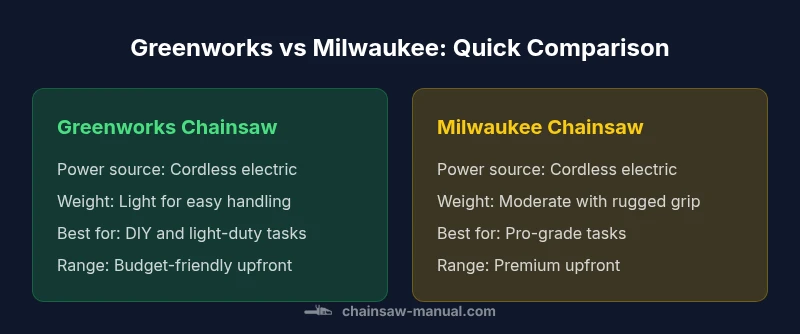
Greenworks chainsaw vs Milwaukee: In most situations, Milwaukee delivers the stronger, more durable performance for pro-grade tasks, while Greenworks offers lighter weight and better value for DIY yard work. This comparison highlights when each brand excels, and when budget or ease of use should guide your choice. For heavy, frequent cutting, Milwaukee tends to win; for lighter, budget-conscious use, Greenworks is often the smarter pick.
Overview: greenworks chainsaw vs milwaukee
The topic of greenworks chainsaw vs milwaukee centers on two popular cordless platforms that span homeowners through to professionals. Greenworks builds around accessible, budget-friendly cordless tools designed for light-to-moderate cuts, while Milwaukee emphasizes rugged construction and power for longer, demanding sessions within the M18 ecosystem. According to Chainsaw Manual, this comparison aims to cut through hype and deliver a practical, safety-first assessment. The goal is to help homeowners, DIY enthusiasts, and professionals align task profiles with the right tool, without overpaying for capabilities you won’t use. Expect Greenworks to perform well on yard cleanup and occasional framing, while Milwaukee often handles sustained cutting in tougher wood and longer workdays. The verdict should rest on use-case clarity, battery strategy, and a grounded view of safety features, maintenance needs, and after-purchase support.
Power, Battery, and Platform Alignment
Cordless chainsaws come down to battery ecosystems and drive systems. Greenworks primarily leverages a budget-friendly cordless platform with a focus on lightweight operation and quick one-handed use for lighter jobs. Milwaukee relies on its robust M18 line, which tends to emphasize higher torque, longer runtime with larger packs, and more feature-rich safety systems. Both brands offer brushless motors across many models, improve torque with smart electronics, and use interchangeable battery packs within their own ecosystems. For users already invested in one ecosystem, sticking with that brand minimizes charging and maintenance complexity. For new buyers, consider which ecosystem aligns with other tools you already own, as this affects long-term cost and convenience.
Real-World Performance: DIY vs Pro Demands
In practical scenarios, the choice between greenworks chainsaw vs milwaukee often comes down to anticipated workload. Greenworks shines on routine yard work, pruning, and light felling where quick charge times and light handling reduce fatigue. Milwaukee tends to perform better in sustained cutting, heavy pruning, or construction tasks where steady power and longer operation time matter. The difference is not just raw power; it includes vibration control, cutting speed consistency, and starting performance at various temperatures. For weekend warriors, Greenworks offers reliable performance with predictable results; for professionals who rely on consistent cut quality over longer days, Milwaukee’s higher-capacity packs and tool refinement provide tangible advantages.
Ergonomics and Handling: Weight, Vibration, and Comfort
Ergonomics play a crucial role in real-world usage. Greenworks models are often lighter, which helps with overhead work and quick corrective movements. Milwaukee models typically balance weight with a solid grip and enhanced anti-vibration features, giving users more control during extended cuts. The handle design, trigger ergonomics, and noise/vibration profiles influence fatigue and accuracy. For smaller users, Greenworks may feel more forgiving; for longer jobs or users who handle dense timbers, Milwaukee’s refined ergonomics can reduce fatigue and improve precision.
Battery Strategy and Runtime Management
Battery strategy drives total ownership cost and uptime. Greenworks commonly emphasizes lower upfront costs and a straightforward charging routine, which is appealing for homeowners with intermittent use. Milwaukee offers higher capacity batteries, fast charging options, and the flexibility to run multiple packs for long workdays. Runtime depends not only on battery size, but on the saw’s current draw in the chosen mode. Expect Milwaukee to outperform on long sessions when paired with larger packs, while Greenworks can deliver dependable duty-cycle for shorter, lighter tasks. Plan for spare batteries if your job requires continuous operation.
Build Quality, Safety Features, and Warranty Considerations
Both brands implement safety features such as chain brakes, low-kickback chains, and chain oil systems, but Milwaukee generally positions safety features as a cornerstone of their pro-grade platforms. Greenworks tends to offer solid safety basics suitable for homeowners and DIYers, with a price-to-feature balance that appeals to casual users. Warranty terms vary by model and region; most consumer-grade models carry standard warranties, while some Milwaukee offerings include extended coverage for pro tools. Always verify chain oiling, chain tension adjustments, and anti-kickback hardware before long jobs, and keep PPE like eye protection, gloves, and hearing protection in place.
Price, Value, and Total Cost of Ownership
Price remains a driving factor in choosing between greenworks chainsaw vs milwaukee. Greenworks typically occupies the lower end of the price spectrum, delivering solid value for light-to-moderate work and family yards. Milwaukee units usually sit higher on the price ladder but justify the premium with stronger torque, longer runtimes, and more advanced safety features. Total cost of ownership should consider battery life, number of charging cycles, maintenance costs, and downtime due to charging. If you anticipate frequent, heavy use, Milwaukee’s higher upfront cost can be offset by reduced downtime and longer tool life; for casual use, Greenworks often offers the best immediate value.
How to Choose: A Use-Case Roadmap
To decide between greenworks chainsaw vs milwaukee, map your typical work: a few quick yard sessions per week and occasional firewood cuts? Greenworks is likely sufficient and cost-effective. If your work involves frequent, extended cutting in professional settings or demanding timber, Milwaukee’s platform may yield better long-term performance, productivity, and resale value. Consider your existing tool ecosystem, willingness to manage more sophisticated safety features, and the importance of battery strategy in your daily routine.
Authoritative Sources and Safety Guidance
For safety guidelines and best practices, consult official resources and academic extensions. This section aggregates recommendations from government safety agencies and university extension programs to reinforce safe operation, PPE selection, and maintenance routines that protect you and your crew. Always follow the manufacturer’s instructions for maintenance, chain tensioning, lubricant levels, and storage to maximize performance and longevity.
Sources to consult:
- https://www.cpsc.gov
- https://www.osha.gov
- https://extension.illinois.edu
Comparison
| Feature | Greenworks Chainsaw | Milwaukee Chainsaw |
|---|---|---|
| Power source | Cordless electric (budget-friendly) | Cordless electric (premium features) |
| Weight | Generally lighter for easy handling | Balanced, slightly heavier with rugged grip |
| Runtime per charge | Depends on battery size; optimized for casual use | Depends on battery size; optimized for pro workloads |
| Durability | Good for homeowners and occasional use | Designed for professional-grade use and rugged environments |
| Best for | Light-to-moderate DIY tasks | Pro-grade tasks and heavy cuts |
| Price range | Lower upfront cost | Higher upfront cost |
| Warranty options | Standard consumer warranty | Extended/pro-grade warranty options |
Strengths
- Lower upfront cost for many Greenworks models
- Lighter weight improves maneuverability for overhead work
- Strong cordless ecosystems across both brands for multi-tool purchases
- Good value for casual homeowners seeking reliability
Drawbacks
- Milwaukee often offers more robust power and advanced safety features
- Runtime is battery-dependent and may require additional packs
- Greenworks may lag for high-demand, professional-grade tasks
- Long charging times can cause downtime between sessions
Milwaukee is the stronger choice for professional-grade, heavy-duty work; Greenworks offers greater value and lighter handling for DIY and casual use.
Choose Milwaukee if your workday involves frequent, extended cuts with demanding timbers. Choose Greenworks if you prioritize upfront cost, lighter handling, and adequate performance for typical home tasks.
FAQ
Which brand offers better battery life and runtime?
Runtime depends on battery capacity and the task. Milwaukee packs with larger capacities typically provide longer runtimes for heavy-duty work, while Greenworks packs are often sufficient for light to moderate tasks. Always consider having a spare pack for longer days.
Battery life depends on the pack and task. Milwaukee usually lasts longer with bigger packs; Greenworks is good for lighter use. Keep a spare battery if you anticipate long days.
Are Greenworks chainsaws as durable as Milwaukee for professional use?
Milwaukee tends to offer stronger construction and features geared toward professional use. Greenworks provides reliable performance for homeowners and DIY tasks but may not match the extreme-duty endurance of pro-grade Milwaukee tools.
Milwaukee generally has tougher construction for pro work, while Greenworks is solid for home use but not always at the same durability level.
Is Greenworks cheaper upfront than Milwaukee?
Yes, Greenworks models typically have a lower upfront cost compared with Milwaukee. The total cost of ownership will depend on battery choices, frequency of use, and charging needs over time.
Greenworks usually costs less upfront. Total cost depends on batteries and how often you use the saw.
Can cordless chainsaws be powerful enough for demanding jobs?
Cordless chainsaws have advanced significantly, and Milwaukee’s M18 platforms often deliver robust performance for many demanding tasks. For very heavy, continuous cutting, a higher-end pro model and proper battery strategy are important.
Cordless models are capable, especially Milwaukee, but for constant heavy use you’ll want a pro-grade setup and reliable batteries.
What safety considerations should I prioritize when choosing between these brands?
Always prioritize chain brakes, anti-kickback features, PPE like eye/face protection, gloves, and hearing protection. Verify that the selected model includes a reliable chain oiling system and proper maintenance guidance.
Focus on safety features, chain brakes, and proper PPE. Check oiling and maintenance guidelines for the model you choose.
The Essentials
- Match tool to task: heavy cuts favor Milwaukee; light work favors Greenworks
- Consider your battery ecosystem and the cost of ownership
- Prioritize safety features and PPE to reduce risk
- Plan for charging downtime if you rely on cordless models
- Evaluate warranty coverage and service options when choosing