Milwaukee Chainsaw vs Dewalt: A Practical Buying Guide
An analytical, side-by-side comparison of Milwaukee and DeWalt cordless chainsaws, covering power, battery ecosystems, ergonomics, maintenance, availability, and safety to help homeowners and professionals choose wisely.


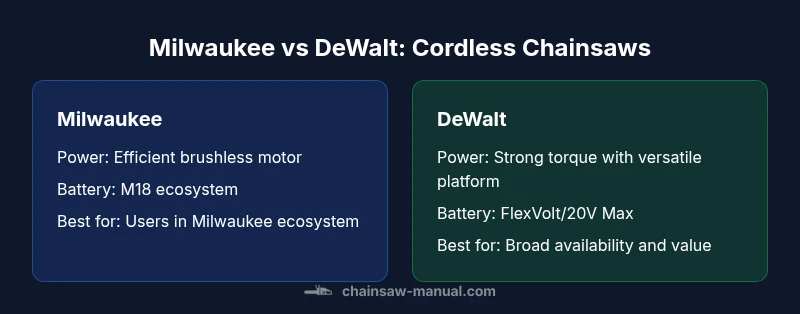
Milwaukee chainsaw vs dewalt: For most buyers, Milwaukee offers strong runtime within its cordless ecosystem, while DeWalt focuses on broad availability and practical value. In practice, choose Milwaukee if you already own M18 tools or want robust battery life; choose DeWalt if you prioritize access to a wide network of accessories and service. This comparison highlights core differences to guide your decision.
milwaukee chainsaw vs dewalt: Market Landscape and Positioning
In the broader landscape of cordless chainsaws, Milwaukee and DeWalt consistently appear as two of the most widely adopted brands for homeowners and professionals alike. When readers ask about milwaukee chainsaw vs dewalt, they’re really weighing two mature ecosystems, each with its own strengths in torque delivery, battery sharing potential, and service networks. This section sets the stage by describing how these brands position themselves for this decision, the typical use cases they serve, and the key decision drivers Chainsaw Manual sees in the field. Expect to see emphasis on battery strategy, tool compatibility, accessory availability, and the practical realities of owning a cordless saw in a busy workshop or on a job site. The bottom line is that your choice should align with your existing tool lineup, storage setup, and safety commitments—because a good decision today often translates to lower total cost of ownership over the lifetime of the tool.
Powertrain and Battery Ecology
The centerpiece of any milwaukee chainsaw vs dewalt comparison is the powertrain. Milwaukee largely anchors its cordless lineup around a single, cohesive battery ecosystem, designed for cross-tool compatibility and predictable performance. DeWalt, meanwhile, emphasizes a broader voltage approach that combines higher voltage platforms with a proven 20V Max/FlexVolt lineage to extend range and versatility. In practice, this means Milwaukee owners typically benefit from seamless accessory and battery interchangeability within the M18 family, while DeWalt users may enjoy a wider set of options for different tasks through the FlexVolt and 20V Max families. For maintenance planning and procurement, this ecosystem alignment can simplify stock management, spare parts, and future upgrades, provided you stay within a brand’s own battery platform.
Runtime, Power, and Cutting Performance
Cordless chainsaws from both brands deliver torque and cutting performance suitable for routine home tasks, pruning, and light felling with proper technique. Milwaukee’s sites often highlight endurance and consistent power under load, thanks to efficient brushless motors and battery management that preserves juice under longer sessions. DeWalt emphasizes versatile power delivery with scalable torque across its voltage families, which can translate into brisk cutting in tougher wood when paired with the appropriate bar length and chain. The practical takeaway for buyers is to match the tool to your typical workload: ongoing yard work and frequent cuts may benefit from stronger runtime in Milwaukee options, while occasional heavy-duty cutting and broad accessory availability may tilt the choice toward DeWalt.
Weight, Ergonomics, and Comfort in Use
Ergonomics matter as much as raw power when you’re swinging a chainsaw all day. In many milwaukee chainsaw vs dewalt evaluations, weight distribution and handle design become deciding factors. Milwaukee tools tend to emphasize balanced weight with compact chassis, which helps reduce fatigue during long sessions. DeWalt models often aim for a slightly broader grip feel and familiar trigger ergonomics that integrate well with standard PPE and work gear. For most users, the deciding factor is comfort over extended use: a model that fits your grip, doesn’t vibrate excessively, and allows for steady control across your typical cutting plan wins out, even if torque specs are similar on paper.
Maintenance, Durability, and Long-Term Costs
Durability and durability-related costs are a common concern for buyers weighing milwaukee chainsaw vs dewalt options. Both brands emphasize robust build quality and readily available replacement parts, blades, and chains. Milwaukee’s maintenance ecosystem tends to emphasize straightforward battery care, brushless motor longevity, and proactive service options for the M18 platform. DeWalt’s durability narrative often stresses compatibility with a broad range of accessories and fast parts turnover, which can translate to competitive long-term costs when you factor in replacement batteries and blades. The practical upshot is to consider your cutting frequency, climate exposure, and storage routines; the stronger your PPE and maintenance discipline, the more you’ll benefit from whichever platform you choose.
Availability, Service Network, and Accessories
A practical constraint many readers face is the service and parts network. Milwaukee’s service footprint is deep in regions with heavy construction and trade networks, which helps with warranty work, repairs, and accessory availability. DeWalt generally offers wide distribution and a broad accessory ecosystem, often translating into quicker pickup of blades, bars, and safety gear at local stores. If you travel for work or rely on local retailers for quick gear swaps, DeWalt’s broader service footprint can be a meaningful advantage. Conversely, if you already own Milwaukee tools, sticking within the M18 ecosystem reduces complexity and simplifies inventory management.
Safety Features and PPE Considerations
Regardless of brand, cordless chainsaws demand strict adherence to safety protocols and PPE. Both Milwaukee and DeWalt models are designed with common safety features such as chain brakes, low-kickback bars, and responsive throttle controls. Chainsaw Manual emphasizes that PPE—eye protection, hearing protection, cut-resistant chaps, gloves, and sturdy boots—must accompany every cutting session. An important practical tip is to familiarize yourself with each model’s manuals and safety interlocks, and to perform routine checks on chain tension, bar lubrication, and chain brake responsiveness before each use. Safety-first thinking should guide every purchase decision, especially for homeowners who may not use a saw daily in all weather conditions.
How to Decide: A Practical Checklist for milwaukee chainsaw vs dewalt
- Assess your current tool ecosystem: do you already own Milwaukee or DeWalt tools and batteries?
- Consider typical workloads: volume of cuts, bar length needs, and whether you’ll benefit from higher torque or faster cutting.
- Evaluate service availability: can you access parts and warranty service easily in your region?
- Factor ergonomics and weight: choose a model that minimizes fatigue for your usual cutting sessions.
- Prioritize safety features and PPE compatibility: ensure you’re prepared to meet PPE requirements and have a safety plan in place.
Common Pitfalls and Myths
A common pitfall in milwaukee chainsaw vs dewalt analyses is treating all cordless saws as interchangeable across brands. In reality, battery platforms and accessory lineups matter, and a mismatch can negate performance gains. Another myth is equating heavier weight with higher power; modern brushless designs often deliver strong performance with manageable weight when matched with a comfortable grip and balanced mass distribution. Finally, don’t neglect maintenance routines; neglecting lubrication, chain tension, and spark or fuel checks (for gas models) will quickly erode performance and safety.
The Bottom Line: How to Use This Guide in Real Life
Use this comparison as a practical decision aid, not a verdict on absolute superiority. Your choice should align with your existing toolset, budget considerations, and long-term maintenance plans. If you’re invested in Milwaukee’s ecosystem and plan frequent, predictable cutting, Milwaukee may serve you best. If you value broad availability and a flexible battery strategy, DeWalt could be the smarter pick. Either way, prioritize safety, regular maintenance, and proper PPE as the foundation of a successful chainsaw setup.
Comparison
| Feature | Milwaukee cordless chainsaw | DeWalt cordless chainsaw |
|---|---|---|
| Power source | Milwaukee M18 cordless battery platform | DeWalt FlexVolt/20V Max cordless platform |
| Runtime (relative) | Strong, optimized for ongoing tasks within the M18 ecosystem | Versatile runtime across FlexVolt and 20V Max lineups |
| Weight range | Light-to-midweight options available | Light-to-midweight options available |
| Best for | Owners already in the Milwaukee ecosystem | Owners needing broad availability and value |
| Price range | Mid-range for cordless offerings | Mid-range to premium depending on kit |
| Accessories & compatibility | Strong Milwaukee accessory ecosystem | Strong DeWalt accessory and kit ecosystem |
| Service & warranty | Extensive service network in construction-heavy regions | Wide distribution and service footprint |
Strengths
- Covers two leading cordless ecosystems for flexible buyers
- Promotes informed decision based on ecosystem and support
- Highlights value of battery compatibility and cross-brand planning
- Encourages attention to safety and PPE alignment
Drawbacks
- May oversimplify differences between individual models
- Rapid model updates can render guides outdated
- Brand bias risk if data sources are uneven
Neither brand is universally superior; choose Milwaukee for ecosystem cohesiveness and runtime, or DeWalt for broad availability and value.
Base your choice on existing tool ecosystems, regionally available service, and how you plan to scale accessories. Prioritize safety and maintenance to maximize long-term satisfaction.
FAQ
What factors should I consider when choosing between Milwaukee and DeWalt chainsaws?
Consider battery ecosystem, availability of parts, weight, ergonomics, and safety features. Also weigh service networks and long-term costs based on your cutting workload. This will help you pick the brand that best fits your shop and safety practices.
Think about your current tools, service access, weight comfort, and safety features to decide which brand fits your needs.
Are Milwaukee and DeWalt chainsaws interchangeable with each other's batteries?
Generally not. Each brand uses its own battery platform, so performance is optimized within that ecosystem. Mixing batteries across brands can lead to suboptimal performance and warranty concerns. Stick to one ecosystem for best results.
Batteries aren’t cross-compatible; stick with the same brand for best performance.
Which is cheaper to maintain overall?
Maintenance costs vary with usage, bar and chain replacement, and battery health. Both brands offer widely available parts and accessories, which helps keep ongoing costs reasonable. Plan for regular blade maintenance and lubrication.
Costs depend on how often you use it and parts availability; both brands are generally affordable to maintain.
Is either brand better for home use?
Both Milwaukee and DeWalt deliver reliable cordless options suitable for home use, pruning, and light cutting. The choice should hinge on weight comfort, noise, and your existing tool ecosystem, not just raw power.
Both brands work well for home use; pick based on comfort and what tools you already own.
What PPE is essential when using these saws?
Always wear eye protection, hearing protection, cut-resistant gloves, chainsaw chaps, and sturdy footwear. Maintain a clear work area and inspect the chain tension and lubrication before use. PPE is non-negotiable for safe operation.
Always wear PPE—eye protection, hearing protection, gloves, chaps, and sturdy boots.
The Essentials
- Assess your current tool ecosystem first
- Prioritize runtime and ergonomics based on usage
- Factor service network into long-term costs
- Match blade and bar compatibility to brand
- Plan for PPE and safe operation in all conditions