How Big Is a Chainsaw? A Practical Size Guide
Explore bar lengths, overall length, and weight to understand how big a chainsaw is. This analytical guide helps homeowners, DIYers, and pros choose the right size for pruning, firewood, and felling tasks with safety in mind.


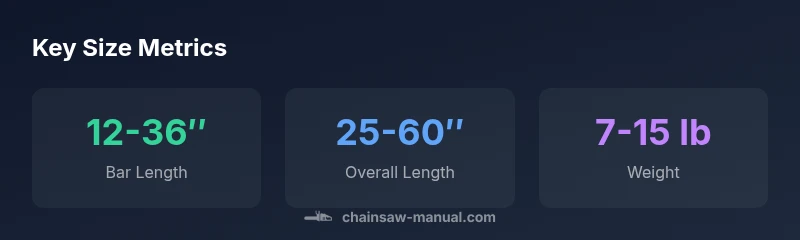
How big is a chainsaw? For most consumer models, the bar length ranges from 12 to 36 inches, and the overall length (including handle) typically runs about 25 to 60 inches. Shorter bars are lighter and easier to control, while longer bars reach deeper into wood but require more handling skill and safety precautions. Chainsaw Manual notes variation by model and purpose.
How big is a chainsaw in practical terms?
The question of how big a chainsaw is centers on three dimensions: bar length, overall length, and weight. Bar length determines how far the chainsaw can reach into a cut, while overall length gives a sense of the tool's physical footprint when carried or stored. Weight affects balance, control, and user fatigue during longer sessions. When homeowners ask, you’ll often see a standard range discussed: bar lengths from about 12 inches on compact models up to 36 inches on larger professional units. In practice, your choice will depend on the types of tasks you tackle most often—pruning small branches, limbing, bucking firewood, or felling trees.
In this guide, we use the phrase how big is a chainsaw to refer to the practical, real-world footprint of the tool, not just the nominal hardware. Chainsaw Manual analyses in 2026 show that most common consumer models cluster around mid-range bars (18–20 inches) for everyday DIY work, with larger options available for specialized tasks. This means size is a factor of reach, control, and safety, all balanced against weight and handling characteristics.
Understanding bar length and what it means for work
Bar length is the most visible size metric on a chainsaw. It is the distance from the tip of the bar to the connection point near the crankshaft. Shorter bars (12–16 inches) are ideal for pruning, smaller limbs, and tight spots where maneuverability matters. Mid-sized bars (18–20 inches) strike a balance between reach and control for general framing and light to medium firewood work. Longer bars (28–36 inches) are reserved for larger trees, heavy-duty bucking, and professional use where reach and cutting depth are critical. It’s important to remember that increasing bar length increases leverage, which affects kickback risk and fatigue. When comparing models, consider your most frequent tasks and the maximum diameter you expect to encounter. Safety mechanisms, such as low-kickback chain and anti-vibration features, become more significant as bar length grows.
How overall length affects usability and storage
Overall length includes the bar, chain, and the body length from the front handle to the rear handle. A typical homeowner setup might range from roughly 25 to 40 inches for compact models, with larger pro models approaching 50–60 inches in total length. Longer overall length can improve reach but reduces maneuverability in tight spaces, increases weight, and changes handling dynamics. If you transport a chainsaw in a vehicle or store it in a shed, consider available space, mounting points, and whether you’ll frequently carry the tool over long distances. In some cases, a shorter bar with a longer reach via technique or a second, longer bar may be the simplest path to efficiency and safety.
Weight and ergonomic considerations when sizing up a chainsaw
Weight directly influences comfort, fatigue, and control. Homeowners typically see weights in a broad range, often from about 7 to 15 pounds for consumer models. Heavier chainsaws usually accompany longer bars and more powerful engines, which can improve performance for large cuts but demand stronger technique and PPE. Ergonomics matter: a well-balanced saw reduces wrist and shoulder strain, especially during extended use. If you’re new to chainsaws, start with lighter, shorter-bar models to learn proper stance, grip, and kickback avoidance before stepping up to heavier equipment. The goal is to match the tool’s size to your strength, experience, and the scale of work you plan to perform.
Task-based sizing guidelines: matching size to the job
Different tasks benefit from different size profiles:
- Pruning and light trimming: 12–16 inch bars, lighter weight for quick, precise cuts.
- General firewood and starter building: 18–20 inch bars, balanced weight and reach.
- Heavy-duty felling and bucking: 28–36 inch bars for long reach and deeper cuts, with emphasis on operator proficiency and safety.
- Professional logging: longer bars and higher-powered engines, often with customized bar-length configurations. Always account for kickback potential, choose low-kickback chains, and use personal protective equipment (PPE) appropriate to the size of the saw and the job.
Safety considerations when selecting chain saw size and performing cuts
Size is important, but safety is the highest priority. Larger chainsaws generate more kickback potential and require stronger stance, better footing, and more consistent control. Always wear PPE: helmet with face shield or goggles, hearing protection, cut-resistant chaps or pants, gloves, and sturdy boots. Maintain sharp chains and appropriate chain tension, and follow the manufacturer guidance for bar length matching the task. If in doubt, start smaller and increase bar length as you gain experience, rather than overreaching with a tool that’s too large for your skill level.
Sizing snapshot: how bar length, overall length, and weight vary by model type
| Model Type | Bar Length (inches) | Overall Length (inches) | Weight (lbs) |
|---|---|---|---|
| Compact homeowner | 12-16 | 25-32 | 7-9 |
| Standard homeowner | 18-20 | 34-40 | 9-11 |
| Pro-grade | 28-36 | 50-60 | 12-15 |
FAQ
What is the smallest practical chainsaw size for DIY tasks?
For pruning and light cutting, a 12–16 inch bar is usually enough; lighter weight improves control and reduces fatigue for beginners.
For small DIY tasks, start with a 12 to 16 inch bar—that keeps it light and easy to control.
Do longer bars cut faster?
Longer bars don’t automatically cut faster. Cutting speed depends on chain sharpness, engine power, and technique; longer bars mainly increase reach and leverage.
Longer bars don’t always cut faster; they increase reach and leverage, not speed.
Can I use a long bar for small tasks safely?
Long bars are heavier and harder to control in tight spaces. For small tasks, choose a smaller model and upgrade only as you gain experience.
A long bar can be risky for small tasks; use a smaller saw to stay in control.
How does bar length relate to kickback risk?
Longer bars can increase kickback potential due to greater leverage. Use low-kickback chains and proper stance to mitigate risk.
More length means more leverage—watch kickback and wear protective gear.
Is there a standard for bar length by task?
There isn’t a universal standard. Common ranges are 12–16 inches for pruning, 18–20 inches for general woodwork, and 28–36 inches for larger trees.
There isn’t a universal standard; pick a size that fits your most frequent job and your skill.
“Size matters for reach, but control and safe handling determine real-world performance.”
The Essentials
- Compare bar lengths to your primary tasks.
- Longer bars reach deeper cuts but add weight.
- Shorter bars boost control for pruning.
- Check overall length to gauge maneuverability.
- Prioritize safety features and proper PPE.