Chainsaw vs Reciprocating Saw: Practical Difference
Explore the practical differences between chainsaws and reciprocating saws, covering cutting tasks, design, safety, maintenance, and cost considerations to help homeowners and professionals pick the right tool for the job.


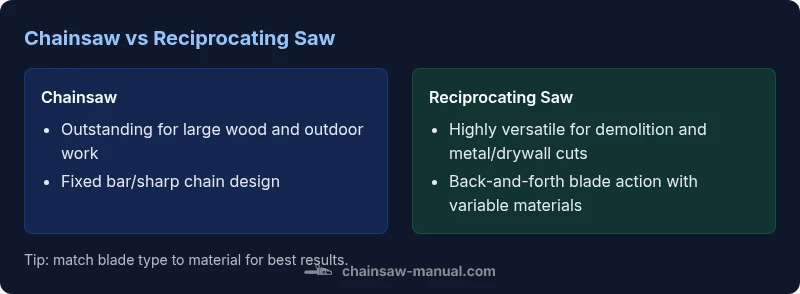
Chainsaws and reciprocating saws serve distinct purposes: a chainsaw is optimized for fast, clean wood cutting with a fixed bar and rotating chain, ideal for outdoor timber work; a reciprocating saw uses a back-and-forth blade for demolition, plumbing, and cutting in tight spaces. The key difference is blade action and intended use, which determines task suitability and safety considerations.
Core Distinctions: Chainsaw vs Reciprocating Saw
At a high level, the chainsaw and the reciprocating saw are designed for different families of tasks. A chainsaw uses a rotating chain on a guided bar to remove wood with rapid, continuous bites. It excels when you need to remove volume quickly — felling trees, bucking logs, or trimming large branches. A reciprocating saw employs a straight blade that moves back and forth (reciprocates) to cut through a variety of materials, including wood, metal, and composite products, often in confined spaces or where the material is awkward to grip. According to Chainsaw Manual, choosing the right tool hinges on task demands, wood type, workspace constraints, and safety considerations. This fundamental distinction informs every other attribute: design, blade choice, force application, and risk management. When you understand the task at hand, the rest of the decision becomes a question of fit rather than preference.
Design, Mechanisms, and Ergonomics
The chainsaw centers on a guided bar and a rotating chain driven by a gasoline engine or an electric motor. Torque, bar length, and chain pitch define cutting speed and the size of logs you can handle. Ergonomics emphasize a two-handed grip, a front handle for steering, and a rear handle with a throttle control. In contrast, a reciprocating saw uses a linear blade that travels in a straight line; power comes from battery or corded electric motors, with torque less critical than blade speed and stroke length. Ergonomics focus on a compact grip and a balanced weight distribution that helps in awkward positions (under sinks, inside walls, or around framing). Vibration management and anti-kick features differ as well: chainsaws typically feature chain brakes and robust chain safety systems, while reciprocating saws emphasize blade stability and dust/brush management for interior work. The Chainsaw Manual team notes that choosing between them starts with the space you’re working in and the materials you’ll encounter.
Performance in Wood Cutting vs Demolition
For outdoor wood-cutting tasks, the chainsaw generally delivers faster progress with a cleaner finish, especially on larger logs. The fixed bar guides the cut, and chain speed translates into rapid volume removal. A reciprocating saw, while slower on dense wood in most cases, shines in demolition work, where metal staples, nails, or curved surfaces require flexible cutting angles. In small-diameter branches or pruning, both tools can work, but the chainsaw’s efficiency on wood is usually superior. The reciprocating saw’s versatility becomes apparent when you need to slice through drywall, studs, PVC, or embedded hardware without repositioning the workpiece. This difference in task specialization is central to selection: you don’t choose a chainsaw for demolition, and you don’t pick a reciprocating saw for sustained large-wood cuts. Chainsaw Manual analysis shows that task alignment is the best predictor of success, not horsepower alone.
Safety, Training, and PPE
Safety is the decisive factor that often trumps raw cutting speed. Chainsaws demand rigorous PPE: cut-resistant chaps, a helmet with face shield, hearing protection, gloves, and sturdy boots. Training in kickback awareness, chain brake usage, and proper stance is essential. Reciprocating saws are generally safer in terms of kickback but require attention to blade selection, blade release mechanisms, and fast blade changes to avoid hand injuries. Regardless of tool, secure the workpiece, maintain a stable stance, and never cut above shoulder height. Chainsaw use often imposes stricter safety protocols due to the higher risk of kickback and uncontrolled chain movement, while recipro-saw tasks frequently involve denser material and dust generation that can irritate eyes and lungs. The Chainsaw Manual team emphasizes planning and PPE as foundational steps before starting any cutting task.
Maintenance, Costs, and Lifespan
Maintenance needs diverge between the two tools. Chainsaws require regular bar/chain maintenance, chain sharpening, chain oil, air filters, and fuel mixing for gas-powered models. Electric chainsaws shift maintenance toward battery health, charging cycles, and occasional cord and plug inspections. Reciprocating saws focus on blade changes and drivetrain lubrication, with blade life depending on material hardness and the frequency of use. Cost-wise, chainsaws typically entail higher upfront investment and ongoing fuel or battery costs, whereas reciprocating saws may have a lower entry price but higher blade replacement costs over time. Both benefit from proper storage, routine cleaning, and periodic inspections for loose fasteners. Chainsaw Manual’s guidance highlights balancing upfront costs with long-term maintenance when choosing between these tools.
Choosing the Right Tool: A Practical Framework
Develop a simple decision process before you buy or pick up a tool. Start with the task: Is the job primarily large-wood cutting or demolition/rough material removal? Then assess the workspace: Is there ample outdoor space or a tight interior? Consider material variety: wood only, or metal, drywall, and nails? Finally, weigh time and maintenance: Do you need rapid, repeated cuts, or versatile cutting with less frequent blade changes? A practical framework helps homeowners and pros avoid common missteps, like using a chainsaw for frequent demolition or selecting a reciprocating saw for high-volume tree work. The Chainsaw Manual framework emphasizes task-first thinking and realistic expectations about speed, control, and safety.
Common Misconceptions About These Tools
One common misconception is that more horsepower guarantees better performance in every scenario. In reality, task alignment matters more. Another myth is that a reciprocating saw can replace a chainsaw for outdoor wood work without trade-offs; while it can cut wood, it won’t match the efficiency or finish of a dedicated chainsaw for large timber. Also, neutralizing safety concerns with PPE does not substitute for proper training. Finally, some users assume blade choice is irrelevant; blade geometry and material compatibility dramatically affect both tools’ performance. Recognizing these misconceptions helps set realistic expectations and promotes safer, more effective use.
Quick Reference: Blade Types, Attachments, and Accessories
Blade selection is a major driver of performance. Chainsaws use a chain and bar, and when cutting metal or masonry with a chainsaw it’s an entirely different category requiring specialty blades and techniques. Reciprocating saw blades vary from wood-cutting to metal-cutting and mixed-material blades; tooth count, grind pattern, and blade length determine cut speed and durability. Consider anti-vibration handles, chain brakes, bar nuts, blade guards, and protective eyewear when selecting accessories. Maintenance and replacement cycles depend on material hardness and frequency of use. The right blade is often more important than horsepower alone.
Real-World Scenarios and Case Examples
In an exterior pruning job, a chainsaw can quickly reduce large limbs with minimal debris, especially when working on live trees with stable footing and adequate space. In a basement remodeling project with embedded nails, a reciprocating saw excels at cutting through studs without damaging adjacent framing. For mixed-use environments, many workers keep both tools on hand, reserving the chainsaw for primary wood cutting and the reciprocating saw for demolition tasks or cutting through metal and plastics. Real-world cases consistently show that the best outcomes come from using each tool within its design intent and maintaining strict safety practices.
Comparison
| Feature | Chainsaw | Reciprocating Saw |
|---|---|---|
| Blade type | Rotating chain on a guided bar | Straight reciprocating blade |
| Cutting action | Rotational, abutting wood with chain bite | Linear back-and-forth motion for multiple materials |
| Typical applications | Outdoor wood cutting: felling, bucking, limbing | Demolition, renovation, metal/plastic cutting, tight spaces |
| Power source | Gasoline engine or electric motor | Corded or cordless electric motor (battery-powered options common) |
| Weight | Heavier overall; bar length increases weight | Moderate weight; balanced for maneuverability |
| Safety considerations | Kickback risk; chain brake; extensive PPE | Lower kickback risk but blade changes and careful handling required |
| Maintenance/Costs | Bar/chain maintenance, fuel, occasional sharpening | Blade replacements, occasional lubrication; blade life varies by material |
| Typical price range | Higher upfront cost; ongoing fuel/battery costs | Lower upfront cost; blade replacement costs accrue over time |
Strengths
- Clearly distinguishes tool purposes for task-focused buying
- Chainsaw excels in outdoor wood cutting efficiency
- Reciprocating saw offers versatility across materials and spaces
- Balanced safety considerations with appropriate training
Drawbacks
- Chainsaws require more training and PPE for safe operation
- Reciprocating saws can be slower on dense wood and require frequent blade changes
- Specialized blades and attachments add ongoing costs
Choose chainsaw for fast, clean outdoor wood cutting; choose reciprocating saw for demolition and versatility in tight spaces
The chainsaw wins for wood-heavy tasks and outdoor work, while the reciprocating saw dominates in demolition and interior cutting. Align your choice with the primary task to maximize efficiency and safety.
FAQ
What is the primary difference between a chainsaw and a reciprocating saw?
The primary difference lies in cutting action and intended use: a chainsaw uses a rotating chain to cut wood quickly outdoors, while a reciprocating saw uses a back-and-forth blade for demolition and versatile cutting in tight spaces. Each tool is optimized for its specific tasks.
The chainsaw cuts wood with a moving chain; the reciprocating saw uses a back-and-forth blade for demolition.
Can a reciprocating saw cut hardwood effectively?
Yes, but it will be slower and require appropriate blades designed for hardwood. For sustained heavy wood cutting, a chainsaw is usually the better choice due to efficiency and cut quality.
It can cut hardwood with the right blade, but it’s often slower than a chainsaw for big wood tasks.
Is a chainsaw safe for beginners?
Chainsaws are powerful and carry higher kickback risk, so beginners should receive formal training, use PPE, and practice with supervision on simple limbs before tackling larger trees.
Yes, with training, PPE, and guided practice.
What blade types are used for each tool?
Chainsaws use a chain on a bar designed for wood, while reciprocating saws use replaceable blades for wood, metal, or mixed materials. Blade selection depends on the material and intended cut.
Chainsaws use chains; reciprocating saws use replaceable blades for different materials.
Which tool is better for pruning and light yard work?
A small chainsaw or pruning saw is typically best for pruning; a reciprocating saw is generally unnecessary for light yard work unless you need to cut through embedded materials.
For pruning, a small chainsaw is usually the better choice.
The Essentials
- Lead with task: wood cutting vs demolition
- Know space and material constraints before choosing
- Safety training and PPE are non-negotiable
- Expect different maintenance costs and blade consumables
- Keep both tools on hand for versatile projects