Chainsaw and Beam: A Practical Comparison Guide
An analytical comparison of chainsaws and beam saws for outdoor and shop use, covering performance, safety, costs, and use-case scenarios to help homeowners, DIYers, and professionals decide wisely.


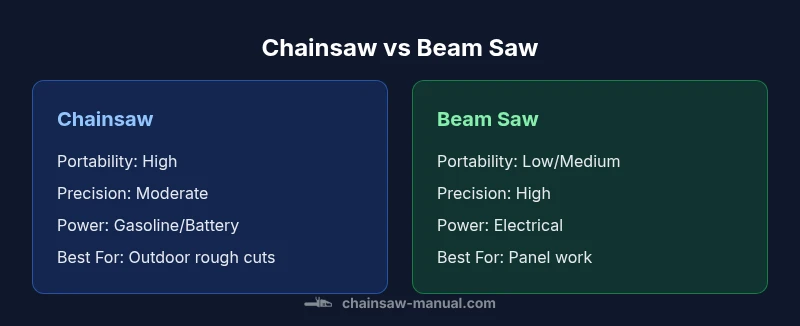
A practical comparison shows that chainsaws shine outdoors for rough timber and branches, while beam saws excel in precise cuts of sheet goods in controlled environments. When deciding, prioritize mobility and rugged outdoor use with a chainsaw, or accuracy and efficiency for panels with a beam saw. Always follow proper safety practices and training.
Understanding the Core Difference: Chainsaw vs Beam Saw
In most construction or land-management tasks, the choice boils down to the tool's core strengths. Chainsaw and beam saw occupy different ends of the spectrum: one prioritizes mobility and heavy-duty rough cuts, the other emphasizes precision, repeatability, and panel work. For many tasks, the decision reduces to comparing a chainsaw and beam saw: which tool best balances mobility and precision. The chainsaw is designed to cut through wood with speed and versatility in outdoor environments, often in uneven terrain. Its power comes from a combustible engine or a large battery, and its rugged construction helps operators work with minimal setup. By contrast, the beam saw sits on a solid frame and guides a blade along a fixed path, delivering straight, predictable cuts with minimal deviation. This fundamental difference shapes every other consideration: safety protocols, maintenance routines, and the expected lifecycle costs. In practice, homeowners often reach for a chainsaw to clear brush or fell a tree, while professionals favor a beam saw for sheet goods, cabinetry, and precise panel fabrication. Understanding these roles helps prevent misfit tool purchases and unsafe experiments.
Portability and Site Accessibility
Portability is the defining factor for outdoor work. A handheld chainsaw can be carried into forests, across slopes, or up a hillside with relative ease, while a beam saw requires a stable floor space and appropriate mounting or stand. Weight distribution matters: a typical chainsaw centers mass around the handle, letting you pivot and reach limbs, but you’ll still carry the weight as you move along a cut. In contrast, a beam saw is stationary or semi-portable at best; even if transportable, its base, rails, and cutting station demand a level surface and a secure anchor. When evaluating portability, consider job-site constraints: limited space, uneven terrain, remote locations, and planned cut length. For DIY projects on a driveway or backyard, a chainsaw plus a compact worktable might cover most needs. Professional use often requires a dedicated workshop environment with a beam saw for high-volume panel processing. The trade-off is clear: mobility versus controlled accuracy; choose the configuration that reduces trips up and down and keeps your body within safe working posture. This chainsaw and beam pairing concept helps determine the best setup for the site.
Cutting Performance: Rough Timber vs Precision Panels
When you slice through rough timber, a chainsaw demonstrates rapid bite and momentum. It can kerf irregular shapes, notch branches, and perform felling tasks in open environments where speed matters more than perfect edges. However, the blade path is forgiving rather than rigid, and operator skill influences straightness. A beam saw, by contrast, shines when cutting sheet goods, plywood, and laminated panels. The guiding rails enforce a straight line, and feed speed combined with a fixed blade yields repeatable dimensions. For many projects, you’ll find chainsaws to be a workhorse for initial rough cuts, followed by a beam saw for finish-grade panel trimming and assemble-stage accuracy. In a balanced shop, both tools complement each other: the chainsaw clears and sizes, and the beam saw delivers precise, repeatable results with minimal waste. The key is to match tool selection to the desired tolerance and surface quality, and to understand how each tool handles kerf, dust, and blade wear over time.
Power Sources and Operational Costs
Power source considerations often drive the initial decision between a chainsaw and a beam saw. Chainsaws can run on gasoline, batteries, or a hybrid system, which makes them versatile for remote sites without immediate power access. Gasoline models offer broad energy-on-demand at the expense of fuel costs and ongoing maintenance. Battery chainsaws provide cleaner operation and lower running costs per hour but depend on battery life and charging cycles. Beam saws rely on a stable electrical supply or a dedicated power system; the advantage is consistent performance and predictable operating costs, but the trade-off is reduced mobility and higher upfront equipment costs. When evaluating long-term expenses, include blade/chain wear, refueling or charging, lubrication, and potential downtime. The broader picture for a chainsaw and beam pairing is clear: choose mobility for the field and efficiency for workshop workflows, then balance upfront investment against lifecycle costs.
Safety Framework and Training Needs
Safety considerations differ but share core principles: PPE, training, and defensive work habits. Chainsaw operation requires awareness of kickback zones, proper stance, and chain brake engagement. PPE includes helmet with face shield, hearing protection, cut-resistant chaps, gloves, and sturdy boots. Beam saws demand secure mounting, consistent workholding, and awareness of blade path in a controlled environment. Training should cover setup, maintenance checks, and emergency procedures. Always perform a risk assessment before each cut, inspect for loose clamps or guides, and verify that guards are in place. For both tools, establish a clear command of space—define bystanders, establish a safe retreat path, and implement lockout-tagout during maintenance. A well-structured safety program reduces incidents and extends tool life. In short, the chainsaw and beam pairing demands disciplined practice, consistent PPE, and ongoing skills development.
Maintenance, Durability, and Longevity
Routine maintenance is the backbone of reliability for both tools. Chainsaws require timely chain sharpening, tension adjustment, bar care, and fuel system cleanliness to avoid performance drops. Regular air and fuel filter checks, along with bar oil levels, help maintain cutting efficiency and reduce wear. Beam saws rely on clean rails, precise alignment, and blade maintenance; lubrication points and drive components must be inspected for wear, with rails kept free of debris that could affect accuracy. Durability rests on build quality, protective housings, and proper storage. For the chainsaw and beam pairing, establish a maintenance calendar: pre-season checks, mid-season inspections, and post-project cooling. Invest in a reliable set of replacement blades, chains, and lubricants, and store tools in dry, ventilated spaces to prevent rust or corrosion. A disciplined maintenance routine improves safety and extends the life of both systems.
Suitability for Hobbyist, DIY, and Professional Use
Bob the DIYer may prioritize flexibility, lower upfront costs, and easy learning curves. A hobbyist often benefits from a compact chainsaw for outdoor work and a small, portable panel-cutting setup for occasional projects. Professionals value throughput, repeatability, and durability; the beam saw becomes central for cabinetmaking, furniture fabrication, and high-volume panel processing, while a chainsaw remains essential for site prep and rough cuts. For mixed-use scenarios, a combined toolkit reduces the time-to-cut and enhances safety by using the right tool at the right moment. The chainsaw and beam pairing approach helps define a staged workflow that aligns with project demands, workspace constraints, and personnel expertise.
Economic Considerations: Upfront vs Lifecycle Costs
Upfront costs influence initial procurement decisions. Chainsaws typically offer lower entry prices for basic models but incur ongoing fuel, maintenance, and replacement blade costs. Beam saws have higher upfront costs, but the running costs are often lower due to electricity efficiency and long blade-life. Lifecycle cost analysis should factor in frequency of use, task diversity, and expected project volume. If you regularly handle outdoor clearing and rough cuts, the return on investment for a capable chainsaw can be favorable. If your work centers on shop-based precision cutting, a beam saw can deliver cost-per-cut reductions and improved yield. Consider financing options, warranties, and service plans to optimize total ownership cost. The chainsaw and beam pairing requires a careful budget plan that reflects both immediate needs and long-term project demands.
Environmental Impact and Noise Considerations
Environmental considerations differ between the two tools. Gasoline-powered chainsaws emit exhaust and are typically louder, creating more disruption on outdoor jobsites and affecting local air quality. Battery-powered chainsaws reduce emissions and can help meet green-building goals, but battery production and disposal add another lifecycle factor. Beam saws, when powered by electricity, contribute fewer direct emissions but require energy consumption in a fixed workspace. Noise comparisons depend on model design and operation, with some high-performance chainsaws producing noticeable sound levels. Regardless of choice, ear and hearing protection is a must, and operators should consider dust control and waste management practices. The chainsaw and beam pairing thus intersects with environmental responsibility, ergonomics, and long-term community impact.
Quick-start Guide: How to Decide in 5 Steps
- List your primary tasks (outdoor rough cuts vs shop panel work).
- Evaluate site constraints (mobility, space, power access).
- Compare initial cost and ongoing operating costs.
- Assess safety training needs and PPE requirements.
- Pilot with a basic setup and upgrade as your volume and precision needs grow. This structured approach helps you choose wisely between a chainsaw and a beam saw, ensuring you invest where it matters most for your projects.
Common Misconceptions Debunked
- Misconception: A beam saw can replace a chainsaw in all outdoor tasks. Reality: Beam saws are superb for precision cuts on panels but are not portable or robust enough for rough outdoor work. - Misconception: Chainsaws are always louder and less safe than beam saws. Reality: Safety depends on training and PPE; a well-trained operator using the right tool is safer than a poorly used tool regardless of type. - Misconception: You only need one tool. Reality: A well-rounded setup often benefits from both tools to handle different phases of a project.
How to Transition Between Tools Safely
Start with a clear work plan that assigns specific tasks to each tool. Establish a safe transfer zone when moving from outdoor to indoor work, and ensure proper storage between uses. Develop a routine for tool checks, sharpening, and calibration before each job. Finally, train all operators on the unique hazards and best practices for each tool to minimize risk and maximize productivity.
Comparison
| Feature | Chainsaw | Beam Saw |
|---|---|---|
| Portability | High (handheld, field-ready) | Low to medium (stationary/bench) |
| Cutting Precision | Moderate, rough cuts | High, precise panel cuts |
| Typical Use | Outdoor timber, brush, felling | Shop panels, cabinetry, precise cuts |
| Power Source | Gasoline or battery (model dependent) | Electrical outlet or dedicated power supply |
| Setup Time | Low (unpack and go) | Medium (setup and alignment) |
| Maintenance & Running Cost | Fuel, chain oil, replacement parts | Electrical power, blade maintenance |
Strengths
- High portability for outdoor sites
- Rapid rough-cut performance for timber
- Low upfront setup for quick tasks
- Versatile on uneven terrain and restricted spaces
- Can clear brush and prepare timber quickly
Drawbacks
- Limited precision for fine joinery
- Higher safety risk without training
- Beam saws incur higher upfront costs
- Fuel and maintenance for chainsaws can be costly
Beam saws excel in precision and efficiency for panels; chainsaws dominate outdoor versatility and mobility.
For shop-focused panel work, a beam saw offers better accuracy and repeatability. For outdoor site work, a chainsaw provides portability and faster rough cuts. The best approach often uses both tools in a complementary workflow, aligned with task and environment.
FAQ
What are the primary use cases for each tool?
Chainsaws are ideal for outdoor clearing, felling, and rough cuts; beam saws excel in shop-based panel cutting, cabinetry, and precise trimming. Each tool plays a distinct role based on task and environment.
For outdoor work, use a chainsaw. For shop panel work, use a beam saw.
Is one tool safer than the other?
Safety depends on training, PPE, and adherence to protocols. Both tools carry risks, and proper technique and protective gear are essential.
Both require training and PPE; safety comes from how you use them.
Can I substitute a beam saw for a chainsaw in the field?
Not generally. Beam saws are optimized for precise, indoor cuts and require a stable setup, making them unsuitable for rough outdoor tasks.
Beam saws aren’t the best outdoor substitutes for chainsaws.
What should I consider before buying?
Assess project types, space, power access, and budget. Decide whether mobility or precision matters more for your typical tasks and future projects.
Think about where you’ll use it, how often, and your workspace.
What safety PPE is essential?
Eye and hearing protection, cut-resistant gloves, helmet with face shield, protective chaps or pants, and sturdy boots. Always wear PPE appropriate to the tool and task.
Always wear eye and ear protection, gloves, and the appropriate PPE.
How do I maintain each tool?
Regular cleaning, lubrication, blade/chain maintenance, and storage in dry conditions. Follow manufacturer guidelines for service intervals and parts replacement.
Keep blades sharp, clean, and lubricated; store properly.
The Essentials
- Define clear use-cases: outdoors vs. shop panels
- Choose mobility for field work and precision for workshops
- Balance upfront investment against ongoing costs
- Prioritize safety training and PPE
- Adopt a two-tool workflow for best results