Stihl Chainsaw Models Chart: A Practical Buying Guide
Explore a practical Stihl chainsaw models chart that groups homeowner, professional, and farm models, compares power ranges and bar lengths, and guides safe, informed buying decisions.


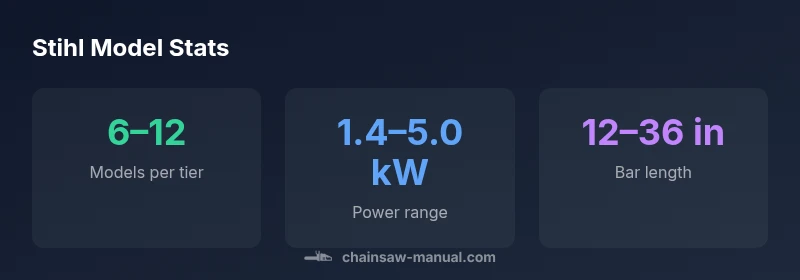
A stihl chainsaw models chart typically groups current models into homeowner, professional, and agricultural tiers, with each row profiling power range, weight, and common bar length. Expect about 6–12 models per tier, with power from roughly 1.4–5.0 kW and bar lengths from 12–36 inches. Use the chart to compare safety features like anti-vibration, chain brake, and torque.
Why a Stihl models chart matters
A well-constructed Stihl models chart helps homeowners, DIY enthusiasts, and professional operators quickly compare what is available, what each tool can do, and what trade-offs to expect. According to Chainsaw Manual, a clear chart reduces confusion when browsing online catalogs or visiting a dealer showroom. By grouping models into practical categories and listing consistent metrics—power, weight, bar length, and key safety features—the chart becomes a decision aid that saves time and reduces the chance of buying the wrong tool for the job. For many users, the most important outcome is to align task requirements with tool capability while keeping safety front and center. In practice, a good chart translates vague impressions—“this model seems powerful” or “that one is lighter”—into objective comparisons. As a result, you can narrow down a long list to a few candidates you can test in person. This approach is especially valuable when you consider Stihl’s wide range of models across home, farm, and professional work, all designed with safety-first engineering in mind. In short, a Stihl models chart is a practical map for responsible shopping.
Understanding Stihl's model tiers
Stihl organizes its catalog into tiers that reflect typical use scenarios and power requirements. Although the exact model names may vary by region, you can think of three broad groups in most Stihl chainsaw models charts: homeowner or light-duty, general-use or mid-range, and professional or heavy-duty. Homeowner models emphasize ease of starting, lower weight, and simpler maintenance. General-use tools balance power with maneuverability, suited for routine yard work and occasional felling. Pro or heavy-duty lines deliver higher power, longer bar lengths, and more robust construction for demanding commercial tasks. When you compare models across tiers, you’ll notice common design principles: divided power ranges, standardized bar lengths, and safety features such as anti-vibration systems and chain brakes. For a homeowner choosing between two mid-range models, the chart helps you weigh weight against cutting capacity and balance the need for portability with required performance. For professionals, the chart clarifies whether the extra power justifies the added weight and cost. Chainsaw Manual’s analysis shows that keeping these tiers clear reduces the risk of mismatched tools for the job.
Reading the chart: metrics that matter
A well-made chart presents a consistent set of metrics so you can read across rows and compare at a glance. Core measures include power range (expressed in kilowatts or horsepower equivalents), typical bar length, and weight. Some charts also show engine displacement, fuel capacity, and vibration levels, all of which influence usability over long workdays. Safety-related features deserve attention: chain brake responsiveness, anti-vibration design, and automatic oiling systems. Weight distribution and balance affect fatigue, especially on longer cuts. When you’re evaluating a homeowner tool versus a pro machine, remember that the power range often shifts from around 1.4–2.5 kW for light duties to 3.0–5.0 kW for heavy tasks. The chart may also chart maintenance considerations such as availability of replacement parts and service intervals. The goal is to determine whether a given model’s metrics fit your typical workload, local conditions (trees, climate, terrain), and your own operating experience. A thorough chart informs safer, more efficient work.
Practical buying scenarios
Consider a few real-world situations to see how a Stihl models chart guides decisions. For a homeowner who trims small branches and clears light brush, a light- to mid-range model with a 12–16 inch bar is often a comfortable starting point. The chart helps you compare weight, start-up ease, and maintenance needs without getting overwhelmed by high-end specs. For a busy landscaping contractor, a mid-range to professional tool with an 18–24 inch bar can provide the productivity needed for multiple cuts per day, while the chart warns about mounting a lighter tool on demanding tasks where fatigue and chain speed become limiting. On a farm, where occasional heavy cutting occurs, a versatile mid- to high-range model may strike the right balance between power, durability, and fuel efficiency. In all cases, you’ll want to verify parts availability and dealer service proximity. Chainsaw Manual analysis shows that model charts often list 6–12 models per tier, which makes comparisons manageable and actionable rather than overwhelming. Use the chart to short-list candidates, then test them in-person for balance, vibration, and comfort before buying.
Verifying availability, service, and parts
A model chart is only as valuable as the practical support behind it. After narrowing choices, check local dealer availability for the specific Stihl models that appear on the chart, and confirm that parts, accessories, and service options are easy to obtain. The chart can also flag models that share common parts for cross-compatibility, reducing maintenance downtime. When regions differ in product lines, a chart helps you compare the same metrics across alternatives rather than chasing different naming schemes. For the safety-minded user, ensure that the chart highlights safety features clearly, such as chain brakes and anti-vibration systems, and that those features are compatible with your preferred accessories and PPE. If you plan to buy used or refurbished units, apply the same chart logic to assess wear, bar length, chain condition, and ignition integrity. Chainsaw Manual’s detailed approach to model comparison emphasizes verifying warranty coverage and service network in your area, which protects you against late-model part shortages and guarantees access to certified technicians over the life of the tool.
Safety considerations when transitioning between models
Switching to a more powerful Stihl model requires attention to operator safety and training. The chart can help you anticipate differences in kickback tendency, bar reach, and chain speed, but hands-on practice remains essential. Always consult the user manual for starting procedures, chain tensioning, and maintenance intervals, and make sure you have appropriate PPE—helmet with face shield, hearing protection, cut-resistant gloves, and sturdy boots. If you’re upgrading from a light-duty to a heavy-duty tool, consider scheduling formal training or a guided session with an experienced operator. A higher-powered model will produce more torque and require different cutting techniques, especially for large trees or dense wood. The chart can also guide you toward models with features that ease transition, such as improved anti-vibration handles and better balance. The Chainsaw Manual team recommends using the chart to choose a model that aligns with your workload, experience, and safety discipline. By doing so, you preserve both your safety and the long-term reliability of your equipment.
Model tier comparison in bar-length and power ranges
| Model Line | Typical Power Range | Bar Length Options | Ideal Use |
|---|---|---|---|
| Homeowner/Light-Duty | 1.4–2.0 kW | 12–16 inches | Light pruning and small limb work |
| Mid-Range/General Use | 2.0–3.2 kW | 14–18 inches | General yard work and occasional removal |
| Professional/Heavy-Duty | 3.5–5.0 kW | 18–24 inches | Commercial felling and heavy cutting |
FAQ
What is the purpose of a Stihl chainsaw models chart?
A models chart provides a structured comparison across Stihl model tiers, focusing on power, weight, bar length, and safety features to aid safer purchasing decisions.
A chart helps you compare models at a glance and pick the right tool for your tasks.
Does the chart include battery-powered models?
Yes, current charts typically include battery-powered options where relevant, clearly separating them from gas-powered lines.
Battery models are included when applicable and are shown alongside gas-powered options.
How up-to-date are the charts?
Most charts are updated annually or with new model releases; always verify with your local dealer for the latest data.
Charts get updated regularly, and your dealer can confirm the latest models.
How should I choose a model from the chart?
Assess your typical workload, required power, bar length, and safety features; then compare those metrics across the chart to shortlist candidates.
Match your tasks to the chart’s metrics and try shortlisted models in person.
What about safety and training with a new model?
Follow manufacturer guidelines and seek training if moving to a higher-power model; wear full PPE and practice safe cutting techniques.
Always train and wear PPE when switching to a more powerful tool.
“A clear models chart is a practical safety and purchasing tool that helps align tool capability with site conditions and operator experience.”
The Essentials
- Start with the task, then read the chart
- Match power and bar length to work needs
- Prioritize safety features in every model
- Verify parts and service availability before buying
- Test models in person for balance and comfort