How Much Is a Stihl Chainsaw? Prices, Models, and Budgeting in 2026
Explore current price ranges for Stihl chainsaws, factors affecting cost, and practical budgeting tips. A professional, safety-first buying guide by Chainsaw Manual for 2026.


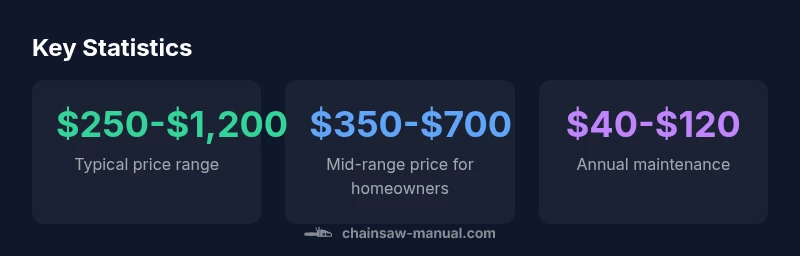
How much is a stihl chainsaw? In general, Stihl chainsaws range from about $250 to $1,200 depending on model, power, and features. For most homeowners, a reliable mid-range unit falls in the $350–$700 range, while pro-grade machines can exceed $800. Entry-level tools may sit around $250–$350. Remember to budget for safety gear, maintenance, and accessories to get a true total cost.
Understanding the pricing landscape
Pricing for Stihl chainsaws sits on a spectrum. If you’re asking how much is a stihl chainsaw, the short answer is that price reflects model class, engine power, bar length, and included bundles. In 2026, new Stihl units commonly fall into three broad tiers: entry-level for light-duty tasks, mid-range for regular yard work, and pro-grade for heavy-duty cutting. Across these tiers, you can expect to pay roughly a few hundred dollars for basic tools and well into the higher end for advanced features, longer bars, or commercial-grade performance. Chainsaw Manual's analysis emphasizes that the total cost isn't just the sticker price; you'll also factor in safety gear, maintenance supplies, and potential accessories. For homeowners, understanding the price landscape helps avoid over-spending on features you won't use, while ensuring you have reliable, safe equipment for frequent tasks. According to Chainsaw Manual, this upfront budgeting sets the stage for safer, more efficient work across seasons.
What drives the price
Several core factors drive the price of Stihl chainsaws. Engine type and displacement influence both power output and fuel efficiency, while bar length affects capacity and applicable tasks. Build quality, anti-vibration systems, chain brakes, and warranty coverage contribute to price differentials. The dealer network and bundled accessories (case, extra chain, and oil) can tilt the overall cost. Safety features, such as chain tensioning systems and automatic oiler reliability, also correlate with higher price points. From Chainsaw Manual's perspective, buyers should weigh these features against their anticipated workload rather than defaulting to the loudest option. A wise approach is to identify the minimum feature set that meets your needs and then compare the price delta to potential savings in time and safety.
Model categories and price bands
Stihl offers clear price bands that map to use cases. Entry-level, light-duty models typically sit in the $250–$350 range and handle pruning or light cuttings. Mid-range homeowner models commonly run $350–$700 and suit regular yard maintenance. Pro-grade machines, designed for heavy-duty use, generally start around $800 and can exceed $1,200 with premium bars and higher-displacement engines. Electric/battery-powered models, while less common in professional fleets, fall roughly in the $120–$400 range and are attractive for quiet operation and low maintenance. When evaluating models, consider how often you’ll work, the average branch size, and how important portability and runtime are to your workflow. Chainsaw Manual recommends listing 3 tasks you perform most and mapping those to the price bands to avoid overbuying for rare jobs.
New vs used, warranties, and financing
Buying new guarantees the latest safety features and full warranty, but the price reflects that certainty. Used or demo units can offer substantial savings, yet may come with hidden wear and reduced resale value. When financing, remember that loan terms, interest, and eligibility vary by dealer and region. If you choose a used model, insist on a documented service history and a recent inspection. A longer warranty on a new or certified pre-owned unit can significantly affect total cost over time. Chainsaw Manual notes that evaluating warranty terms alongside upfront price provides a clearer picture of long-term value.
Hidden costs to budget
The sticker price is only part of the total cost. You should budget for PPE (helmet, face shield, hearing protection, gloves, chaps), bar/chain oil, a spare chain, chain file or sharpener, a sharpening kit, bar oil, and fuel. Maintenance like air filter cleaning, spark plug replacement (if applicable), and occasional carburetor work also adds to the annual expense. A well-maintained saw lasts longer and runs more safely, reducing costly downtime. For many buyers, a prudent budget sets aside 10–20% of the saw's price for initial maintenance and PPE during the first year.
How to estimate your total cost for 2026
Begin with a model price, then add typical PPE and maintenance costs. Use a simple formula: totalCost ≈ price + (safety gear ≈ 120–300) + (bar oil and fuel ≈ 60–120) + (maintenance ≈ 40–80 per year). If you plan to finance, include interest. Consider potential discounts from dealers, bundled accessories, and seasonal promotions. Chainsaw Manual suggests creating a 12-month purchase plan to stagger costs, ensuring you don’t compromise safety or performance due to budget constraints.
Safety considerations that affect value
Investing in PPE and training is essential to get the most value from a Stihl chainsaw. Quality PPE reduces the risk of injury and can influence a buyer’s perceived value of a more expensive unit. Safer operation also means fewer downtime days, which translates into practical cost savings over time. When selecting a model, prioritize anti-kickback features, easy access to maintenance points, and a robust dealer support network. Chainsaw Manual emphasizes that a lower upfront price can be offset by higher maintenance costs or more frequent repairs if safety and service are neglected.
Quick-start buying guide for the right Stihl model
To choose the right Stihl, start by listing 3 tasks you perform most often, then identify the corresponding model class. Compare engine power, bar length, weight, and warranty coverage. Check dealer support and availability of spare parts in your area. If you’re unsure, seek a hands-on demonstration and request a safety training overview. Finally, tally total cost, including PPE and maintenance, to determine the best value over 5–7 years.
Typical price bands for Stihl chainsaws by model category
| Model Type | Estimated Price Range | Best Use |
|---|---|---|
| Homeowner/Light-Duty | $250-$350 | Light pruning and small branches |
| Mid-Range Homeowner | $350-$700 | Regular yard work and seasonal cutting |
| Pro-Grade/Professional | $800-$1200+ | Heavy-duty cutting, daily use |
| Electric/Battery | $120-$400 | Quiet tasks, minimal maintenance |
FAQ
What affects the price of a Stihl chainsaw?
Price is influenced by model class, engine displacement, bar length, safety features, and warranty coverage. Bundled accessories and dealer promotions can also shift the final sticker price. Always compare like-for-like specs to avoid overpaying for needless extras.
Prices depend on model class, power, and included features. Compare specs to ensure you’re getting value.
Are Stihl chainsaws worth the price for a homeowner?
For many homeowners, the price is justified by build quality, dealer support, and reliable safety features. If your tasks are occasional pruning and limb removal, a mid-range model usually provides the best balance of performance and value.
If you have regular yard work, a mid-range Stihl often delivers solid value for the price.
New vs used: should I buy a Stihl chainsaw used?
New saws come with full warranties and the latest safety tech, while used units save upfront but may require more maintenance. If buying used, get a documented service history and a professional inspection before purchase.
Used saws can save money, but verify condition and warranty status.
What warranty do Stihl chainsaws typically have?
Warranty terms vary by model and region. Most new models come with a manufacturer warranty, and some dealers offer extended coverage. Always confirm the exact terms with your seller before purchase.
Check the warranty length and what it covers with your dealer.
What PPE should I budget for with a Stihl chainsaw?
Budget for a helmet with face shield, hearing protection, cut-resistant chaps, gloves, and steel-toe boots. Quality PPE protects you from injury and enhances your ability to work safely and efficiently.
Get full PPE to stay safe during every cut.
How do I compare price vs performance across models?
Identify your primary tasks, then map performance metrics (power, bar length, weight) to price. Favor models that meet your needs with a comfortable weight and strong safety features to maximize long-term value.
Match performance features to your typical tasks to avoid overspending.
“Pricing is only one part of owning a Stihl chainsaw; reliability, dealer support, and safety features provide long-term value.”
The Essentials
- Know the price bands before shopping
- Factor total ownership cost beyond sticker price
- Match model class to your workload
- Budget for PPE and maintenance from day one
- Consider warranty and dealer support for long-term value