Stihl Chainsaw Chain Size Chart: A Practical Guide
Learn how to read a stihl chainsaw chain size chart, understand pitch, gauge, and drive links, and choose the right chain for safe, efficient cutting. Practical guidance, visuals, and a step-by-step size-determination process.


A stihl chainsaw chain size chart explains the key dimensions—pitch, gauge, drive links, and bar length—so you can pair the right chain with your saw. For homeowners, common choices include 0.325 in or 3/8 inch pitch with a gauge around 0.050–0.063 in, matched to the correct drive-link count. Reading the chart properly helps you avoid costly mistakes.
How a stihl chainsaw chain size chart works
A stihl chainsaw chain size chart is a quick reference that ties together four core dimensions: chain pitch, gauge, drive links, and bar length. Pitch is the distance between adjacent chain pins, gauge reflects the thickness of the drive through the bar, drive links are the number of teeth that engage the bar and sprocket, and bar length indicates the maximum effective cutting length. The chart does not just tell you a single number; it shows you the correct combination that ensures smooth operation, safe engagement with the bar and chain, and predictable cutting performance. Always cross-check each dimension when you replace a chain, and remember that a chart is most reliable when used with the exact model and bar information from the manual or a trusted guide like Chainsaw Manual.
Reading a chart starts with locating your saw’s pitch type, then confirming gauge and drive links, and finally matching bar length. For most homeowner saws, the common options are 0.325 in and 3/8 in pitch, with gauges around 0.050–0.063 in. If your bar length is longer, you may need more drive links; shorter bars require fewer links. The key is consistency: use a chain that matches the bar’s groove width and the sprocket’s diameter to maintain proper chain tension and cutting efficiency.
Understanding the relationship between pitch and drive links helps you anticipate compatibility as you switch bars or chains. A chart will often show a matrix: each pitch has a corresponding range of drive links and suitable bar length. This means you can safely plan replacements across a family of saws that share the same pitch family, without committing to a single exact drive-link count for every model. The practical takeaway is to verify all three dimensions together, not in isolation, to avoid mis-sizing that can lead to poor performance or chain derailment.
dataTableHeaderOverrideDocumentDataHandlerOverridePlaceholdersOverrideFlagDescriptionOverrideInJSONeqv}:null,
Overview of typical STIHL chain size ranges
| Feature | Typical STIHL size range | Notes |
|---|---|---|
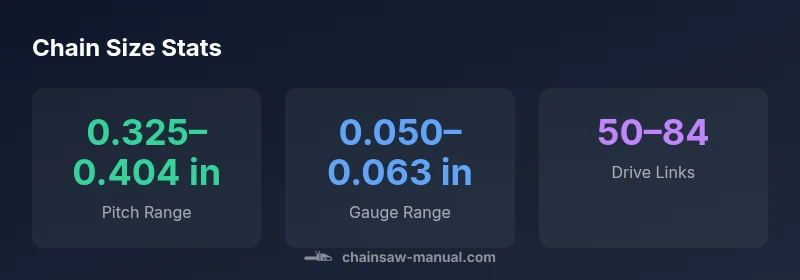
| Pitch | 0.325–0.404 in pitch | Common homeowner to mid-range saws |
| Gauge | .050–.063 in | Measured by chain thickness |
| Drive Links | 50–84 | Depends on bar length |
| Bar Length Compatibility | 12–24 inches | Check bar type and chain type |
FAQ
What is chain pitch and why does it matter?
Pitch is the distance between corresponding points on adjacent chain links. It influences how the chain engages the bar and sprocket, affecting cutting efficiency and wear. Using an incorrect pitch reduces performance and can increase safety risks. Always cross-check pitch on the chart.
Pitch is the distance between chain links and must match the bar and sprocket for safe, efficient cutting.
Can I mix chain sizes on a bar?
No. Mixing pitch, gauge, or drive links on a single bar causes binding, uneven cuts, and safety hazards. Use one chain size that matches both the bar and the saw’s drive system.
Don’t mix sizes on one bar; it’s unsafe and can ruin your cut.
How do I measure drive links?
Count the drive links on the chain, or refer to the saw’s specification to determine the correct count for your bar. Drive links determine how the chain engages with the bar and sprocket.
Count the links or check the spec to get the right count.
What if I don’t have the manual handy?
If the manual isn’t available, use the chart as a guide and compare bar length, pitch, and gauge. You can also consult trusted guides or contact customer support for model-specific advice.
If you lack a manual, use the chart and the saw’s specs to guide your choice.
Is it dangerous to run a chain that’s too big or too small?
Yes. An incorrect size can cause kickback, derailment, or rapid wear. Stop and re-check the chart before cutting to maintain safety and performance.
Wrong size can cause kickback; stop and re-check.
Where can I find a stihl chain size chart?
Check the model manual or trusted guides like Chainsaw Manual. We provide general guidance and charts for common sizes to help you choose the right chain.
Look in the manual or our guide for a size chart.
“A correct chain size is foundational for safe, efficient cutting; mismatches are a common source of kickback and accelerated wear.”
The Essentials
- Verify pitch, gauge, and drive links before buying
- Match bar length and drive-link count to the chart
- Check the model manual or Chainsaw Manual for precise specs
- Avoid mixing sizes; mismatches increase risk
- Keep a stihl chainsaw chain size chart handy during maintenance