Reasons for Chainsaw Not Starting: Troubleshooting Guide
Urgent, practical guide to diagnose why your chainsaw won’t start and fix fuel, spark, and air issues safely.


Most chainsaw starting problems come from fuel, spark, or air—often fuel freshness or a fouled spark plug. Quick fix: confirm fresh, correctly mixed fuel; verify the choke and on/off switch are in the correct position; inspect or replace the spark plug and clean the air filter. If it still won’t start, follow the diagnostic flow for deeper causes.
Baseline safety and immediate checks
When you face the reasons for chainsaw not starting, the fastest path to a diagnosis is safety-first and basic checks. Before you touch any moving parts, shut the engine off, remove the spark plug boot, wear eye protection, and secure the saw on a stable surface. Most starting problems come from three simple culprits: fuel, spark, or air. The majority can be resolved without tools by confirming fuel freshness and the correct fuel mix, ensuring the choke and stop switch are in the proper positions, and verifying that the air intake is clear. If your saw has a carburetor, a clogged air intake or flooded carb can starve it of air or flood the engine, preventing ignition. If it still won’t start after these quick checks, proceed to the diagnostic flow to identify deeper issues. This guide from Chainsaw Manual explains the step-by-step approach to identify and fix common ignition and starting problems safely.
Fuel system: the first place to check
Fuel problems are the most common reason for chainsaw not starting. Begin by inspecting the fuel: is it fresh, properly mixed if your saw requires oil in the gasoline, and free of water contamination? Stale or contaminated fuel can foul the carburetor and prevent starting. Check that the fuel cap seals properly and that fuel lines are not pinched or cracked. If you primed the saw, listen for a consistent suction from the primer bulb; if fuel isn’t moving, clean or replace clogged lines. After you confirm fuel delivery, attempt another start. If the engine still won’t fire, move to spark ignition and air supply checks in the diagnostic flow.
Spark and ignition: diagnosing fire
Spark is the spark that ignites the fuel-air mixture. Inspect the spark plug for fouling, glaze, or wear; remove and check the gap according to the manufacturer’s specification. Clean or replace as needed. Check the ignition coil and wiring for corrosion or loose connections. Remove the boot, hold the plug against a metal surface, and pull the starter to see if a bright blue spark appears. If there’s no spark or a weak spark, the problem could be the ignition module or coil; consider service or replacement.
Air and carburetor: air intake and fuel delivery
A clogged air filter or a restricted air intake can starve the engine of air and prevent starting. Inspect the air filter every time you troubleshoot; Clean or replace it if dirty. Check the carburetor for varnish or gummed jets, especially if the saw has sat unused. An air leak in the intake manifold or a cracked boot can also lean out the mixture and inhibit starting. When correcting air and carb conditions, always ensure the engine breathes freely and there are no vacuum leaks.
Maintenance and model differences: gas vs electric
Gas-powered saws share starting pitfalls with spark, fuel, and air, but electric or battery-powered models introduce battery health, charger status, and switch safety into the mix. For battery saws, confirm the battery is charged, seated properly, and the safety switch and chain brake are disengaged. For corded electric models, ensure the power source is active and the switch is in the run position. Always follow the manufacturer’s maintenance schedule to prevent recurring starting problems.
Prevention through routine care
Prevention is better than repair. Regularly replace or clean the spark plug, air filter, and fuel lines as recommended; use fresh fuel and proper storage; drain fuel if you won’t use the saw for extended periods; and perform a quick start test after any maintenance. Record service dates and keep a simple log of noticed symptoms to spot recurring patterns before they escalate to a no-start situation.
Quick-start print-friendly checklist
Keep this handy list next to your saw:
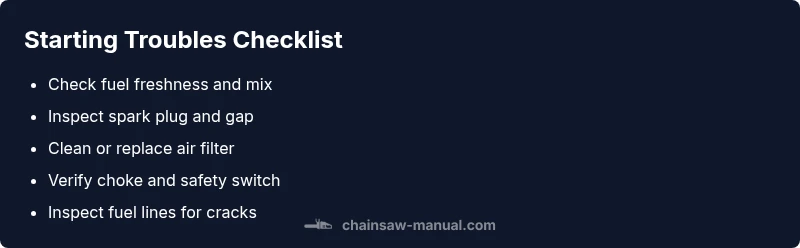
- Check fuel freshness and mix (if required by model)
- Inspect spark plug; clean or replace if fouled
- Clean or replace air filter; inspect air intake
- Verify choke and stop switch positions
- Check for fuel line cracks or pinches
- Confirm ignition switch and safety features are functioning
- If still not starting, move through the diagnostic flow to locate deeper issues
Steps
Estimated time: 60-90 minutes
- 1
Ensure safety and stabilize the saw
Place the saw on a flat surface, wear PPE, and engage the chain brake. Remove the spark plug boot to prevent accidental starting while you work on ignition components.
Tip: Always disconnect power or spark to avoid accidental starts. - 2
Check fuel and lines
Drain and replace fuel if old or contaminated. Inspect fuel lines and connections for cracks, leaks, or kinks; replace if needed.
Tip: Never mix fuel with the spark plug still connected; work with clean hands. - 3
Inspect spark plug
Remove the spark plug, check for fouling or wear, clean or replace, and re-gap according to the manual if applicable.
Tip: A clean, properly gapped plug is often the fix for many starts. - 4
Check air and carburetor
Inspect and clean the air filter and air intake; if needed, inspect carburetor for varnish and clean jets.
Tip: A restricted air path is a common cause of failure to start. - 5
Verify choke and switch positions
Make sure the choke is in the correct starting position and that the on/off switch is set to run after priming.
Tip: Incorrect choke position is a frequent, easy-to-fix cause. - 6
Attempt restart and test
Try starting with a short, steady pull or a gentle start; listen for consistent ignition or a popping sound. If there is still no start, move to professional help.
Tip: If there’s no improvement after these steps, a professional inspection may be needed.
Diagnosis: Saw won't start or starts briefly then dies
Possible Causes
- highFuel is old, contaminated, or not reaching carburetor
- highSpark plug fouled or ignition coil/wiring degraded
- highAir intake blocked or air filter clogged
- mediumChoke left on, or switch in the wrong position
- mediumCarburetor flooding or clogged jets
- lowVacuum/leak in intake or cracked hoses
Fixes
- easyReplace with fresh fuel and verify fuel lines are intact and not pinched
- easyInspect/replace spark plug; clean gap and test for spark
- easyClean or replace air filter; check air intake path for obstructions
- easyReset choke and switch to correct starting position; wait for warm-up if required
- mediumClean carburetor jets or check for flooding; consider a carb kit if needed
- mediumInspect for vacuum leaks or damaged hoses; replace as needed
FAQ
What is the first thing to check if my chainsaw won’t start?
Start with safety and basic checks: fuel freshness, air filter, spark plug condition, and choke position. These basics cover the majority of no-start situations and guide you to deeper issues if needed.
First check safety gear, fuel freshness, air filter, spark plug, and choke position. If it still won’t start, follow the diagnostic flow.
Can a dirty air filter cause starting problems?
Yes. A clogged air filter restricts airflow and can prevent starting or cause hard starting. Clean or replace the filter and inspect the air intake path.
A dirty air filter can prevent starting. Clean or replace it and recheck the intake path.
Is old fuel the main culprit for starting issues?
Old or contaminated fuel is a common cause of poor starting performance. Replace with fresh fuel and verify proper mixing if required by your model.
Old fuel is a common culprit. Use fresh fuel and correct mixing if needed.
How often should I replace the spark plug?
Follow the manufacturer’s recommended interval. If the plug is fouled, damaged, or worn, replace it to restore reliable starting.
Replace the spark plug per the manual or if you notice wear or fouling.
What safety steps should I take before starting a chainsaw?
Wear PPE, ensure the chain brake is engaged until ready to start, and check surroundings for bystanders. Then follow the starting procedure in the manual.
Wear PPE, secure the chain brake, and start according to the manual.
What should I do if there’s no spark at all?
No spark could indicate a faulty ignition module or coil, or a wiring issue. Inspect connections and consider professional service if spark remains absent.
If there’s no spark after checks, the ignition may need professional service.
Watch Video
The Essentials
- Test fuel, air, and spark first
- Follow the diagnostic flow for deeper issues
- Perform routine maintenance to prevent starting problems