Chainsaw Without Sound: Urgent Troubleshooting Guide
Urgent, practical troubleshooting for a chainsaw that won’t sound. Learn quick checks, safe fixes, and prevention tips to restore operation and protect you on the job.


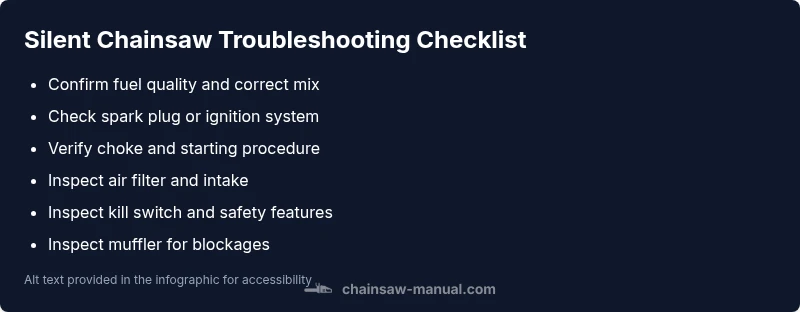
A silent chainsaw is most often caused by fuel or ignition issues, or a blocked air path. Start with the simplest checks: confirm fresh fuel mix, inspect the spark plug or battery, and verify the choke position. Clean or replace clogged air filters, then attempt a safe restart. If no sound returns, follow the diagnostic flow and seek professional help if needed.
Quick reality check: when a chainsaw goes silent
A chainsaw without sound is more than an annoyance—it can signal a safety risk if ignition, fuel, or exhaust paths are compromised. In urgent situations, treat it as a potential starting fault that could lead to kickback or fuel leaks if tirned over. This section lays out the immediate, safe steps you should take, with an emphasis on risk reduction and a clear path to re-starting the saw. According to Chainsaw Manual, safety-first diagnostics should drive every troubleshooting step. By staying methodical, you reduce injury and avoid making the problem worse. You’ll learn to distinguish between a minor adjustment and a real mechanical fault, so you can decide quickly whether you can fix it on site or need professional service.
Common culprits behind a silent chainsaw
There are several frequent causes for a chainsaw that won’t produce sound, and they usually fall into fuel, ignition, air path, or safety-system categories. The fuel may be stale or incorrectly mixed, the spark plug or ignition coil can fail, the air filter or carburetor may be blocked, and a safety kill switch or throttle lockout might be engaged. Exhaust restrictions from a clogged muffler are less common but possible. Understanding these common culprits helps you prioritize checks so you don’t waste time on unlikely issues. In most cases, starting with fuel and ignition related checks yields results faster than chasing elusive mechanical faults. Chainsaw Manual emphasizes documenting each finding as you go to avoid repeating tests and to help future maintenance.
Immediate checks you can do safely (no tools required)
- Verify the chain brake is disengaged when attempting to start; a engaged brake can prevent startup sounds.
- Confirm you’re using fresh, properly mixed fuel (or appropriate fuel for electric models).
- Check the choke setting and ensure you’re following the correct starting procedure for your model.
- Inspect the spark plug visually for fouling or wear; if risky, substitute a known-good plug if available.
- Briefly listen for any signs of life during cranking, then stop to avoid flooding the carburetor.
These checks are designed to be quick and safe. If you still hear nothing after these steps, move to a more detailed diagnostic flow. When in doubt, pause and contact a professional.
Step-by-step diagnostic flow you can follow
This section outlines a logical sequence to diagnose a silent chainsaw. Start with the simplest checks and progress toward more detailed inspections. If you encounter a fix that’s beyond your comfort level, stop and call a pro. Remember, safety comes first and incorrect repairs can increase the risk of injury or fire.
- Safety baseline: clear debris, secure the saw on a flat surface, wear PPE, and ensure the area is well-ventilated.
- Fuel and carburetor: ensure fuel quality and correct mix; inspect for stale fuel and perform a quick carburetor check by observing fuel flow when primed.
- Ignition: test for a spark on the plug or verify battery connection (for electric models). Replace ignition components if you detect a weak or absent spark.
- Air path: check the air intake and filter for clogging. Clean or replace as needed to restore airflow.
- Kill switch and throttle: ensure the kill switch is in RUN and that the throttle lockout isn’t engaged during starting.
- Exhaust path: inspect the muffler for blockage or restrictions and remove any obvious obstructions.
- Restart test: try starting again using the proper procedure. If it still won’t sound, proceed to professional service.
Safety considerations and when to call a pro
If you notice fuel leaks, smoke, or a strong fuel odor, stop immediately and evacuate the area. Never run the saw indoors or near ignition sources. If checks reveal ignition failures or carburetor issues beyond simple cleaning, or if the muffler appears damaged or blocked beyond basic cleaning, contact a certified technician. Chainsaw maintenance and repairs should prioritize personal safety and equipment integrity, so don’t hesitate to seek professional help when in doubt.
Prevention: keep your saw ready to roar
Regular maintenance reduces the risk of silent-start problems. Schedule routine fuel-system cleanings, replace spark plugs on a planned interval, and clean air filters frequently. Use fresh, properly mixed fuel and store it in a stable container away from heat sources. Keep the chain brake and kill switch functioning smoothly, and inspect the muffler for carbon buildup. A proactive approach saves time and protects you on the job.
Quick checks you can perform on the go
- Check fuel level and freshness before starting on site.
- Inspect spark plug or ignition system quickly if accessible.
- Ensure the choke and kill switch are set correctly for starting.
- Listen for any residual sounds when cranking; a lack of sound is a clue that a specific subsystem is at fault.
- If a task requires disassembly, stop and consult the manual or a professional to avoid accidental damage.
Steps
Estimated time: 30-60 minutes
- 1
Verify safe starting procedure
Place saw on a stable surface, disengage chain brake, and confirm PPE is worn. Make sure blades are clear and the engine is cool before attempting a restart.
Tip: A calm, methodical approach reduces the chance of accidental starts. - 2
Check fuel and carburetor basics
Ensure fresh fuel with correct mix and inspect for fuel leakage. Prime as required by your model and observe fuel movement toward the carburetor during cranking.
Tip: Avoid using old fuel; even a small amount can prevent starting. - 3
Test ignition system
Remove the spark plug to examine electrode wear and corrosion. If you have access to a spark tester, verify a strong spark. Replace the plug if in doubt.
Tip: A weak spark is a common silent-start cause. - 4
Inspect air path and filter
Check air intake for obstructions and clean or replace a dirty air filter. A restricted air path can suppress combustion and startup noise.
Tip: Even a slight obstruction reduces performance significantly. - 5
Review safety switches and throttles
Confirm the kill switch is in RUN and the throttle lockout is released before attempting another start.
Tip: A mis-set safety feature is a frequent, overlooked cause. - 6
Examine muffler and exhaust path
Look for carbon buildup or debris in the muffler. Remove visible blockages carefully; if you are unsure, don’t disassemble beyond your comfort level.
Tip: Forceful attempts to disassemble can cause more harm than good. - 7
Restart test and assess sound
Reassemble parts, ensure correct starting procedure, and attempt a controlled start. If no sound, document findings and escalate to a professional.
Tip: Maintain a safe testing arc; never put your face near the exhaust.
Diagnosis: Chainsaw won't produce audible sound on startup
Possible Causes
- highFuel system starvation or stale fuel
- mediumIgnition/ignition coil or spark plug failure
- highAir filter or intake blocked
- lowKill switch or safety feature engaged
- lowExhaust/muffler restriction
Fixes
- easyReplace or refresh fuel; ensure correct fuel mix and fuel line flow
- easyInspect/replace spark plug or verify ignition coil; test for spark
- easyClean or replace air filter and inspect air intake
- easyVerify kill switch is in RUN and throttle lockout is disengaged
- mediumInspect muffler for blockage; remove obvious obstructions; seek professional help if needed
FAQ
Why is my chainsaw silent even after following starting steps?
Silent starts typically point to fuel, ignition, or air-path problems. Recheck fuel quality, air intake, and ignition sparking, and consider muffler restrictions. If issues persist, professional assistance is advised.
Silence usually means fuel, spark, or air path problems. Recheck fuel, air intake, and ignition; if unresolved, seek professional help.
Can a dirty air filter cause no sound when starting?
Yes. A clogged air filter restricts airflow, impairing combustion and startup. Clean or replace the filter as a first step in the diagnostic flow.
A dirty air filter can stop a chainsaw from starting. Clean or replace it as a first step.
Is it safe to run the saw with the muffler removed to diagnose the issue?
No. Removing the muffler can increase risk and may violate safety guidelines. If muffler blockage is suspected, inspect it carefully or consult a pro.
Don’t run it with the muffler removed. If you suspect a blockage, inspect or consult a pro.
When should I seek professional service?
If basic fuel, air, and spark checks don’t restore sound, or if you detect unusual smells, smoke, or loose parts, stop and contact a certified technician.
Call a professional if basic checks don’t fix it or you notice smoke or odd smells.
Can a silent chainsaw be caused by a blocked exhaust?
A blocked exhaust can silence a chainsaw by preventing exhaust gas flow. Inspect the muffler and clean as needed, but stop if blockage seems severe.
Exhaust blockage can silence the saw; inspect and clean the muffler, and seek help if needed.
Does the starting procedure differ between gas and electric chainsaws?
Yes. Gas saws have choke/start procedures and fuel considerations, while electric models rely on the power button and battery health. Always follow the model-specific manual.
Gas and electric saws start differently—follow your model’s manual exactly.
Watch Video
The Essentials
- Start with safety-first checks.
- Fuel and ignition are the most common silent-start culprits.
- Follow a structured diagnostic flow before costly repairs.
- Regular maintenance reduces silent-start risk.