How to Install a Chainsaw Wall Mount: Step-by-Step Guide
Comprehensive, safety-first instructions for selecting, mounting, and maintaining a chainsaw wall mount to keep your workshop organized and secure.


Install a secure, wall-mounted chainsaw wall mount by locating studs, selecting a rated mount, and using proper fasteners. This quick guide outlines placement, attachment, and safety checks, followed by a detailed, step-by-step installation process for a durable, safe setup in a home workshop.
Positioning for safe use
A chainsaw wall mount transforms a cluttered workshop corner into a safe, organized space. The right mount keeps the bar and chain shielded from accidental contact, reduces tripping hazards, and makes the saw quickly accessible when you need it. Start by visualizing a workflow: where you stand to start a cut, where you carry fuel and bar oil, and how you avoid cable or tool interference. In addition, plan for regular maintenance tasks such as cleaning the bar, checking the chain, and inspecting mounting hardware. According to Chainsaw Manual, thoughtful placement can significantly lower the risk of injuries and tool damage, especially in busy home shops. This section sets the foundation for a safe, efficient setup that integrates with existing storage practices.
Key takeaway: a well-placed mount supports safe operation and smooth workflow in any workshop.
Assess weight, compatibility, and load path
Before selecting a chainsaw wall mount, determine the saw’s weight, bar length, and balance point. Weight ratings and mounting patterns vary by model; choose a mount with a load rating comfortably above the saw’s weight. Consider the wall type (drywall over studs, solid concrete, or brick) and the load path from the saw to the wall. The load path should pass through solid anchors or studs, never solely through drywall. In practice, you’ll want a mount that aligns with the saw’s center of gravity to minimize sway and reduce vibration transfer to the wall. Chainsaw Manual emphasizes matching the weight class of the saw to the mount’s rated capacity for long-term safety and performance.
Tip: confirm that the mount’s mounting holes align with studs or appropriate anchors at the intended height.
Choosing the right mounting hardware
Hardware is the backbone of a secure wall mount. For wooden walls with studs, heavy-duty lag screws or bolts anchored into studs provide the strongest hold. On masonry walls, use approved masonry anchors or sleeve anchors designed for high loads. Always pair fasteners with washers to distribute load and prevent pull-through. Select mounting brackets with a compatible hole pattern for your saw’s mounting points. If you’re unsure about the hardware, consult the mount’s installation guide or a hardware professional. The goal is to achieve a rigid, vibration-free connection that can withstand repeated handling without loosening over time.
Pro tip: carry a small magnet to confirm stud locations behind drywall during planning.
Wall type and anchor planning (studs vs masonry)
Drywall over wooden studs is the most forgiving surface for mounting a heavy tool like a chainsaw wall mount. Locate studs with a stud finder and confirm their edges with a small nail test before drilling. For masonry walls, mark the anchor locations carefully and drill with a hammer drill and the correct masonry bit. Use the recommended anchors and fasteners for the wall material, and consider adding a backing board if the wall surface is uneven. Planning the anchor type ahead of time reduces the risk of drilling into pipes or wires and improves overall safety.
Note: never rely on drywall alone for heavy equipment; always transfer load to structural elements.
Measuring, marking, and leveling the installation
Precision matters for a stable mount. Use a level to draw a straight line for the top edge of the bracket, and double-check measurements from floor to bracket height. Mark the pilot hole locations through the mount’s mounting holes, then drill pilot holes at the correct depth. If fastening into studs, ensure you drill near the center of the stud for maximum bite. If you must work with multiple mounting points, measure each point to maintain even load distribution and visual alignment.
Tip: verify clearance around the saw so you can open and close the blade guard without interference.
Bracket installation and first attachment
With pilot holes prepared, fasten the wall bracket to the wall using the chosen hardware. Start with one screw in each mounting point to loosely hold the bracket, then check alignment with a level. If needed, adjust before fully tightening. Use a torque pattern that seats the fasteners and avoids overtightening, which can strip the wall or crack the bracket. The bracket should sit flush against the surface with no wobble when you apply a gentle sway test.
Warning: wear eye protection during drilling and be mindful of nearby wiring or pipes in the wall cavity.
Securing the chainsaw to the mount
Mounting the saw involves aligning the saw’s mounting points with the bracket’s hooks or clamps. Use the provided locking mechanism or strap to secure the saw so it cannot shift or fall if bumped. Ensure the bar does not protrude into the space of your work area or tool bench. Balance weight so the saw hangs steadily, with the chain away from any accidental contact zones. Regularly inspect the fastening hardware for tightness after the first few uses and after any heavy impact or vibration.
Pro tip: test by gently pulling on the saw; if there’s any give, re-tighten and verify alignment.
Clearance, access, and maintenance considerations
A good wall mount leaves enough clearance for your hands to operate the saw safely, with room for occasional adjustments and blade changes. Consider ambient lighting and the proximity to fuel storage to minimize spill risk. Periodic maintenance includes cleaning dust, re-tightening fasteners, and inspecting for corrosion or wear. If you notice looseness after a few weeks, re-anchor with longer or higher-grade fasteners designed for your wall type. A properly maintained chainsaw wall mount keeps the tool ready for quick access while preserving workshop organization and safety.
Warning: never store a running chainsaw on a wall mount; always turn off the engine and remove the key before mounting.
Safety protocols, PPE, and personal workflow
Safety begins with PPE: gloves, eye protection, hearing protection, and steel-toed boots as appropriate. Create a defined workflow for lifting, positioning, and securing the saw to avoid pinch points or accidental contact with hot exhaust or moving parts. Store fuel and oil separately away from heat sources and always disconnect spark plugs if performing maintenance while mounted. Establish a routine that includes a quick visual inspection of the mount, the locking mechanisms, and the surrounding area before using the saw. Chainsaw Wall Mount systems improve safety when they are paired with clear standard operating procedures.
Note: never bypass safety features or skip lock-down procedures for speed.
Common mistakes and fixes
Common mistakes include mounting too high or too low, using drywall screws without anchors, and choosing a mount that cannot bear the saw’s weight. Others neglect to check for clearance around the blade or fail to level the bracket, which results in wobble and fatigue on the mounting points. Fixes include reassessing height, replacing inadequate fasteners with rated hardware, and re-checking alignment with a level and measuring tape. In some cases, adding a backing board or a supplemental bracket can distribute load more effectively and reduce wall stress.
Pro tip: plan the installation in a dry run without drilling; visualize all three axes of movement before final mounting.
Adapting to different workshop layouts and future needs
Workshops change: tool inventories grow, walls get repurposed, and floor space shifts with renovation. A modular mounting system that allows repositioning or the addition of extra hooks can future-proof your setup. When you expect growth or frequent reconfiguration, choose a wall mount with multiple adjustment points or a compatible expansion kit. A flexible approach ensures your chainsaw wall mount remains safe, accessible, and integrated with other storage solutions as your shop evolves.
Pro tip: document mounting positions with a simple sketch or photo so you can reproduce or modify your layout later.
Tools & Materials
- Stud finder(Use to locate exact stud centers; test multiple spots to confirm consistent results)
- Drill with bits (pilot and screw bits)(1/8 inch pilot for wood; ensure bits are sharp and appropriate for the wall material)
- Hammer drill and masonry bits(Necessary for masonry walls (brick/concrete); ensure correct bit type and masonry anchor compatibility)
- Lag bolts or heavy-duty screws(Choose length crossing into stud by 1.5–2.5 inches; use washers to distribute load)
- Wall anchors (wood screws, toggle/expansion for masonry)(Use only if mounting into masonry or where studs aren’t aligned with mounting holes)
- Level(Precisely level bracket to prevent slippage and uneven load stress)
- Wrench/Socket set(Tighten fasteners to manufacturer torque recommendations)
- Screwdriver set (Phillips/flathead)(Used for bracket and accessory screws)
- PPE (gloves, eye protection, hearing protection)(Always wear PPE during drilling and mounting; protect hands and eyes)
- Measuring tape(Accurate measurements for spacing and height; double-check before drilling)
- Backing board or plywood(Optional, adds distribution surface in soft walls or uneven surfaces)
- Lubricant or dust remover(Keep holes clean to improve screw bite and alignment)
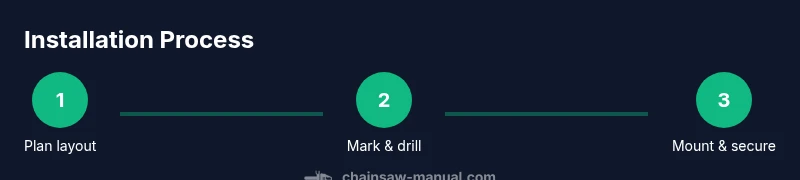
Steps
Estimated time: 90-120 minutes
- 1
Assess space and select mount
Evaluate your workshop layout to choose a mount that aligns with the saw’s weight, bar length, and balance point. Confirm compatibility with the wall type and available anchors. This planning step prevents rework and ensures a stable installation.
Tip: Document saw weight and mounting pattern before you drill. - 2
Locate studs or masonry anchors
Use a stud finder to locate structural studs or identify suitable masonry anchors. Mark precise locations for the mount’s holes, ensuring even spacing and alignment with the saw’s mounting points.
Tip: Double-check each mark with a level before drilling. - 3
Mark and drill pilot holes
Mark pilot hole locations and drill pilot holes to the appropriate depth for your chosen fasteners. Pilot holes minimize wood splitting and ensure the hardware bites securely.
Tip: Keep drill perpendicular to the wall for straight holes. - 4
Attach wall bracket to wall
Position the bracket, insert screws or bolts, and loosely tighten to allow small adjustments. Verify level and alignment before final tightening.
Tip: Start with one fastener in each corner to hold the bracket steady. - 5
Tighten and verify mounting
Fully tighten all fasteners to manufacturer torque specs. Re-check level and ensure no wobble when you apply gentle force to the bracket.
Tip: Test load capacity by applying gentle, steady pressure. - 6
Prepare chainsaw mounting points
Align the saw’s mounting points with the bracket’s hooks or clamps. Ensure compatibility and that there’s no interference with the bar or chain.
Tip: Slide the saw slowly into place to avoid scratches. - 7
Secure the chainsaw
Engage the locking mechanism or strap to secure the saw. Confirm there is no play and that the weight is evenly distributed across the mount.
Tip: Check for any movement with a light push and pull. - 8
Check clearances and accessibility
Ensure there is room for blade access, oil cap removal, and fuel handling without obstruction. Confirm the saw remains accessible and safe to remove.
Tip: Keep a clear path for quick, safe removal. - 9
Perform safety checks
Inspect for loose hardware, sharp edges, and potential pinch points. Verify the area around the mount is free of clutter and flammable materials.
Tip: Wear PPE during final check and testing. - 10
Document and maintain
Record installation details and maintenance schedule. Plan periodic inspections to tighten fasteners and confirm condition.
Tip: Set a reminder for quarterly maintenance.
FAQ
What is a chainsaw wall mount and why should I use one?
A chainsaw wall mount is a bracket or rack attached to a wall to hold a chainsaw securely off the floor. It improves safety, keeps the workspace organized, and makes the saw quickly accessible. By reducing clutter and creating predictable storage, it helps prevent accidental contact with the chain and bar.
A wall mount holds your saw securely on the wall, away from floor traffic and tools, making it safer and easier to reach.
How much weight can a typical chainsaw wall mount support?
Weight capacity depends on the specific mount model and wall construction. Always choose a mount rated for the saw’s weight and double-check the installation surface to ensure it can carry the load.
Check the mount’s rating and match it to your saw’s weight for a safe setup.
Do I need to mount into studs or masonry to be safe?
For wood walls, mount into studs for the strongest hold. For masonry walls, use appropriate anchors. Do not rely on drywall alone to bear the load.
Yes—use studs for wood walls or proper anchors for masonry to ensure safety.
Is it safe to run the chainsaw while mounted?
No. Do not operate or run the chainsaw while it is mounted. Mounts are for storage and safe retrieval, not for operation.
Never run the chainsaw while it’s mounted.
Can I mount more than one chainsaw on a single rack?
Some mounts are designed for multiple saws, but you must verify weight limits and spacing. If in doubt, use separate mounts to maintain balance and safety.
If you have more than one saw, check the load rating and space; it’s often safer to use individual mounts.
What maintenance is required after installation?
Regularly inspect all fasteners for tightness, clean away dust and oil, and check for corrosion or wear on brackets. Re-tighten or replace hardware as needed to maintain safety.
Keep the mount clean and check fasteners every few months.
Watch Video
The Essentials
- Mount the saw on solid walls (studs/mixed anchors) for stability
- Use hardware rated above the saw’s weight and balance
- Level, mark, and pilot holes before attaching brackets
- Secure the chainsaw with a locking mechanism and test for movement
- Regularly inspect hardware and keep the area clear of hazards