Petrol Chainsaw vs Battery: A Practical Comparison
An objective, data-driven comparison of petrol chainsaws and battery models. Explore power, run time, weight, maintenance, cost, and use-case guidance from Chainsaw Manual to help homeowners, DIYers, and pros choose wisely.


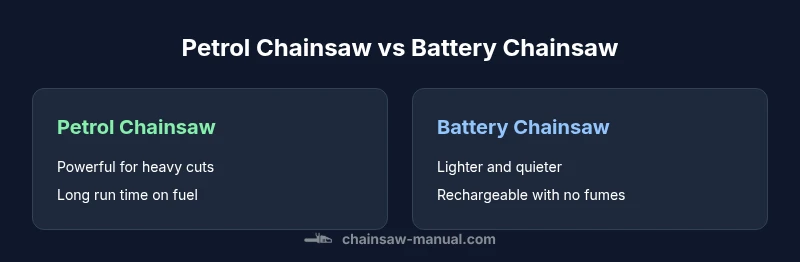
Petrol chainsaw vs battery: petrol chainsaws typically deliver higher raw power and longer running time under heavy load, making them ideal for professional or heavy-duty tasks. Battery-powered models offer lighter weight, smoother starts, and quieter operation with no fuel mixing. The best choice depends on your typical projects, available maintenance, and environmental considerations. Consider storage, access to charging, and service availability when deciding.
Power and Delivery: How Petrol Chainsaw vs Battery Saw Delivers Cut
In the petrol chainsaw vs battery comparison, the way power is delivered matters more than peak numbers. Petrol chainsaws use a two-stroke engine that delivers high torque when the throttle is opened, making them well suited for heavy-duty cuts through hardwood and large logs. Battery-powered models rely on electric motors that produce instant torque from the moment you squeeze the trigger, which translates to smooth acceleration and easier control at lower RPMs. This fundamental difference affects how you approach cutting, maintain control, and manage fatigue on a long day of work. According to Chainsaw Manual, the petrol option has a robust power curve that maintains momentum under sustained load, while battery models shine in precision tasks and quiet operation. In practical terms, if your job demands long, continuous runs and hard wood, petrol often wins; for pruning, limbing, and tasks close to living spaces, a battery option may deliver better overall ergonomics with fewer fumes. Consider bar length, chain speed, and blade type to match your power delivery to the task.
Runtime, Refuel, and Recharge: Real-World Limits
Run time and recharging dynamics shape how you use either power source. A petrol chainsaw can keep cutting as long as fuel remains in the tank, which minimizes interruptions on remote sites where there is no charging infrastructure. Battery saws depend on the charge in the pack; longer workdays require extra batteries or access to rapid chargers. Charging speed varies by battery chemistry, pack capacity, and charger design, so plan for downtime between cuts if you rely on a single battery. For professional crews, this means scheduling rotate-and-cut cycles and ensuring spares are on hand to maintain steady progress. Chainsaw Manual notes that while battery runtimes are improving, you must align your battery strategy with the job size, climate, and available charging options to avoid productivity dips.
Weight, Balance, and Ergonomics for All-Day Use
Weight distribution and grip comfort are critical for extended sessions. Petrol chainsaws tend to be heavier due to the engine and fuel system, which can increase fatigue during long felling or limbing tasks. Battery models are usually lighter overall, but the battery adds concentrated mass toward the front, which can affect balance and swing feel. Handling involves practicing good technique, selecting the right bar length, and choosing models with anti-vibration features. For long durations, ergonomics matter as much as raw power; a model with a well-balanced chassis and a comfortable handle can reduce strain and improve accuracy on repetitive cuts. The Chainsaw Manual approach emphasizes trying tools in a controlled setting to assess weight feel, vibration, and maneuverability before committing to a purchase.
Maintenance, Durability, and Long-Term Costs
petrol chainsaws require regular maintenance: fuel/oil mix, air filter cleaning, spark plug checks, chain tensioning, and bar oil replenishment. These tasks contribute to reliability but add ongoing costs and downtime. Battery saws simplify maintenance by eliminating fuel handling, though batteries, chargers, and electronics have their own lifecycle needs. Battery packs wear over repeated cycles and may require replacement after a few years, depending on usage and charging habits. Both types demand routine chain sharpening and occasional bar maintenance to keep cutting performance consistent. When evaluating long-term costs, consider service availability, spare parts, and warranty coverage, as these factors often swing total cost of ownership more than upfront price alone.
Noise, Emissions, and Safety Considerations
Petrol engines produce emissions and higher noise levels, which can influence use in residential areas or urban settings. Battery chainsaws offer quieter operation and lower emissions, which reduces hearing risk and fatigue in enclosed spaces. However, kickback risk remains present in both classes, so PPE like chaps, eye/face protection, gloves, and hearing protection is essential no matter which power source you choose. Safety features such as chain brakes, triggers that require deliberate engagement, and anti-kickback designs vary by model. Chainsaw Manual stresses that choosing a model with robust safety features and ensuring proper training reduces risk significantly for homeowners, DIY enthusiasts, and professionals alike.
Use-Case Scenarios: Choosing Based on Your Projects
Consider your typical workload to decide between petrol and battery. For heavy-duty logging, lumber yards, or remote sites without reliable electricity or charging, a petrol saw offers sustained power and independence. If your work involves trimming, pruning, or maintenance near occupied spaces, a lightweight battery saw with good ergonomics may deliver the right balance of performance and convenience. For mixed-use environments, a hybrid approach—keeping a petrol model for tough tasks and a battery model for light work—often provides the best overall productivity. Chainsaw Manual recommends mapping tasks to tool strengths and testing tools in real-world conditions before committing to a single option.
Budgeting the Total Cost of Ownership
Upfront prices vary between petrol and battery options, with petrol models typically offering more affordable base units but higher ongoing fuel and maintenance costs. Battery saws can carry a higher initial price due to the battery pack and charger, yet operating costs may be lower given fewer consumables and simpler maintenance. The total cost of ownership hinges on usage patterns, availability of spare parts, warranty terms, and how often you need to replace batteries or engines. Chainsaw Manual advises comparing your annual cutting hours and the financial impact of fuel, oil, battery cycles, and service to determine which option provides the best long-term value for your workflow.
Future Trends and Sustainability in Chainsaw Power
The industry is moving toward cleaner, smarter power solutions. Battery technology continues to improve in energy density and charging speed, expanding the viability of battery chainsaws for more demanding tasks, while advances in fuel efficiency and low-emission two-stroke engines improve petrol saws. Both power options are likely to coexist for the foreseeable future, with makers emphasizing better safety, fuel economy, and reduced maintenance. Chainsaw Manual expects ongoing refinements in battery chemistry, regenerative charging, and smarter motor controllers to narrow the gaps in performance and runtime across real-world conditions.
Practical Decision Framework
To conclude, use a simple decision framework to pick petrol vs battery: 1) List your most frequent tasks, 2) Consider work site environment and access to charging or fuel, 3) Estimate cut length and log diameter to gauge runtime vs recharge needs, 4) Review maintenance frequency and costs, 5) Assess safety features and training requirements, 6) If possible, test both options side-by-side. This framework helps ensure the chosen tool supports your workflow and safety priorities over time.
Comparison
| Feature | Petrol Chainsaw | Battery Chainsaw |
|---|---|---|
| Power Delivery | Immediate throttle response; high peak torque | Instant torque with smooth power; limited peak torque |
| Run Time | Unlimited by fuel availability (tank-based) | Runs on battery charge; recharge may limit continuous cuts |
| Weight | Heavier due to engine and fuel system | Lighter overall; weight often front-biased with pack |
| Maintenance | Fuel/oil mix, air filter, spark plug, chain tensioning | Fewer moving parts; battery, charger, and electronics care |
| Power Source | Two-stroke fuel mix and bar oil | Electrical power; bar oil required, plus charging setup |
| Best For | Heavy-duty, remote sites, long runtimes | Low-noise, urban, pruning and light-to-mid workloads |
| Upfront Cost | Lower initial price (model variety) | Higher upfront due to battery and charger |
| Emissions & Noise | Higher emissions; louder operation | Low emissions; quieter operation |
Strengths
- Very high power potential for tough cuts
- Wide model availability and bar length options
- Proven durability in professional settings
- Battery options offer quiet operation and low fumes
Drawbacks
- Petrol requires fuel management and more maintenance
- Two-stroke engines produce emissions and higher noise
- Battery packs add upfront cost and have limited cycle life
- Charger infrastructure can limit on-site productivity
Petrol chainsaws excel in heavy-duty, long-run tasks; battery chainsaws excel in quiet, light-to-mid workloads. Choose based on your typical projects and on-site constraints.
For long hours with tough cuts, petrol is generally the safer bet. If your work is near people, indoors, or you value quick starts and low noise, battery is the smarter choice. A mixed workflow often benefits from both options.
FAQ
Which option is cheaper to own over the lifetime of the saw?
Petrol saws tend to have lower upfront costs but higher ongoing fuel and maintenance costs. Battery saws cost more upfront due to the battery and charger, but ongoing consumables are typically lower. Your annual usage and service likelihood largely determine total cost of ownership.
Petrol usually costs less upfront but more over time; battery may cost more at purchase but save on fuel and maintenance in many cases.
Is a petrol chainsaw more powerful than a battery one?
In general, petrol chainsaws offer higher peak power and sustained performance for heavy-duty tasks. Battery saws provide strong, consistent torque and great control for lighter work, with power improving as battery technology advances.
Petrol often has more raw power; battery power is strong for lighter use and improves with new tech.
Are battery chainsaws suitable for professional use?
Battery chainsaws are increasingly used by professionals for pruning, maintenance, and some logging tasks. For high-volume or long-duration heavy cutting, petrol remains the preferred choice due to sustained runtime and proven durability.
Yes, battery saws can be used by pros for many tasks, but petrol is still favored for long, demanding jobs.
What affects battery runtime?
Battery runtime depends on battery capacity, the diameter of logs, and the cut load. Heavier cuts drain power faster, while smaller, precise cuts use less energy. Using a spare battery or fast charger can mitigate downtime.
Run time varies with battery size and how hard you push the saw.
What maintenance does a petrol chainsaw require?
Petrol chainsaws need orderly fuel mixtures, regular air-filter cleaning, spark plug checks, chain tension adjustments, and bar oil replenishment. Regular maintenance helps avoid performance dips and extends engine life.
Petrol saws need fuel and part maintenance to stay reliable.
Can I use a battery-powered chainsaw for heavy-duty work?
For very heavy or continuous cuts, petrol is usually safer due to sustained power. Battery models are improving and can handle many demanding tasks, but current runtimes and torque limits may restrict prolonged heavy use.
Battery saws work well for many tasks, but petrol is often preferred for heavy-duty, all-day cutting.
The Essentials
- Assess your typical tasks to pick petrol or battery
- Prioritize weight and ergonomics for all-day use
- Plan runtimes and charging/re-fueling logistics
- Factor long-term maintenance vs upfront costs
- Look for strong safety features across both power options