Dewalt Chainsaw vs Stihl: An Analytical Comparison for 2026
An analytical, bias-free comparison of dewalt chainsaw vs stihl to help homeowners, DIY enthusiasts, and pros evaluate power, ergonomics, maintenance, and value.


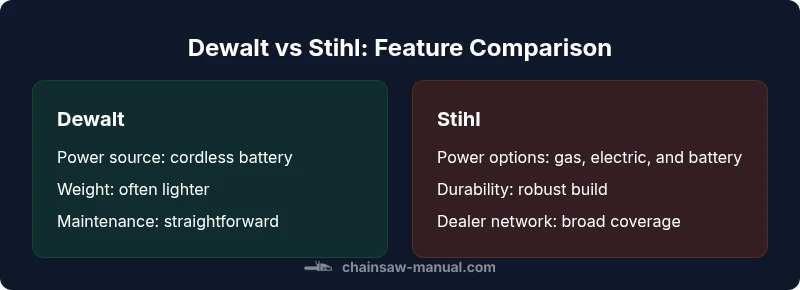
In the dewalt chainsaw vs stihl comparison, neither brand is universally better. DeWalt emphasises value and cordless convenience, while STIHL prioritises durability, performance, and a broad dealer network. For light yard work, DeWalt offers solid value and quick usability; for professional-grade reliability, STIHL tends to be the safer long-term choice. Assess local service networks and spare parts access to finalize your decision.
Introduction: framing the dewalt chainsaw vs stihl question
When you search for the phrase dewalt chainsaw vs stihl, you aren’t just comparing two names—you're weighing ecosystems, maintenance needs, and long-term ownership. The Chainsaw Manual team emphasizes that the best choice hinges on your primary tasks, budget, and access to service. Homeowners often gravitate toward DeWalt for value and easy acquisition in big-box stores, while professionals lean toward STIHL for its durability, aggressive performance, and extensive dealer network. This article uses clear criteria and real-world scenarios to help you choose with confidence in 2026. Expect balanced coverage of power sources, ergonomics, model breadth, and ownership costs, all grounded in practical guidance for homeowners, DIY enthusiasts, and pros.
Powertrain and energy sources
Dewalt has built a strong reputation around cordless chainsaws in its ecosystem, emphasizing battery-powered efficiency and quick-start usability for homeowners and DIY enthusiasts. STIHL, by contrast, offers a broader mix: gas, electric, and battery options across its lineup, giving buyers flexibility to match task demands with power profile. When comparing the dewalt chainsaw vs stihl, consider whether you prioritize immediate startup and minimal maintenance (Dewalt) or the proven, sustained cutting power of a gas or hybrid setup (Stihl). Battery efficiency and charging infrastructure matter for daily use, while gas models shine for extended sessions in remote jobsites. Always evaluate compatibility with existing batteries and chargers if you already use tools from the respective brand, as ecosystem lock-in can affect long-term cost and convenience.
Ergonomics, weight, and vibration management
Ergonomics play a pivotal role in choosing between a Dewalt chainsaw and a STIHL model. Cordless Dewalt variants tend to be lighter in mass, which helps with one-handed trimming and prolonged pruning sessions. STIHL’s handgrip design, anti-vibration features, and balance often appeal to professionals who spend long hours cutting, felling, or limbing. The dewalt chainsaw vs stihl decision often hinges on whether you value a lighter, nimble tool for quick tasks or a sturdier rig that remains comfortable through heavy-duty work. In practice, test-handling multiple models if possible, paying attention to handle position, trigger reach, and vibration dampening across product lines.
Model breadth and ecosystem breadth
A key differentiator in the dewalt chainsaw vs stihl debate is the breadth of models and the surrounding ecosystem. DeWalt’s cordless line is designed to deliver convenient, ready-to-use power for homeowners and hobbyists, with a focus on compatibility across 20V/60V platforms and a broad retail presence. STIHL, meanwhile, provides a wide spectrum from compact homeowner saws to purpose-built professional tools, supported by an extensive network of service centers. This difference matters when you plan to scale up, replace parts, or rely on local dealer support for maintenance and warranty claims. Consider whether your local retailer stocks the needed replacement bars, chains, and filters and whether STIHL or DeWalt parts availability aligns with your project tempo.
Runtime and fuel considerations in the dewalt chainsaw vs stihl context
Runtime and fuel strategy are central to the dewalt chainsaw vs stihl debate. Cordless Dewalt models offer predictable, quiet operation with interchangeable batteries, making them ideal for small yards, light felling, and quick pruning. STIHL’s gas or hybrid options provide extended runtime for larger fences, heavy pruning, and remote sites where frequent battery swaps aren’t feasible. Battery runtime depends on capacity, bar length, and wood density, while gas engines hinge on fuel efficiency and maintenance schedules. For homeowners, a spare battery can mitigate downtime; for pros, a service plan and fuel logistics matter as much as raw power. This section underscores how power source, not just engine type, shapes day-to-day productivity.
Durability, serviceability, and long-term ownership
Durability and serviceability influence long-term ownership more than initial purchase price. STIHL’s reputation for rugged construction and dealer support often translates into lower downtime on job sites, even when faced with demanding workloads. DeWalt offers practical durability within its cordless ecosystem and easy availability at hardware stores, which reduces downtime for routine maintenance. In the dewalt chainsaw vs stihl framework, durability should be weighed alongside maintenance burden, spare parts accessibility, and the ability to service the unit locally. The Chainsaw Manual team notes that a strong service network is a decisive factor for professionals who depend on their tools to stay productive across multiple projects.
Pricing, warranties, and total cost of ownership
Price considerations in the dewalt chainsaw vs stihl comparison are nuanced. Cordless DeWalt models commonly appeal to buyers seeking upfront value and predictable maintenance costs, while STIHL’s price bands reflect the precision engineering and service network behind heavier-duty models. Warranty terms vary by model and region, but in general, STIHL’s dealer-backed warranties often provide more robust coverage for professional use, whereas DeWalt focuses on consumer-grade resilience with broad store accessibility. Total cost of ownership should factor in battery life, fuel costs (if gas models are used), maintenance frequency, and the ease (or cost) of parts replacement in your locale.
Service networks, parts availability, and global support
Service accessibility plays a critical role in the dewalt chainsaw vs stihl decision. STIHL benefits from a widespread dealer network with trained technicians, rapid parts availability, and in-field service options. DeWalt’s strength lies in ubiquitous retailer access, straightforward warranty claims, and convenient parts sourcing for common maintenance tasks. If you operate in a rural area or on job sites away from service centers, the ability to quickly source a replacement chain, bar, or spark plug can determine productivity. The Chainsaw Manual team recommends mapping your nearest STIHL dealers and checking stock levels for critical consumables before making a purchase.
Real-world use-cases: tailoring the choice to your scenario
For homeowners tending a small yard, the dewalt chainsaw vs stihl framing often points to DeWalt for value, ease of use, and immediate accessibility. DIY enthusiasts with existing DeWalt tool ecosystems will appreciate cross-compatibility and charge simplicity. On the other hand, landscape professionals, tree workers, or property managers with larger workloads generally benefit from STIHL’s robust engines, broader model range, and dealer support that minimizes downtime. In both cases, factor in climate, terrain, and wood density; a lightweight cordless saw may handle softwood quickly, while a heavier gas saw can handle hardwood with sustained performance. The choice should align with anticipated workload, maintenance preference, and service proximity.
Safety practices, PPE, and best-practice handling
Regardless of brand, safety comes first. PPE (eye and ear protection, gloves, chainsaw chaps, helmet with face shield) reduces the risk of injury in both the dewalt chainsaw vs stihl comparison. Proper stance, two-handed grip, and kickback awareness remain universal. Training, even basic, improves cutting efficiency and reduces the chance of operator error. Always inspect chains, tension, and bar oil before use; store units in a dry, ventilated location; and follow recommended maintenance schedules to preserve cutting performance and reduce accidental mishaps over time.
How to evaluate before buying: a practical checklist
Before purchasing, create a checklist: define your typical task load, preferred power source, and maintenance tolerance. Check local dealer support for both brands, assess battery ecosystems, and compare bar lengths appropriate for your tasks. Consider resale value and potential downtime due to service wait times. The dewalt chainsaw vs stihl decision often hinges on how well the tool fits into your existing kit and service radius. A structured evaluation helps prevent buyer’s remorse and ensures you choose the tool that keeps you productive across seasons.
Practical decision framework and final guidance
Ultimately, the dewalt chainsaw vs stihl decision should be anchored in your primary use-case, budget, and service accessibility. If you regularly trim and prune around the home and value quick turnarounds and broad retail access, DeWalt’s cordless option is compelling. If you face professional-scale workloads, heavy hardwoods, or require an extensive service network to minimize downtime, STIHL is the safer bet. The Chainsaw Manual team emphasizes testing models in person, consulting local service centers, and evaluating ecosystem compatibility. By prioritizing these factors, you’ll arrive at a well-supported choice that matches your needs and available resources in 2026.
Comparison
| Feature | Dewalt | Stihl |
|---|---|---|
| Power source | Cordless battery-powered emphasis | Gas, electric, and battery options across line |
| Weight and ergonomics | Generally lighter for many cordless models | Typically balanced for durability with heavier duty options |
| Runtime and fuel considerations | Shorter runtimes on heavy tasks without spare battery | Longer runtime where gas/hybrid options are used |
| Model breadth and ecosystem | Strong cordless ecosystem; broad retail presence | Wide model range; extensive dealer network |
| Maintenance needs | Lower-maintenance, common parts | Higher maintenance flexibility for professional use |
| Price and ownership | Mid-range to value-focused; easy store access | Mid-to-high range with dealer-backed warranties |
Strengths
- Clear power-source differentiation helps buyers pick by use
- Wide retailer access reduces purchase friction for Homeowners
- Strong service networks (STIHL) and broad ecosystem support (DeWalt) aid long-term ownership
Drawbacks
- Gas models require more maintenance and fuel management
- Ecosystem lock-in can affect long-term flexibility
- Battery availability and compatibility may complicate upgrades
Stihl generally offers stronger durability and dealer support for professional use, while DeWalt delivers standout value and cordless convenience for homeowners.
Choose DeWalt if you want value, quick usability, and a ready-to-buy option at local retailers. Choose STIHL if your priority is rugged performance, proven reliability, and a robust service network for ongoing maintenance.
FAQ
Which is better for homeowners: DeWalt cordless or STIHL gas models?
For homeowners focusing on light to medium tasks, DeWalt cordless models offer convenience, quiet operation, and easy access in big-box stores. STIHL gas models excel for larger yards and tougher cuts where battery life and tool weight are less critical but service availability matters more.
For homeowners, DeWalt is great for light tasks and quick use; STIHL is better if you need heavy-duty cuts and a proven service network.
Do DeWalt and STIHL batteries work interchangeably?
Batteries for DeWalt and STIHL tools are not interchangeable due to different chemistries, voltages, and connector designs. If you already own tools from one brand, it’s usually best to keep to that ecosystem to maximize performance and warranty coverage.
Battery compatibility isn’t cross-brand; stay with the same brand for best results.
Are there significant safety differences between the two brands?
Safety considerations are largely consistent across brands: use PPE, maintain the chain, and follow manufacturer instructions. Both brands provide standard safety features, but you should verify specific model-level safety features before purchase.
Safety features vary by model; always check the individual saw’s protections and your PPE.
What maintenance is typical for STIHL vs DeWalt saws?
STIHL saws often require routine maintenance focused on fuel systems and air filters for gas models, while DeWalt cordless saws prioritize battery care, chain sharpening, and bar oil checks. Both require chain tension checks and routine cleaning.
Gas saws need more fuel-system care; cordless models focus on batteries and chains.
Which brand holds value longer or has better resale?
STIHL’s professional reputation and dealer network tend to support higher resale value in commercial markets, while DeWalt’s widely available parts and resale in consumer channels help in home-use contexts.
STIHL often holds resale value better in professional markets; DeWalt is strong for consumer resale due to broad availability.
Should I consider a hybrid or all-electric option?
A hybrid or all-electric option can offer a balance between immediate usability and extended runtime. Evaluate your typical task duration, charge availability, and whether future-proofing your tools matters for long jobs.
A hybrid can offer balance; think about your job size and charging setup.
The Essentials
- Prioritize power source based on tasks and setting
- Check local dealer coverage for service and parts
- Evaluate total cost of ownership beyond sticker price
- Leverage ecosystem compatibility to minimize downtime
- Test handle and vibration to ensure comfort during longer sessions