Dewalt 20V vs Milwaukee: Cordless Chainsaw Showdown
A data-driven comparison of the Dewalt 20V Max cordless chainsaw and Milwaukee M18 chainsaw platforms, focusing on battery ecosystems, runtime, safety, ergonomics, maintenance, and value for homeowners and professionals.


TL;DR: The Dewalt 20V Max cordless chainsaw and Milwaukee M18 offer similar cutting performance for homeowners and DIY projects, with differences driven by battery ecosystems and existing tool investments. If you already own 20V Dewalt tools, the Dewalt option provides seamless compatibility; if you want broader professional access across tools, Milwaukee M18 remains a strong choice. This comparison highlights the key distinctions to guide your decision.
Market landscape for cordless saws
Cordless chainsaws have evolved from niche gadgets into indispensable safety-first tools for homeowners, DIYers, and professionals. In the debate between the Dewalt 20V Max ecosystem and Milwaukee’s M18 platform, users often ask which path offers the best long-term value. Chainsaw Manual's analysis emphasizes two core factors: battery ecosystem compatibility and the availability of compatible tools and accessories. This matters because the battery and charger you buy today typically serve as the backbone for multiple tools tomorrow, influencing total ownership costs and downtime. The comparison between "dewalt 20v chainsaw vs milwaukee" is less about peak speed and more about how your choice integrates with your existing workshop flow, maintenance habits, and service options. As a result, the decision should balance immediate needs with future-proofing considerations.
Dewalt’s 20V Max line is designed around a compact, lightweight footprint that many homeowners find comfortable for overhead work and routine trimming. Milwaukee’s M18 family, conversely, emphasizes rugged performance and a broad professional tool ecosystem, which can be appealing if you already own M18 batteries or require a wide range of compatible tools for job sites. The Chainsaw Manual team notes that switch costs—charging gear and stocking batteries—accumulate quickly, so picking a single platform early on can unlock long-term savings and easier maintenance. In this article, we dissect structure, safety, performance, and value to help you decide if dewalt 20v chainsaw vs milwaukee is the right pairing for your use case.
Key differences between Dewalt 20V Max and Milwaukee M18 platforms
The most visible differences in the dewalt 20v chainsaw vs milwaukee comparison come down to platform strategy and design philosophy. Dewalt emphasizes a broad 20V Max ecosystem that translates to light-weight, balanced tools suited for homeowners and occasional pros. Milwaukee, meanwhile, leans on the M18 platform to deliver robust performance and a broader professional tool family, which can be advantageous for fleets or contractors who need compatibility across multiple trade-specific tools. In practice, this means Dewalt can be the safer, simpler entry point for someone already invested in 20V tools, while Milwaukee can offer greater versatility for those who want to standardize a larger tool lineup within a single battery ecosystem. The practical effect is that each brand prioritizes ergonomic design, perceived reliability, and the availability of replacement parts within their own network, which can influence uptime on workdays and weekend projects alike.
Battery ecosystems and runtime expectations
Battery strategy is the deciding factor in the dewalt 20v chainsaw vs milwaukee equation for many buyers. Dewalt’s 20V Max ecosystem enables convenient cross-tool charging with a familiar battery interface, which reduces the number of chargers and spare packs you must manage. Milwaukee’s M18 ecosystem is equally convenient for users who own more than a couple of Milwaukee tools, because you can rotate charged packs between jobs without carrying extra gear. In both cases, runtime depends heavily on battery capacity and the task. Real-world use shows that longer jobs will benefit from a spare high-capacity pack, while lighter pruning and limbing tasks can be completed with a single full charge. Chainsaw Manual’s stance is that battery life matters more as you scale up, not just for the first weekend. This means evaluating how many batteries you’d realistically carry for a typical project and whether future tool purchases would tie you to one platform.
Performance and cutting experience
Performance in the dewalt 20v chainsaw vs milwaukee comparison hinges on motor design, bar options, and chain quality, rather than raw horsepower alone. Dewalt often emphasizes a lightweight design that reduces operator fatigue during repetitive cuts, which is a meaningful factor for homeowners and DIYers who perform pruning and firewood tasks on weekends. Milwaukee tends to prioritize steady torque and a more rugged feel, which can translate into smoother operation on tougher jobs, particularly if you lean on higher-grade bars or longer bars within the same platform. In practice, both brands deliver responsive chain braking, auto-oiling features, and brushless motors in many models, which improve efficiency and reduce maintenance requirements. The reader should expect similar cutting speed in typical residential use, with differences mainly showing up in ergonomics and long-term reliability under professional workloads.
Safety features and ergonomics
Safety is non-negotiable in the dewalt 20v chainsaw vs milwaukee evaluation. Modern cordless chainsaws from both brands typically include chain brakes, low-kickback bars, proper hand guards, and automatic oiling to maintain chain tension and prevent overheating. Dewalt’s product lines often emphasize a slim body profile that fits narrow, awkward spaces—helpful when trimming trees near structures. Milwaukee’s designs concentrate on robust grip areas and balanced weight distribution to reduce user fatigue on extended sessions. Ergonomics matter for both platforms, as the best tool isn’t the strongest if it causes excessive vibration or awkward posture. Battery placement and weight balance influence control, especially for overhead cutting, which is a common user scenario for both homeowner and professional audiences.
Durability, maintenance, and reliability considerations
Durability in the dewalt 20v chainsaw vs milwaukee discussion often boils down to build materials, maintenance frequency, and spare parts availability. Both brands place emphasis on sealed components and brushless motors that resist wear. Routine maintenance—checking chain tension, lubricating the bar and chain, cleaning air intakes, and inspecting the oil reservoir—remains essential for prolonging tool life. The Chainsaw Manual team notes that consistent care reduces jamming, chain slip, and wear on drive sprockets. When selecting between the two, consider which platform has easier access to service centers and replacement parts in your region, as well as the ease of obtaining replacement bars and chains. Reliability isn’t solely about initial performance; it’s about uptime and the ease of keeping your gear in serviceable condition.
Use-case scenarios: homeowners vs pros
For homeowners who perform occasional pruning, the dewalt 20v chainsaw vs milwaukee question often tilts toward the lighter, more approachable Dewalt option, particularly if you already own a Dewalt drill, impact driver, or flashlight. The Dewalt ecosystem offers a straightforward entry path with predictable maintenance and availability of household-friendly accessories. Milwaukee tends to appeal to professionals who rely on a broad battery ecosystem and the convenience of swapping packs across many trades—carpentry, plumbing, and electrical work, for example—without buying a separate charger for every tool. In a professional environment, this cross-tool compatibility can translate into time savings on job sites. For occasional users, simplicity and lower upfront cost might be decisive, whereas for full-time operators, ecosystem breadth and fleet compatibility may drive the decision toward Milwaukee.
Price ranges, value, and kit considerations
Price is a practical constraint in the dewalt 20v chainsaw vs milwaukee equation. Entry kits for cordless chainsaws typically land in a mid-range bracket, with higher-end bundles offering longer bars, multiple batteries, and faster chargers. For homeowners, a compact kit with one battery and a bar length suitable for pruning is often enough, delivering solid value without overwhelming complexity. Pros evaluating the dewalt 20v chainsaw vs milwaukee scenario may prefer a kit with extra batteries and a longer bar to cover a wider range of tasks. Both brands frequently offer bundle deals that reduce per-unit costs when you purchase multiple tools together. As always, avoid paying for features you won’t use, and assess how much you’ll leverage the platform’s broader tool lineup in your workshop.
Real-world tips for selection and setup
To optimize your choice, start with an honest assessment of your typical tasks: pruning, limbing, or firewood preparation. If you own a handful of Dewalt 20V tools, the Dewalt option minimizes cross-model logistics and accessories; if you need a larger ecosystem for professional projects, Milwaukee’s M18 provides flexibility with a wider ancillary tool set. When possible, test the balance and perceived vibration with a charged battery in the store or showroom. Verify that your bar length options match your common tasks, and confirm availability of replacement chains in your region. Finally, consider a modest starter kit to confirm you’re comfortable with the platform before expanding to a larger investment.
How to decide: a decision framework
Use this framework to decide between the dewalt 20v chainsaw vs milwaukee:
- Inventory review: Do you already own Dewalt or Milwaukee tools and batteries?
- Task profile: Are you mainly doing light pruning or heavier professional work?
- Ecosystem value: Will you benefit more from a broader tool lineup or a compact, integrated setup?
- Maintenance and service: How easy is it to service and source parts in your area?
- Total cost of ownership: Compare kit costs, battery availability, and potential resale value.
- Ergonomics and safety: Which feels more comfortable and safer for your typical workflow?
Comparison
| Feature | Dewalt 20V Max chainsaw | Milwaukee M18 chainsaw |
|---|---|---|
| Battery ecosystem | 20V Max family across Dewalt tools | M18 ecosystem across Milwaukee tools |
| Runtime (typical use) | Moderate with standard 20V packs | Moderate to long with capable M18 packs |
| Weight/ergonomics | Often lighter weight | Balanced feel with strong grip areas |
| Bar options (typical kit scope) | Common compact bars suitable for pruning | Broader bar length availability in kits |
| Safety features | Chain brake, auto-oiling, kickback mitigation | Chain brake, auto-oiling, kickback mitigation |
| Availability of parts | Wide availability in many regions | Broad parts network through Milwaukee channels |
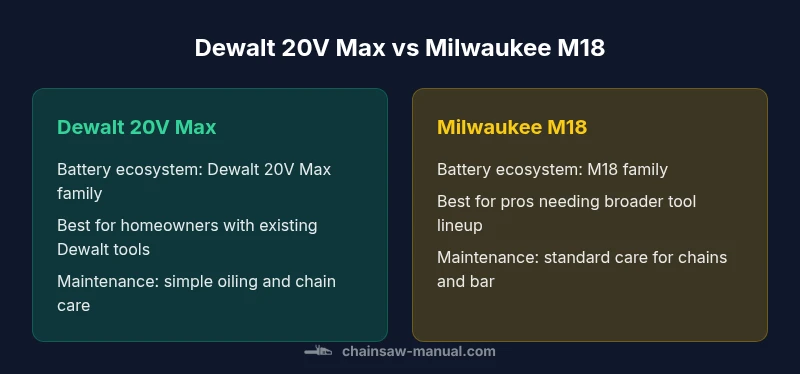
| Best for | Homeowners with existing Dewalt tools | Pros needing a broad tool ecosystem |
Strengths
- Both ecosystems offer cordless convenience and broad accessory compatibility
- Low maintenance compared to gas chainsaws
- Strong service networks and warranty support (brand dependent)
- Ease of finding replacement bars and chains within each ecosystem
Drawbacks
- Higher upfront cost than gas equivalents
- Runtime limited by battery size and task severity
- Cross-brand battery incompatibility requires sticking to one ecosystem
- Long-term value depends on continued investment in batteries and chargers
Choose based on your existing tool investments and the breadth of the tool ecosystem you need
If you already own Dewalt tools, the 20V Max path minimizes friction and accessory duplication. If you want the widest professional tool ecosystem and potential fleet efficiency, Milwaukee M18 is hard to beat. The best overall approach is to align with the platform that fits your workflow and future tool plans.
FAQ
Do Dewalt 20V Max and Milwaukee M18 batteries fit other tools in the same brand?
No, batteries are generally not interchangeable between brands. Each ecosystem uses its own battery format and charging hardware. If you plan to expand beyond the chainsaw, ensure you’re comfortable with expanding within one brand only.
Batteries aren’t cross-compatible; you’ll stay within one brand’s ecosystem for true compatibility.
Which platform tends to offer better value for homeowners?
For homeowners, the Dewalt 20V Max setup often provides strong value due to lighter tools and broad compatibility with existing Dewalt tool investments. However, Milwaukee can offer excellent value if you already own M18 tools and anticipate expanding your kit.
Homeowners usually save more by staying within one brand’s ecosystem, especially if they already own tools.
Are there significant safety differences between the two brands?
Both brands emphasize safety features like chain brakes, automatic oiling, and low-kickback designs. Differences are typically minor and relate more to how these features are implemented and the overall ergonomics of each model.
Safety features are comparable; focus on ergonomics and fit for your use.
Can I expand to longer bars or heavier chains with these platforms?
Yes, both platforms offer a range of bar lengths through their respective kits and accessory lines. Availability and compatibility depend on the model and kit you choose.
Longer bars are available in both ecosystems, but check kit compatibility.
Which is better for professional use?
Milwaukee’s M18 ecosystem often appeals to professionals who require a broad tool lineup and fleet management. Dewalt is strong for individual professionals who value a lighter tool and simpler maintenance.
Pros choose based on the broader toolset and fleet needs.
What should I consider before buying a kit?
Consider your typical tasks, the battery capacity you’ll need, spare batteries, bar length options, and whether you expect to stick to one ecosystem or expand to a wider tool family in the future.
Think about tasks, battery needs, and future tool plans before buying.
The Essentials
- Assess your current battery ecosystem first
- Prioritize ergonomics and safety for long sessions
- Consider total cost of ownership over initial price
- Choose a platform that aligns with your broader tool lineup
- Test balance and vibration before buying