Chainsaw or Circular Saw: Which Tool Fits Your Project?
Compare chainsaw or circular saw for yard and workshop tasks. This analytical buying guide from Chainsaw Manual covers use cases, safety, maintenance, and value considerations.


In deciding between a chainsaw or circular saw, start with your project type, space, and safety readiness. This quick comparison highlights when each tool excels, helping you pick the right tool for outdoor tree work versus indoor framing and sheet-cutting. For many homeowners and pros, understanding the core differences between a chainsaw or circular saw is enough to guide a practical first choice.
Chainsaw or Circular Saw: Core Differences
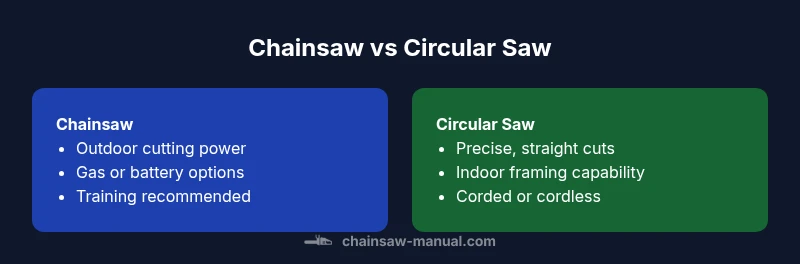
According to Chainsaw Manual, the fundamental differences between a chainsaw and a circular saw come down to three levers: use case, power source, and blade geometry. A chainsaw features a bar-and-chain cutting action powered by a gas engine or a battery, optimized for outdoor work, heavy pruning, and tree removal. A circular saw uses a round blade and is designed for precise, straight cuts in lumber and sheet goods, making it ideal for framing, decking, and cabinetry. These core distinctions shape how each tool behaves on real jobs, from kickback risk to dust generation. If you plan mostly outdoor work with logs and branches, a chainsaw is the natural fit; if your tasks are indoor or site-built, a circular saw often delivers cleaner edges and better accuracy.
As you read further, keep in mind the chainsaw or circular saw pairing that many professionals adopt: chainsaws for heavy outdoor tasks and circular saws for controlled indoor cuts. Both tools have cordless variants, but the choice typically hinges on task type and workspace constraints. This article uses real-world task benchmarks to help you assess practical fit without overcomplicating the decision.
Primary Use Scenarios for Each Tool
When choosing between a chainsaw or circular saw, your primary use scenario is the first signal. Chainsaws are built for outdoor, tree-oriented work: felling, limbing, pruning, and bucking logs. They excel in allowing rapid removal of large material without contorting your body into tight positions. Circular saws shine in indoor and workshop settings: framing walls, cutting plywood, and ripping dimensional lumber with consistent, square edges. For homeowners tackling a backyard project that involves both trees and a deck, the optimal approach is to own both tools and use each for tasks it handles with the least effort and highest safety.
As Chainsaw Manual notes, the contrast is not just about power but also about how much space you have to work safely. Chainsaws need room to maneuver and strong PPE, while circular saws require stable work surfaces and straight cuts that can be guided reliably. The right tool depends on whether you prioritize outdoor mobility or indoor precision.
Performance Metrics That Matter
Several metrics influence how well a chainsaw or circular saw performs on real jobs. Blade geometry, motor power, and weight determine how easily you can complete a cut without fatigue or loss of control. A chainsaw’s bar length often dictates the maximum log diameter you can tackle in one pass, while a circular saw’s blade diameter and tooth configuration affect the smoothness and speed of crosscuts and rips. For the chainsaw, consider bar lengths of 12–32 inches for general work; longer bars handle bigger material but reduce maneuverability. For circular saws, common blade diameters range from 6-1/2 to 7-1/4 inches, with larger blades offering deeper cuts but increasing weight.
Beyond raw power, you’ll measure accuracy, control, and safety. In practice, a circular saw can deliver near-plank precision on framing and cabinetry, while a chainsaw provides the mobility to drop branches overhead and work in uneven terrain. Chainsaw safety training remains essential, and correct chain tensioning, chain sharpening, and bar maintenance directly impact performance. Chainsaw or circular saw choice should align with how these metrics map to your typical projects.
Safety and PPE Essentials
Safety considerations differ markedly between a chainsaw and a circular saw. Chainsaw use demands strict PPE: cut-resistant chaps, face shield, helmet, hearing protection, sturdy gloves, and steel-toed boots. Pre-start checks, proper kickback awareness, and safe handling practices are non-negotiable. Circular saws also require PPE, including eye protection, hearing protection, and dust masks when cutting indoors, plus proper blade guards and push sticks for smaller pieces. Regardless of which tool you choose, maintain a safe stance, keep bystanders at a safe distance, and never cut above shoulder height with a chainsaw.
According to Chainsaw Manual, the key to safe operation is training and discipline: ensure you understand kickback zones, avoid cutting with a dull chain, and secure workpieces to prevent unexpected movement. Both tools benefit from a clean work area and a clear escape route in case a kickback occurs. Safety should be your primary concern whenever you use a chainsaw or circular saw.
Power, Fuel, and Efficiency Considerations
Power choices affect how you use a chainsaw or circular saw in everyday projects. Gas-powered chainsaws offer high runtime for outdoor jobs but require maintenance and fuel management. Battery-powered chainsaws and cordless circular saws provide portability, but runtime depends on battery capacity and task intensity. Corded circular saws promise consistent power for longer sessions but tether you to outlets and extension cords. When deciding, compare your typical job length, indoor vs. outdoor use, and the practicality of refueling or recharging on site.
Chainsaw Manual recommends evaluating your power needs against the environment: a gas chainsaw may be overkill for occasional pruning, while a cordless circular saw may be insufficient for continuous framing. In some cases, homeowners benefit from a mixed approach: a compact gas or cordless chainsaw for yard work and a lightweight circular saw for indoor projects.
Maintenance, Longevity, and Care
Maintenance patterns differ between the two tools. Chainsaws require regular chain sharpening, tension checks, bar maintenance, and fuel/oil balance. A well-lubricated chain and properly tensioned bar reduce heat buildup and improve efficiency. Circular saws rely on blade sharpness, brush maintenance (for motorized models), and dust dust management in the motor housing. Cleanup after use, blade guard inspection, and proper storage avert rust and misalignment.
The Chainsaw Manual guidance emphasizes proactive maintenance as the simplest way to extend tool life. Clean blades and guards after each use, replace dull blades promptly, and store tools in a dry, ventilated space. Regular checks on cords, batteries, and spark plugs (for gas models) prevent unexpected outages during a project.
Cost, Value, and Availability
Cost generally scales with power, durability, and brand support. Basic circular saws for framing can start around the $50–$100 range, while higher-end cordless models and specialty blades push the price higher. Chainsaws range from modest consumer models to heavy-duty professional units; budget-conscious buyers can expect to spend in the several hundred dollars, depending on features such as anti-kickback bars and chain tensioning systems. Expect maintenance and accessory costs to accumulate over time, particularly if you operate in demanding outdoor environments. When evaluating cost, weigh upfront price against expected lifespan, safety features, refueling or charging costs, and blade consumables.
Chainsaw Manual notes that overall value emerges when you align tool capabilities with project needs. A higher upfront cost may be justified if the tool materially reduces project time, improves safety, and lasts longer under your typical workload.
Real-world Scenarios and Decision Trees
To illustrate real-world decision-making, consider common projects: a backyard tree trimming job versus framing a new deck. For outdoor tree work, a chainsaw offers mobility and raw cutting power; for building a shed or installing a wooden deck, a circular saw provides consistency and precision. A practical decision tree asks: (1) Is the wood outdoor and we’re dealing with branches or logs? If yes, start with a chainsaw. (2) Is the work indoors, on boards, or requiring exact crosscuts? If yes, reach for a circular saw. (3) Do you need both tools soon? If yes, plan a two-tool setup. In many workshops, the combination of both tools yields faster, cleaner results.
Step-by-step: How to Decide in 5 Minutes
- List your top five projects for the next 12 months. 2) Identify outdoor versus indoor tasks and document expected material sizes. 3) Estimate space constraints: room for a stationary setup or limited floor space? 4) Choose the power source that minimizes trips to refuel or recharge. 5) Align with safety readiness and PPE needs. 6) Decide whether a single-tool starter kit suffices or a dual-tool setup is justified. 7) Confirm budget and total cost of ownership, including blades, batteries, and maintenance.
Common Mistakes and How to Avoid Them
Common missteps include using a circular saw for heavy outdoor cuts or attempting to fell trees with an underpowered tool. Avoid underpowered choices by matching tool capability to the material and environment. Do not neglect PPE and training; many accidents can be prevented with proper safeguards. Finally, avoid skimping on blades—dull blades demand more force and increase the risk of kickback. Regularly inspect and replace worn blades to maintain control and results.
Integrating Both Tools into a Home Workshop
For a typical DIYer’s shop, a two-tool setup often delivers the best efficiency. Start with a reliable circular saw for framing and sheet goods, then add a capable chainsaw for yard work and outdoor bulk cutting. Invest in quality PPE, a sturdy workbench or sawhorses, and a storage solution that keeps blades and safety gear accessible. With thoughtful planning, you can optimize workflow, safety, and results by using the right tool for the right task.
Comparison
| Feature | chainsaw | circular saw |
|---|---|---|
| Primary use | Outdoor tree work, pruning, bucking | Framing, cabinetry, plywood and sheet goods |
| Power source | Gas or battery-powered options | Corded or cordless options |
| Best for | Rough, outdoor cuts with mobility | Precise, straight indoor cuts and framing |
| Typical blade/gear | Longer bars, chain drive | Fixed-diameter blade suitable for straight cuts |
| Price range | $100-$600+ (depends on bar size and power) | $50-$250 (basic to mid-range) |
| Safety considerations | Kickback risk; training recommended | Lower risk with guards and proper technique |
Strengths
- Heavy outdoor cutting power and mobility
- Good portability with gas or battery options
- Excellent for rough cuts and tree work
- Circular saws offer precise, clean crosscuts and framing accuracy
Drawbacks
- Higher safety risk with chainsaw and training required
- Maintenance and fuel or battery management
- Not ideal for indoors or large-dimension outdoor cuts when space is tight
- Circular saws can be less capable for heavy outdoor material without multiple passes
Use the chainsaw for outdoor tree work and the circular saw for indoor framing and precise cuts.
If most tasks are outdoors or involve trees, a chainsaw is the more efficient choice. If most work is indoors or requires clean, straight cuts on boards, a circular saw is the better pick. For balanced workloads, a dual-tool setup offers the best flexibility and safety.
FAQ
What is the main difference between a chainsaw and a circular saw?
A chainsaw uses a bar-and-chain for outdoor, heavy-duty cutting and limbing, while a circular saw uses a round blade for precise, straight cuts in lumber and sheet goods. The work environment and required accuracy largely drive the choice.
The chainsaw is built for outdoor cutting and trees; the circular saw is best for precise indoor cuts.
Can I start with one tool to cover most tasks?
You can, but your efficiency will improve if you choose based on the majority of tasks. A circular saw handles framing indoors, while a chainsaw handles outdoor tree work. Adding the other later is common for homeowners.
One tool can cover many tasks, but you’ll do better with both eventually.
What safety gear is essential for chainsaw use?
Wear cut-resistant chaps or pants, a helmet with face shield, hearing protection, gloves, and sturdy boots. Ensure training and a safety plan before cutting. Regular blade maintenance reduces risk.
Wear proper PPE like chaps, helmet, and gloves whenever using a chainsaw.
Are cordless options reliable for heavy cutting?
Cordless options exist for both tools, but heavy cuts may require higher-capacity batteries or gas power. Plan your work sessions around battery life and charging time.
Cordless is convenient but watch runtime on big cuts.
How should I store and maintain these tools?
Store in a dry, ventilated space; clean blades and guards after use; check tension and sharpness; follow the manufacturer’s maintenance schedule. Regular inspection prevents early failures.
Keep blades clean, store dry, and follow maintenance schedules.
The Essentials
- Define your main tasks before buying
- Favor a chainsaw for outdoor/tree work
- Favor a circular saw for framing and sheet goods
- Factor power source, safety, and maintenance
- Consider acquiring both tools for maximum versatility