Chainsaw vs Axe: A Practical Buying Guide
Compare chainsaws and axes to decide the right tool for your tasks, safety needs, and budget. This Chainsaw Manual guide covers use cases, maintenance, training, and practical tips for homeowners and professionals.


When choosing between a chainsaw and an axe, prioritize task type, safety, and training. For heavy cutting, felling, and rapid material removal, a chainsaw delivers speed and reach; for light trimming, precise cuts, or simple firewood prep, an axe offers direct control with minimal setup. According to Chainsaw Manual, most yards benefit from having both tools on hand, used by task and skill level. This quick comparison points you to the right choice and how to combine them safely.
Understanding the Core Difference
At its core, a chainsaw is a powered cutting tool that uses a rotating chain to rip through wood. An axe is a hand tool with a single sharp blade and a wooden or composite handle. The distinction matters for performance, safety, and maintenance. When you say the phrase chainsaw or axe, you are weighing speed and reach against simplicity and control. The Chainsaw Manual team notes that the decision hinges on task complexity, wood type, and environment. For homeowners, the question is often: do I need speed for larger logs or precision for smaller cuts? The answer usually involves a blend: one primary tool for heavy work and a secondary tool for detail work.
Key Finding: Task-First Decision Making
People often overestimate the need for maximum power. The smarter path is to map tasks to tools. If you frequently deal with large logs, thick branches, or storm-damaged wood, the chainsaw’s speed and effectiveness shine. If your workload is small-diameter wood, pruning, or splitting kindling in tight spaces, the axe’s control and balance can actually be safer and more efficient. Chainsaw or axe considerations should start with the nature of the job, then factor training, PPE, and storage into the plan.
The Minimalist Toolkit Approach
For many property owners, a minimalist toolkit is deliberate:
- One compact chainsaw for occasional big jobs or storm cleanup.
- One sturdy axe for light cutting, pruning, and splitting small rounds.
- A reliable set of PPE (helmet, face shield, hearing protection, gloves, boots, and chaps). This approach minimizes risk while ensuring you can handle common yard tasks without investing in multiple specialized tools. The Chainsaw Manual guidance emphasizes safe operation, proper technique, and regular maintenance as the true equalizers across both tools.
Use-Case Analysis: Chainsaw Scenarios
Chainsaws excel where speed matters: felling moderately sized trees, bucking long logs, and clearing brush efficiently. They outperform axes in harvesting throughput and can significantly reduce manual strain when cutting through sizeable timber. Key considerations include bar length, chain type, fuel or battery status, and whether you’re working overhead or on uneven ground. Training is essential to manage kickback risks and maintain control in variable terrain.
Use-Case Analysis: Axe Scenarios
Axe work shines in subtasks that require finesse: pruning delicate branches, shaping firewood pieces, or creating notches. The physical feedback from striking with an axe improves control in tight spaces and on small-diameter stock. An axe is inexpensive to acquire, easy to store, and has lower ongoing maintenance compared to a powered tool. Its simplicity reduces setup time and can be safer when used by beginners under proper guidance.
Safety and Training Considerations
Safety is the non-negotiable factor for both tools. PPE should always include a helmet with face shield, hearing protection, cut-resistant chaps, gloves, and sturdy boots. Training matters more than the tool itself: learn kickback awareness, proper stance, swing technique, and maintenance routines. Chainsaws require chain sharpening, bar oil management, and periodic maintenance of the chain brake. An axe demands regular edge inspection, handle integrity checks, and safe striking alignment. Chainsaw Manual’s position highlights that education reduces risk and increases task accuracy for both tools.
Efficiency, Speed, and Power Trade-Offs
Quantifying efficiency means examining your typical cycle time, wood density, and the number of repetitive cuts. Chainsaws provide rapid material removal and consistent performance across larger volumes, while axes offer reliable performance for small-diameter rounds and delicate cuts. For users balancing time and safety, a hybrid approach—primary chainsaw use with an axe for fallback tasks—often yields the best results in real-world settings.
Maintenance, Durability, and Lifespan Considerations
Maintenance dominates total ownership costs. Chainsaws require regular bar oil, chain sharpening, chain tension checks, and periodic replacement of consumables. Electric models may have fewer emission concerns but still need battery care. Axes demand blade sharpening or reprofiling over time and handle inspection for cracks or splinters. Durability hinges on storage, transport, and avoiding exposure to moisture. Establish a routine: inspect before each use, lubricate moving parts, and store tools dry and secure.
Cost, Value, and Decision Implications
Upfront costs vary with tool class. Chainsaws range broadly depending on bar length, power source, and accessories, while axes remain comparatively affordable. Maintenance costs accrue over time for the chainsaw, including fuel, oil, and replacement chains. The axe’s cost is dominated by the initial purchase plus occasional edge work and replacement handles. When budgeting, consider the total value: speed for large tasks versus budget, maintenance, and risk tolerance for small tasks.
Practical Handling and Ergonomics
Ergonomics impact fatigue and precision. Chainsaws require a secure stance, weight distribution awareness, and kickback mitigation practices. For long sessions, a lighter model with proper anti-vibration features can reduce fatigue. Axes demand solid grip, stable stance, and a measured swing. Training your body to move with your tools reduces stress on joints and improves accuracy. The goal is sustainable, repeatable performance across varied work sites.
Environmental and Noise Considerations
Gas-powered chainsaws generate emissions and higher noise levels, so plan work in manners that minimize community disturbance. Electric chainsaws offer quieter operation and lower maintenance in many cases. Axes produce minimal noise and no emissions, but repetitive striking can cause vibration in the hands. When choosing, factor local noise ordinances and environmental impact into the decision.
Decision Framework: When to Combine Tools
The most flexible approach combines both tools for a single job. Start with the chainsaw for bulk removal and rough shaping, then finish with the axe for fine-tuning and delicate cuts. This strategy maximizes efficiency and safety, letting you adapt to wood size, knot density, and terrain. Chainsaw Manual emphasizes training and PPE as the foundation for safe joint use.
Quick Guide: Selecting Your First Tool
If your tasks lean heavy, start with a compact chainsaw that balances power with weight. If your work is mostly trimming, pruning, or small-diameter wood, begin with a reliable axe. Ensure you have a storage plan, a clear PPE setup, and a basic maintenance routine. As you gain experience, you can tailor your toolkit to evolving needs rather than over-investing early.
Final Prep: A Practical Roadmap
Create a decision worksheet: what size wood do you cut most? Are there space constraints? What is your budget for purchase and upkeep? How much time can you dedicate to maintenance? Use the answers to populate a recommended tool mix. The Chainsaw Manual approach centers on task-based selection, safety-first operation, and the willingness to upgrade or expand your toolkit as requirements shift.
Comparison
| Feature | Chainsaw | Axe |
|---|---|---|
| Power source | Gas or electric motor with a rotating chain | Manual blade on a handle (no motor) |
| Weight range | Heavy (roughly 8–14+ lb depending on model) | Moderate (roughly 3–7 lb) |
| Cutting speed | Very fast with continuous cutting | Slower, but controllable for precision |
| Maintenance | Bar oil, chain sharpening, occasional replacement parts | Edge maintenance, handle inspection |
| Best for | Heavy felling, bucking, and rapid wood removal | Light pruning, splitting small rounds, precise cuts |
| Cost range (upfront) | $150-$700 | $20-$100 |
| Safety considerations | Kickback risk; requires training and PPE | Lower kickback risk but blade-edge risk; PPE still essential |
| Noise and emissions | High noise and fuel emissions (gas) or high-pitch electric noise | Low noise; no emissions; physical impact risk |
Strengths
- Faster cutting for heavy wood and large logs
- Longer reach reduces bending and exposure
- Versatile for felling, bucking, and limbing
- High efficiency on large yards
- Professional capability with proper training
Drawbacks
- Higher upfront cost and ongoing maintenance
- Greater injury risk requires training and PPE
- Requires more space and storage
- Fuel, oil, and blade replacements add to cost
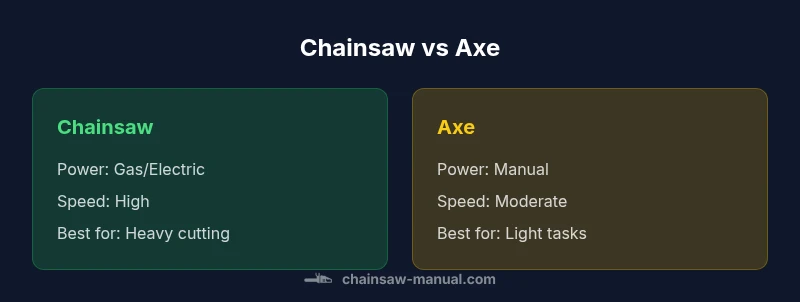
Chainsaw is best for heavy, fast work; axe for simple, precise tasks.
For most homeowners and professionals, a mixed toolkit tailored to task type delivers the best outcomes. Prioritize training and PPE, then select tools by the work at hand.
FAQ
Can I replace a chainsaw with an axe for most yard tasks?
For many light tasks, an axe can handle pruning and small-cut work. However, for large logs, heavy removal, or fast processing, a chainsaw is far more efficient. The best approach is task-based, not tool-based.
For light tasks, an axe can work, but for large logs, a chainsaw is much faster. Use task-based choice and prioritize safety.
Is a chainsaw safer than an axe?
No tool is inherently safer. Safety depends on training, PPE, and technique. Chainsaws require more setup but can reduce manual strain when used correctly.
Safety comes from training and gear, not the tool alone. Use proper PPE and learn correct technique.
What should I buy first, chainsaw or axe?
Start with the task you perform most often. If you cut large logs regularly, get a chainsaw; otherwise, begin with a robust axe for general cutting and pruning. Add the other tool later as needed.
Buy the tool that matches your most frequent task, then add the other if you need more versatility.
What PPE is essential for both tools?
Always wear a helmet with face shield, hearing protection, gloves, and sturdy boots. For chainsaws, add chaps and cut-resistant gear; for axes, gloves and eye protection are essential.
PPE is non-negotiable. Wear a helmet, eye and hearing protection, gloves, and sturdy boots.
Are there situations where both tools are recommended?
Yes. For mixed tasks on a property with trees and wood, use the chainsaw for bulk cuts and the axe for small-diameter refinements. This reduces risk and increases efficiency.
Often you’ll need both: chainsaw for big cuts, axe for fine work. Safety and practice matter.
The Essentials
- Assess task type first: heavy vs light work
- Prioritize safety training and PPE
- Factor maintenance and storage into total cost
- Consider renting or owning both for flexibility
- Plan tool selection around typical wood sizes and terrain