Auto Axe vs Chainsaw: A Practical Comparison for Safe, Efficient Cutting
Compare auto axe and chainsaw design, safety, maintenance, and best-use scenarios to help homeowners, DIYers, and pros choose the right tool for safe, efficient cutting.


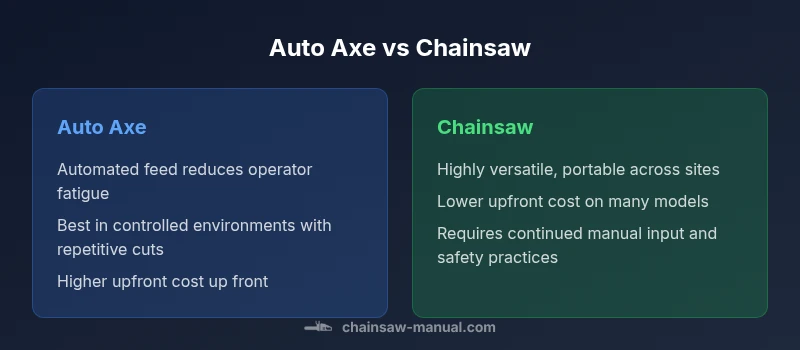
Auto axe vs chainsaw presents a trade-off between automation and versatility. For controlled tasks with repetitive cuts, auto axes can reduce fatigue and standardize output, while chainsaws excel in portability and raw cutting speed. This comparison explains key differences, use-case sweet spots, safety considerations, and maintenance implications to help you choose the right tool for your project.
What Auto Axe and Chainsaw Are
Auto axes are powered tools that automate the feed of the cutting element, designed for repetitive, controlled cuts in defined environments. Chainsaws are handheld, engine-driven tools that rely on operator input for feed and guidance. When discussing auto axe vs chainsaw, the distinction is not merely about power but about how much of the cut process is automated and how much remains manual. According to Chainsaw Manual, a safe operating approach begins with understanding the intended task, the site conditions, and your experience level. In practice, a well-chosen tool matches the task profile: precision, speed, and fatigue management in one. The following sections unpack the design principles, use cases, and real-world trade-offs that drive decision-making.
Design and Mechanism: How They Cut
The core difference between auto axes and chainsaws lies in cutting action and drive mechanism. An auto axe typically integrates a motor-driven blade or chopping head with an automated feed system that advances the cutting edge along a guided path. This setup minimizes the need for continuous manual input, making it well-suited for repetitive, structured cuts where consistency matters. A chainsaw uses a rotating chain driven by a gasoline or electric motor, with the user controlling feed rate, angle, and speed. The outcome is greater adaptability across varied wood types and sizes, but it demands normal emphasis on operator technique, stance, and follow-through. In short, automation reduces the physical toll, while manual control offers flexibility across unpredictable tasks.
Safety Considerations for Each Tool
Safety remains the foremost concern in any cutting task. For chainsaws, standard PPE (helmet, face shield, hearing protection, gloves, chainsaw chaps) is essential, and modern models typically include chain brakes, anti-vibration handles, and automatic oiler features. Auto axes add different risk profiles: automated feeds can mitigate kickback in repetitive cuts, but the machine may present pinch points, entanglement hazards, or unpredictable feed behavior if not properly programmed or maintained. A robust safety plan includes task assessment, proper guarding, training on machine-specific controls, and emergency stop protocols. Chainsaw Manual emphasizes a proactive safety mindset: never rely on a single feature, always inspect guards and guards, and ensure a clear work area free of bystanders.
Performance in Typical Scenarios
For controlled environments such as a workshop or a clearing operation with fixed dimensions, auto axes can deliver steady, repeatable cuts with minimal operator fatigue. They shine in jobs where precision and consistency are critical, such as cross-cutting in lumber preparation or repetitive limb removal on selected trees. Chainsaws excel in field scenarios: storm cleanup, rough felling, pruning, and portable work where access is constrained. The best performance comes from matching the tool to the site's demands—auto axes for repetitive, predictable workloads; chainsaws for diverse, on-the-spot cutting. Chainsaw Manual notes that reliability hinges on proper maintenance and correct model selection for the job at hand.
Maintenance and Longevity
Maintenance profiles diverge between the two tools. Chainsaws require regular chain tension checks, bar oil refills, chain sharpening, spark plug replacements for gas models, air filter cleaning, and occasional carburetor service. Auto axes emphasize motor health, sensor calibration, battery life, cooling systems, and firmware updates. Regular inspection of moving parts, lubrication points, and safety interlocks remains essential for both. Chainsaw Manual analysis shows that neglecting routine maintenance can dramatically shorten a chainsaw’s lifespan and increase safety risk, while neglecting electronics or feed mechanisms in an auto axe can reduce automation performance and reliability over time.
Cost of Ownership and Availability
Cost considerations extend beyond the sticker price. Chainsaws typically offer a broad price spectrum, from basic consumer models to professional-grade units, with widespread service networks and readily available replacement parts. Auto axes often entail higher upfront costs due to automation components, sensors, and specialized motors, with more variable after-sales support depending on the model and manufacturer. Availability of parts and service may be more niche for auto axes, which can influence long-term maintenance planning. In both cases, the total cost of ownership should account for fuel or electricity, consumables (bar oil, replacement chains or blades), and potential downtime during maintenance.
Environmental Impact and Noise
Engine-driven chainsaws emit exhaust and produce substantial noise, with environmental impact dependent on engine size and fuel mix. Electric chainsaws reduce emissions and often operate more quietly, though performance is affected by battery capacity. Auto axes, depending on design, may rely on electric power or battery systems, which reduces direct emissions but still requires electricity or charging cycles. Noise output for automation-focused systems varies by build and intended use; in workshop settings, noise may be mitigated by enclosure and vibration-damping features. Safety-first design should always include hearing protection, regardless of tool type.
Practical Setup: When to Choose Each
To decide between an auto axe and a chainsaw, begin with task analysis. If you regularly perform repetitive, guided cuts in a controlled environment, an auto axe can lower fatigue and increase consistency. For versatile, mobile work—especially where logs vary in size and shape—a chainsaw offers superior adaptability. If space and power infrastructure permit, consider a hybrid approach: using an auto axe for routine, repetitive tasks and a chainsaw for on-site adjustments. Chainsaw Manual emphasizes documenting your typical projects and aligning gear with those workflows to maximize productivity and safety.
Common Pitfalls and How to Avoid Them
Common mistakes include overestimating automation capabilities, neglecting regular maintenance for either tool, and underpreparing with proper PPE. For auto axes, ensure calibration and software updates are current, and never rely on automated safety features as a substitute for operator vigilance. For chainsaws, avoid cutting with dull blades or improper tension, which increases kickback risk and reduces efficiency. Always inspect the work area, secure refuse and bystanders, and maintain a consistent stance to minimize injury risk. A deliberate, informed approach reduces surprises when switching between tools.
Comparison
| Feature | Auto Axe | Chainsaw |
|---|---|---|
| Power source | Electric/battery-powered with automatic feed mechanism | Gasoline-powered or electric with manual feed |
| Cutting mechanism | Automated feed with integrated cutting head | Rotating chain driven by engine or motor |
| Best use case | Controlled, repetitive cuts in workshops or fixed sites | Versatile field cutting, pruning, felling, and storm cleanup |
| Safety features | Auto-stop, guarded feed, sensors (model-dependent) | Chain brake, anti-kickback, PPE compatibility |
| Maintenance frequency | Sensor checks, battery care, occasional calibration | Chain tension, bar oil, air filter, spark plug (gas) |
| Typical cost range | Higher upfront, variable by model | Broad range from affordable to professional |
| Best for | Precision, fatigue reduction, predictable outputs | Flexibility, speed, portability across sites |
Strengths
- Reduces operator fatigue with automated feed
- Offers repeatable, consistent cuts in fixed environments
- Can improve safety in predictable tasks by reducing manual input
- Potentially lower direct exposure to sharp moving parts in repetitive work environments
Drawbacks
- Higher upfront cost and more complex maintenance
- Limited model availability and service networks in some regions
- Less versatile for varied, on-site tasks
- Dependence on power or battery charge can interrupt work
Chainsaw remains the most versatile and cost-effective option for most users; auto axe shines in controlled, repetitive workflows.
Choose a chainsaw for broad tasks and mobility. Pick an auto axe when your work is repetitive, predictable, and performed in a controlled setting where automation reduces fatigue and standardizes outputs. Chainsaw Manual’s analysis supports matching the tool to the task for best safety and efficiency.
FAQ
What is an auto axe, and how does it differ from a chainsaw?
An auto axe automates the feed of the cutting edge, enabling repetitive cuts with less operator input. A chainsaw requires continuous manual guiding and control. The core difference is automation versus manual control, which affects speed, precision, and fatigue across tasks.
An auto axe feeds the cut automatically, reducing your effort for repetitive work, while a chainsaw needs you to guide it actively for each cut.
Is an auto axe safer than a chainsaw?
Safety depends on design and usage. Auto axes can reduce kickback exposure in repetitive tasks, but automation adds system complexity and potential pinch points. Chainsaws have well-understood safety features like chain brakes and guards, but rely heavily on operator technique and PPE.
Safety varies by model. Automation can help in some cases, but follow PPE and proper training for either tool.
Which tool is better for storm cleanup?
Chainsaws are typically better for storm cleanup due to their portability, versatility, and ability to handle varied debris on uneven terrain. Auto axes may be useful for repetitive cuts in a fixed workspace but are less adaptable to irregular debris.
For storm cleanup, chainsaws usually win on versatility and reach.
Can an auto axe replace a chainsaw for all tasks?
No. While an auto axe benefits repetitive, controlled tasks, a chainsaw remains essential for mobility, diverse cuts, and handling unpredictable wood. A practical setup often combines both tools for different job phases.
An auto axe can’t cover every task; keep a chainsaw for versatility.
What maintenance starts right after purchase?
Register the machine, inspect safety interlocks, verify proper lubrication and air filters, and check battery or fuel system. Regular sharpening or blade maintenance for the cutting edge is crucial, especially on chainsaws. Auto axes rely on electronics and motors that require calibration and software checks.
Set up, safety checks, and a basic maintenance plan from day one.
Are auto axes common in DIY setups?
Auto axes are less common in DIY kits but are growing in specialized workshops and facilities with repetitive cutting tasks. Most DIYers will rely on chainsaws for versatility and cost-effectiveness. Review your typical projects before investing.
They’re not common for most DIYers; consider your project mix first.
The Essentials
- Match the task: automation for repetitive work, portability for varied sites
- Prioritize safety: PPE and guards are essential with both tools
- Budget for total cost: upfront price, maintenance, and consumables matter
- Consider maintenance networks: availability of parts affects long-term use
- Plan for power needs: battery life or fuel availability can drive decisions