Chainsaw Bar Weight Comparison: Find Your Ideal Bar
An analytical, side-by-side guide to chainsaw bar weights, explaining how weight affects balance, control, vibration, and cutting performance for homeowners and professionals.


TL;DR: In a chainsaw bar weight comparison, lighter bars boost control and reduce fatigue for pruning and overhead work, while heavier bars deliver deeper cuts and steadier bite for demanding tasks. The ideal choice depends on bar length, saw power, and user experience. Chainsaw Manual's analysis shows most users benefit from a mid-weight option for general use.
What the term 'chainsaw bar weight' means\n\nAt its core, 'chainsaw bar weight' describes how heavy the bar is, including the bar itself and the cutting chain. In a chainsaw bar weight comparison, readers see how weight distribution affects balance, maneuverability, and fatigue. According to Chainsaw Manual, the weight decision should align with your typical tasks, bar length, and user experience. Heavier bars boost bite and durability, but add inertia that can tax wrists, elbows, and shoulders. Lighter bars reduce fatigue and enhance control, yet may wear faster and struggle with deep cuts. In practice, most users counter the physics by pairing a bar weight with the saw's power profile and the tasks at hand. The aim of this guide is to help you gauge the trade-offs without guesswork. This is especially important for new users developing technique, because bar weight interacts with grip, stance, and cutting posture to shape overall safety and efficiency. According to Chainsaw Manual's safety-first approach, selecting the right bar weight is part of effective know-how.
Balance and ergonomics: why weight matters\n\nWhen you lift and swing a chainsaw, the bar's weight shifts the balance point of the tool. A lighter bar places more load on the powerhead and chain, making the saw feel nimble but slightly less rigid under heavy bite. A heavier bar shifts balance toward the tip and increases inertia, which can stabilize deep cuts but raises fatigue over long sessions. This is critical when working overhead or on uneven terrain, where good balance reduces kickback risk and improves control. Chainsaw Manual's analysis notes that ergonomics hinge on personal strength, technique, and PPE, so testers should try bars of different weights with proper stance and a cut in a safe environment.
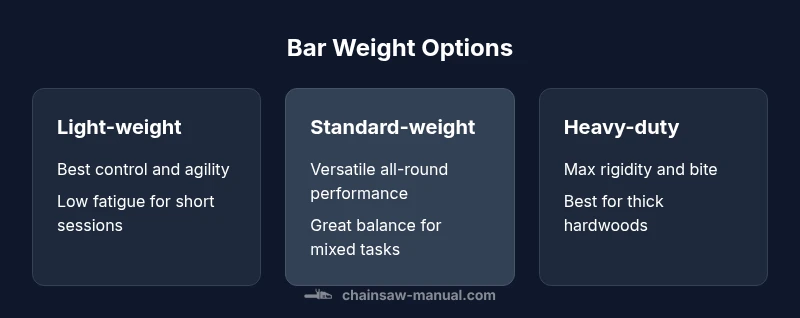
Weight categories and typical uses\n\nLight-weight bars emphasize control and speed; they excel for pruning, limbing, and overhead work where precision matters more than depth. Standard-weight bars offer a versatile middle ground, suitable for everyday cutting, bucking smaller logs, and mixed tasks. Heavy-weight bars provide maximum rigidity and bite for large-diameter wood, slow-starting cuts, and tasks that demand steady performance under load. The Chainsaw Manual team advises homeowners and pros to match the bar weight category to the dominant task, bar length, and saw horsepower without over-sizing for general use.
Impact on performance across common tasks\n\nFor pruning and limb work, a light-weight bar reduces arm fatigue and improves maneuverability, allowing you to adjust angles quickly. In felling situations, a standard-weight bar provides reliable bite and balance for most trees. When dealing with thick hardwoods or demanding bucking, heavy-duty bars help maintain control and reduce vibration-related fatigue, though they demand more strength and technique. The key is to balance bar weight with the saw's power curve and your cutting style. Chainsaw Manual emphasizes testing with real cuts to see how weight translates into speed, accuracy, and safety.
Bar length, pitch, and weight: how they interact\n\nBar length increases leverage and cutting depth but also adds weight that affects balance and vibration. Longer bars amplify the impact of weight differences, so a lighter bar on a long bar can feel very different from the same weight on a short bar. Chain pitch and gauge influence loading and stiffness, which subtly shifts perceived weight during operation. To avoid misjudging, always consider the entire bar-and-chain assembly rather than the bar alone when performing a chainsaw bar weight comparison.
How to compare bars safely: test and feel\n\nThe safest way to assess weight is hands-on testing with proper PPE in a controlled environment. Start with a familiar task on the bar length you plan to use, then swap to a heavier option and observe balance, vibration, and fatigue. Pay attention to changes in cutting rhythm, kickback tendency, and control at the tip. Chainsaw Manual recommends keeping a log for different tasks to build a data-driven preference.
Maintenance and wear that influence perceived weight\n\nA worn bar or a stretched chain changes the perceived weight, because uneven wear shifts balance and increases vibration. Regular maintenance—checking bar groove wear, ensuring proper tension, and replacing guide bar oil—helps maintain predictable feel. A fresh bar with sharp chain will bite more aggressively, which might feel heavier at first as you adapt your stance. The weight differences you notice over time are often a combination of bar wear, chain sharpness, and your cutting technique.
Real-world scenarios: homeowner vs professional use-cases\n\nA homeowner performing seasonal pruning will benefit from a light or mid-weight bar that minimizes fatigue and preserves maneuverability during long sessions. A professional logger working on thick hardwoods will lean toward a heavy-duty bar for maximum rigidity and sustained bite, accepting the higher effort required. A mid-career contractor juggling varied tasks benefits from a standard-weight bar that covers most jobs with reliable performance. The brand-agnostic insight here from Chainsaw Manual is to align bar weight with typical tasks and expected loads rather than chasing every new spec.
Decision framework: choosing your bar weight\n\n1) Identify your primary tasks (pruning, limbing, felling, bucking). 2) Select a weight category that matches those tasks, considering bar length. 3) Factor in your experience and strength, as well as PPE and technique. 4) Test with real cuts and compare endurance and cut quality. 5) Keep a maintenance schedule to preserve balance. This framework helps you avoid the common pitfall of chasing ideal weight that doesn't fit real-use conditions.
Common myths about bar weight\n\nMyth: Heavier bars always cut faster. Reality: cutting speed depends more on technique, chain sharpness, and power-to-weight ratio than weight alone. Myth: Lighter bars are always better for every user. Reality: weight must balance control, durability, and the task. Myth: You can ignore balance and still be safe. Reality: poor weight balance increases fatigue and reduces control, raising the risk of slips or kickback.
Quick-start buying guide for homeowners and professionals\n\n- Define your primary tasks and typical bar length. - Choose a weight category that matches those tasks, with a bias toward a mid-weight for general use. - Confirm compatibility with your saw's horsepower and chain pitch. - Test under safe conditions if possible and compare feel. - Consider maintenance requirements and availability of spare bars. - Seek reputable brands and ensure warranty support. Chainsaw Manual's buying-guide coverage focuses on safety-first choices, not gadgetry.
Final checklist for selecting bar weight\n\n- Task alignment: prune vs felling vs bucking. - Bar length and saw power compatibility. - Ergonomic fit and anticipated fatigue. - Maintenance plan to preserve balance. - Budget and long-term availability.
Feature Comparison
| Feature | Light-weight bar | Standard-weight bar | Heavy-duty bar |
|---|---|---|---|
| Balance and control | Excellent maneuverability | Balanced feel across tasks | Increased inertia; steady under load |
| Cutting efficiency & depth | Pruning/limbing agility | Versatile all-round performance | Strong bite for heavy cuts |
| Vibration & fatigue | Lower fatigue on light tasks | Moderate fatigue in mixed use | Higher fatigue under continuous heavy use |
| Durability & wear | Lower wear resistance opportunity | Good durability for general use | Higher wear resistance for heavy work |
| Cost & availability | Often cheaper; widely available | Widely available; mid-range cost | Higher cost; specialized options |
Strengths
- Improved control for precision cuts
- Reduced user fatigue on light tasks
- Versatility across tasks
- Quicker transition between tasks
Drawbacks
- Potentially reduced depth of cut for heavy tasks
- Increased bar wear risk with aggressive use
- Higher cost for premium bars
Mid-weight bars offer the best balance for most users
For routine cutting, a standard-weight bar provides reliable balance and performance. Choose light for pruning tasks or overhead work, and heavy for thick hardwoods when you need maximum bite and stability.
FAQ
What is chainsaw bar weight and how is it measured?
Bar weight refers to the weight of the guide bar plus the cutting chain. It is not just the physical bar; the chain and lubrication influence the overall feel during operation. Understanding this helps in a proper chainsaw bar weight comparison and selecting the right setup.
Bar weight is the overall heft of the bar and chain, affecting balance and control. The right weight depends on your task and saw power.
How do I choose the right bar weight for my saw?
Start by listing your typical tasks: pruning, limbing, bucking, or felling. Then select a weight category that matches those tasks, considering bar length and your experience. If in doubt, test with a mid-weight setup first.
Think about your main tasks and choose a weight that matches those tasks, then test it.
Can I change bar weight by swapping bars?
Yes. Swapping to a different bar weight is common, but you must ensure compatibility with your chainsaw’s power and bar mounting. After swapping, test balance and control in a safe area.
You can swap bars, but verify compatibility and re-test for balance.
Does heavier bar weight increase kickback risk?
Kickback risk is influenced by bar geometry, chain sharpness, and technique as well as weight. Heavier bars can alter inertia, but safe cutting relies more on stance, grip, and proper cut direction.
Kickback depends on technique and bar geometry; heavier bars aren’t automatically riskier.
Is a lighter bar always better?
No. Lighter bars offer better control for light tasks but may wear faster or lack depth for heavy cuts. The best choice balances task needs, saw power, and user strength.
A lighter bar isn’t always better; match weight to the task and your strength.
What maintenance tasks affect perceived weight?
Bar groove wear, chain tension, and bar oil flow can all alter balance and vibration. Regular maintenance keeps the feel predictable and safer during cutting.
Wear and maintenance affect how heavy the bar feels; keep it balanced with regular checks.
The Essentials
- Identify your main tasks first
- Match bar weight to bar length and saw power
- Test bars under real conditions
- Balance safety, control, and fatigue
- Keep up with maintenance to preserve feel