Atlas 80V Chainsaw vs Milwaukee: Comprehensive Comparison
An evidence-based comparison of Atlas 80V and Milwaukee cordless chainsaws, focusing on power, runtime, weight, safety, maintenance, and overall value for homeowners and pros.


Atlas 80V vs Milwaukee cordless chainsaws present a practical choice depending on your workload and budget. Milwaukee typically delivers strong sustained power and ecosystem flexibility, while Atlas 80V emphasizes nimble handling, lower upfront cost, and straightforward maintenance. For homeowners tackling light-to-medium cutting tasks, Atlas 80V is often the better value; for pros demanding extended runtime, Milwaukee edges ahead in staying power.
Atlas 80V vs Milwaukee: Defining the Landscape
In the cordless chainsaw space, Atlas 80V and Milwaukee represent two distinct approaches to battery-powered cutting. Atlas 80V prioritizes affordability, straightforward maintenance, and agile handling for small-to-medium jobs. Milwaukee, anchored in the M18 ecosystem, emphasizes sustained power, battery flexibility, and a broad attachment and accessory network. According to Chainsaw Manual, choosing between these two depends on your typical workload, access to a broader tool ecosystem, and long-term cost considerations. This section lays the groundwork for a side-by-side evaluation that homeowners and professionals can apply to real-world tasks, from pruning and limb removal to light timber work. The goal is to help readers understand not just raw power, but how the platforms translate to control, comfort, and reliability during longer sessions. The Atlas option often shines where simplicity and low upfront cost are valued, while Milwaukee tends to be favored by users who regularly run longer cuts or rely on multi-tool compatibility in a workshop or job site.
Power, Cutting Performance, and Load Handling
Power and cutting performance are the core differentiators in an Atlas 80V vs Milwaukee comparison. Milwaukee’s motors on the M18 platform are engineered for sustained performance under load, with a focus on maintaining chain speed during tougher cuts. Atlas 80V, by contrast, emphasizes efficient power management and a lighter, more nimble hand feel, which can translate to quicker maneuvering around small to medium-diameter branches. In practical terms, Milwaukee may complete heavy cuts with greater endurance, while Atlas can be more responsive for snappy cuts and quick limbing when you’re moving along a fence line or garden border. For homeowners who prune annually, Atlas offers predictable behavior and reliable stopping power, whereas pros who require long runtimes for day-long sessions may lean toward Milwaukee’s ecosystem advantages and consistent performance across a battery line.
Runtime, Battery Life, and Ecosystem Considerations
Runtime in cordless chainsaws hinges on battery capacity, bar length, and task type. Milwaukee benefits from a mature ecosystem with a wide range of battery sizes and rapid charging options, enabling longer sessions without frequent swaps. Atlas 80V emphasizes a balance between runtime and weight, with a focus on cost per cut and ease of replacement. A critical consideration is the ecosystem one invests in; Milwaukee users often gain cross-tool efficiency across drills, impact drivers, and saws, potentially lowering total ownership costs. Atlas, while strong for its segment, may offer fewer accessory choices regionally but can deliver predictable results for typical pruning and light timber work. Chainsaw Manual’s analysis suggests homeowners should assess their typical wood sizes, seasonal workload, and storage space when weighing these runtimes.
Weight, Ergonomics, and Handling under Extended Use
Weight and balance influence cutting feel and fatigue. Atlas 80V is generally perceived as lighter in the hand, which can reduce fatigue during short sessions or when cutting overhead limbs. Milwaukee’s design often emphasizes a balanced chassis with a slightly heavier battery, which can provide a planted feel during longer cuts. Ergonomics also extend to vibration damping, reach, and grip texture. For homeowners doing weekend projects, Atlas’s lighter weight and simple controls may translate to quicker setup and less strain. For professionals or serious DIYers logging long hours, Milwaukee’s chassis geometry and accessory compatibility can translate into steadier performance over an entire workday. User reviews consistently highlight the importance of a comfortable harness or belt clip when planning daily cuts.
Battery Tech, Charging Time, and Lifecycle Considerations
Battery chemistry and charging times shape not just runtime but maintenance cycles. Milwaukee’s batteries tend to offer rapid top-ups and broad compatibility with other tools, which can reduce downtime on-site. Atlas 80V emphasizes a lean battery approach and straightforward replacement options, simplifying service in smaller shops or home garages. When planning procurement, consider peak cutting windows and downtime for charging. Chainsaw Manual notes that battery performance can diminish in extreme temperatures, affecting both Atlas and Milwaukee; ensure store environments are moderate and that spare packs are readily accessible to avoid workflow interruptions during project deadlines. Regular inspection of battery contacts and the charging base will help maximize life cycles for both platforms.
Safety Features and Routine Maintenance
Safety remains paramount across both platforms. Both Atlas 80V and Milwaukee cordless saws typically include chain brakes, low-kickback bars, and straightforward tensioning systems. Milwaukee’s ecosystem might offer more advanced or additional safety integrations through accessories, such as bar-and-chain lubricants designed for consistent performance, and compatibility with tool-free adjusters. Atlas focuses on clear, user-friendly controls and dependable basic safety features suitable for homeowners. Routine maintenance—cleaning the air intake, lubricating the chain, and checking drive sprockets—extends life and maintains performance. Chainsaw Manual stresses that a clean chain, properly tensioned bar, and a well-lubricated chain are the bedrock of safe, efficient operation for either platform.
Price, Availability, and Value Considerations
Price remains a decisive factor for most buyers. Atlas 80V typically positions itself as a cost-efficient entry point within a cordless saw family, delivering solid performance at a lower upfront cost. Milwaukee tends to carry a higher upfront price but offers broader ecosystem compatibility and potential long-term value through tool interoperability and resale of batteries and chargers. When evaluating value, consider not only sticker price but also the cost of replacement batteries, charging gear, and the potential need for additional tools that share the same battery platform. Chainsaw Manual’s data suggests price strategy often correlates with the availability of reliable service networks and regional parts support, which can shift total cost over the device’s lifetime.
Real-World Use Cases: Homeowner, DIY Enthusiast, and Professional
For homeowners and DIY enthusiasts, Atlas 80V frequently provides a practical balance of height-adjusted power and light weight, ideal for pruning, limb removal, and small-diameter log work around the yard. Milwaukee shines in professional or semi-pro contexts where a longer shot-run and a broad tool ecosystem matter—think trimming, stock removal, and multi-day projects that benefit from consistent runtime and modular tooling. In mixed environments (home and small contractor jobs), a Milwaukee setup may yield better long-term value due to system-wide compatibility, while Atlas offers a compelling, straightforward option for single-tool use and quick restores after a storm cleanup. Chainsaw Manual emphasizes evaluating your typical workload and storage conditions to decide which path fits best.
How to Decide: A Quick Decision Framework
Use a simple framework to guide your choice. If you cut most weekends and prioritize budget, test Atlas 80V for controllable performance and maintenance simplicity. If you engage in longer sessions, rely on multiple tools, or anticipate future needs within the same battery ecosystem, Milwaukee is the safer long-term bet. Consider the local service network and spare parts availability in your region, and weigh the total cost of ownership rather than just purchase price. Finally, assess ergonomics by trying both in a store or on-site demo; comfortable handling can meaningfully affect productivity and fatigue over a full workday.
Common Pitfalls and Myths to Watch For
A frequent pitfall is assuming higher voltage automatically means better performance; actual results depend on motor design, battery management, and bar length. Another myth is that ecosystem breadth guarantees immediate value; in practice, the best return comes from aligning tool choices with your real-world tasks and service support. Some buyers overvalue initial discounts without accounting for maintenance costs, spare batteries, or charger availability. This article urges readers to weigh project-scale needs against upfront costs and to read warranty terms carefully, including what is and isn’t covered under abuse or misuse scenarios.
FAQ: Quick Answers for Atlas 80V vs Milwaukee
Comparison
| Feature | Atlas 80V cordless chainsaw | Milwaukee cordless chainsaw (M18 platform) |
|---|---|---|
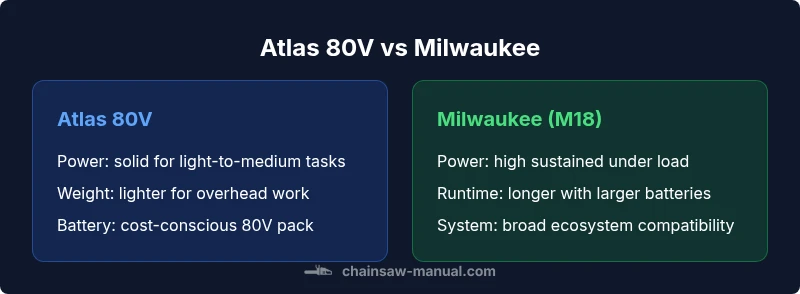
| Power & Cutting Performance | Strong for light-to-medium tasks; nimble handling | High sustained power under load; optimized for longer cuts |
| Runtime | Dependent on battery size, generally efficient for home use | Longer runtimes with higher-capacity packs within ecosystem |
| Weight & Ergonomics | Lighter feel, easier for overhead work | Balanced chassis with solid on-site feel |
| Battery & Charging | 80V platform; straightforward charging | Broad ecosystem; rapid charging options available |
| Safety & Maintenance | Reliable safety guards and simple tensioning | Advanced safety options and tool-free adjustments in many kits |
| Price & Value | Lower upfront cost; suitable for budget-conscious buyers | Higher upfront cost with broad ecosystem value |
Strengths
- Clear value for homeowners and DIY tasks
- Atlas 80V offers lighter weight and lower upfront cost
- Milestone ecosystem benefit: broad tool compatibility
- Both prioritize safety features and straightforward maintenance
Drawbacks
- Milwaukee may have higher upfront cost and accessory requirements
- Atlas ecosystem accessibility may vary by region
- Battery performance can decline in extreme temperatures
- Maintenance and spare parts availability can differ by locale
Milwaukee edges ahead for long runtimes and ecosystem breadth; Atlas 80V wins on maneuverability and cost for light-duty use
Choose Milwaukee if you need sustained power and broad tool compatibility. Choose Atlas 80V if you value lighter handling and lower upfront costs for small-scale tasks.
FAQ
Which chainsaw cuts faster in typical yard jobs, Atlas 80V or Milwaukee?
Cutting speed depends on wood type, bar length, and chain pitch. Milwaukee generally maintains higher sustained power under load, which helps with bigger cuts, while Atlas 80V is more nimble for pruning and smaller limbs. For average yard work, Milwaukee offers an edge on heavier tasks, but Atlas keeps pace for lighter jobs.
Milwaukee often maintains power for bigger cuts, while Atlas is more nimble for small limbs. Your wood and bar length determine the actual speed.
Is Atlas 80V compatible with Milwaukee batteries?
No. Atlas 80V and Milwaukee use different battery ecosystems. You’ll need an Atlas battery for Atlas tools and Milwaukee batteries for Milwaukee tools. This affects cross-compatibility and overall cost of ownership.
They don’t share batteries; you’ll use Atlas packs for Atlas and Milwaukee packs for Milwaukee.
Which option is better for homeowners on a budget?
Atlas 80V typically offers a lower upfront cost and simpler maintenance, making it attractive for homeowners and casual DIYers who handle lighter workloads. Milwaukee can still be budget-friendly if you already own M18 tools, thanks to shared batteries and chargers.
For budget-focused buyers, Atlas often wins on sticker price and upkeep.
What should I consider when buying a cordless chainsaw?
Consider your typical wood size, cutting frequency, and whether you need ecosystem compatibility. Battery availability, service support, and weight are also crucial for comfort and long-term value. Look for safety features, easy maintenance, and warranty coverage.
Think about your jobs, the battery ecosystem, and how comfortable the tool feels in hand.
How important is battery life and charging speed?
Battery life and charging speed influence how many cuts you can make in a session and how quickly you can resume work after a recharge. Milwaukee often offers faster charging options and more battery options, while Atlas aims for a balanced approach with simpler charging.
Battery life and charge time determine your daily cutting capacity and downtime.
Are there safety features that differentiate the two?
Both prioritize core safety like chain brakes and guards. Milwaukee may offer additional safety integrations via its accessory ecosystem, while Atlas focuses on reliable, straightforward safety basics ideal for home use.
Both are safe; Milwaukee may have extra options through its ecosystem.
The Essentials
- Assess your typical cutting tasks before choosing
- Milwaukee shines in long runtimes and ecosystem breadth
- Atlas 80V offers nimble handling and lower upfront cost
- Battery strategy and service availability matter for total value
- Try both if possible to gauge ergonomics and comfort