16 vs 18 in Chainsaw: Choosing the Right Bar Length
Compare 16-inch and 18-inch chainsaw bars to choose the right length. This Chainsaw Manual buying guide covers performance, safety, and maintenance for homeowners, DIYers, and pros.


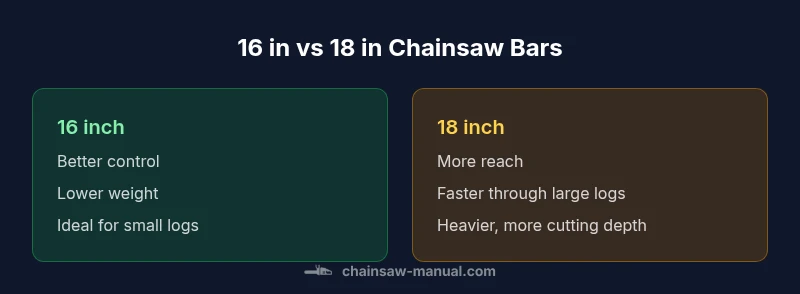
Choosing between a 16-inch and an 18-inch chainsaw bar hinges on balance between control and reach. A 16-inch bar excels for nimble handling on small logs and precise trimming, while an 18-inch bar boosts depth and cutting speed on larger diameters. For homeowners who mostly cut small logs, 16 inches is ideal; for mixed tasks or larger jobs, 18 inches is the safer all-around choice.
How Bar Length Impacts Cutting Performance
Bar length is a fundamental choice that shapes cutting behavior far more than most homeowners expect. The difference between 16 and 18 inches often feels subtle until you face real-world tasks. In general, a longer bar increases the depth you can cut in a single pass, extends reach, and reduces the need for constant repositioning on larger logs. Conversely, a shorter bar improves maneuverability, reduces weight at the tip, and makes precise trimming easier in tight spaces. From the Chainsaw Manual perspective, the 16 vs 18 in chainsaw decision should balance your typical workloads with your preference for control versus speed. When evaluating bar length, consider the diameter range you most frequently encounter, the pruning and limbing tasks you perform, and the space you work in. The right length also interacts with chain pitch, gauge, and bar bevel; a misfit can cause uneven wear or reduced efficiency. If you regularly work on small to medium logs in open spaces, a 16-inch bar often feels quicker and allows finer control. If your job requires longer cuts, deeper kerfs, and more reach, the 18-inch bar pays back the extra investment in speed and productivity.
This section sets the stage for a deeper dive into 16 vs 18 in chainsaw choices, emphasizing that no single length fits every job. It also frames key terminology—bar length, pitch, gauge, and drive sprocket—so you can interpret manufacturer specs with confidence. The Chainsaw Manual team emphasizes safety first: always match bar length to task, keep your stance solid, and maintain sharp chain and proper lubrication.
16-Inch Bars: Best Use Cases and Limitations
A 16-inch bar is a popular default for homeowners and DIY enthusiasts because it yields excellent control in tight spaces and on most small-to-medium logs. With a shorter reach, you can maneuver around obstacles, trim branches more precisely, and reduce the likelihood of kickback when you're close to the workpiece. The key strengths of the 16-inch bar are nimble handling, lower weight at the cutting end, and quicker throttle response in finish cuts. For tasks such as trimming shrubs, cutting seasoned firewood under typical loads, and felling small trees with careful planning, the 16-inch bar often delivers a comfortable, predictable cutting experience. However, the trade-off is depth of cut. On thicker rounds or when you encounter larger diameters, a 16-inch bar may require multiple passes and repositioning, increasing total cutting time. Understanding your log sizes helps you decide if the 16-inch is your go-to or if you should keep an 18-inch on hand for bigger work.
In this context, 16-inch bars shine for finesse work, clean cuts, and high control-to-weight ratio. They pair well with chains that favor precision and a quieter operation, which is especially important when you value safety and clean, staged cuts in confined spaces.
18-Inch Bars: When You Need More Reach and Depth
The 18-inch bar is a compelling option when your work regularly pushes past the limits of a 16-inch length. A longer bar increases the maximum depth of cut and provides more leverage for breaking down larger logs, felling moderate-sized trees, and performing fast, efficient limb removal. For professionals and ambitious DIYers who face a mix of small and large logs, an 18-inch bar often translates into fewer passes and faster throughput. The trade-off is weight and balance: the longer bar demands more strength, steadier handling, and a more deliberate stance to maintain control, especially on hardwoods or dense timber.
When evaluating 16 vs 18 in chainsaw configurations, the 18-inch bar tends to excel in productivity on bigger jobs, but it does so at the cost of greater fatigue and less agility in tight spaces. If you frequently work in a yard with limited space or need to trim branches in awkward angles, you might prefer a 16-inch bar. For mixed workloads that include larger rounds, oak or maple, and occasional felling tasks, the 18-inch bar is often the best balance of speed and reach.
Material and Log Size Scenarios: Matching to Tasks
Choosing the right bar length becomes clearer when you map tasks to log sizes and location constraints. For homeowners who primarily process firewood from small-diameter rounds, a 16-inch bar provides adequate depth for most cuts while maintaining precision and reduced fatigue. If your logs run larger than typical household rounds or you frequently encounter mixed species with varying density, an 18-inch bar reduces the number of passes and can speed up overall progress. In professional settings where time and efficiency are critical, many crews standardize on an 18-inch bar for frequent large-diameter rounds while keeping a 16-inch alternative for trimming jobs or where space is tight. Remember that bar length does not exist in isolation—the chain pitch, gauge, and drive sprocket must be compatible, and bar maintenance becomes a little more important as length increases, since longer rails can wear unevenly if lubrication and tension fall out of spec.
Safety and Handling Considerations for Different Bars
Safety remains the top priority regardless of bar length. A longer bar can produce more aggressive kickback if the tip contacts wood or hidden metal, particularly if your stance is unstable or you’re cutting from an awkward angle. Maintaining a stable stance, keeping both hands on the saw, and using the proper PPE (helmet, eye and ear protection, gloves, and chainsaw chaps) is essential when using an 18-inch bar for larger cuts. A 16-inch bar, while generally safer for beginners, still demands vigilance: kickback can occur if the bar nose strikes a knot or hard spot in the log. Training and practice—framed by safe methods such as the chain brake engaged during repositioning—help you learn how each bar length affects the cut, noise, and vibration levels you experience during work.
For both lengths, ensure correct chain tension, lubrication, and chain sharpening. The Chainsaw Manual recommends testing a simple cut on a scrap log to gauge balance and comfort before tackling heavier tasks, especially when switching between bar lengths.
Weight, Balance, and User Comfort with 16 vs 18 Inch
Weight distribution shifts noticeably with bar length. A longer 18-inch bar increases the moment about your arms, demanding more upper-body engagement and a steadier stance. The same log cut with a 16-inch bar tends to feel lighter and less fatiguing, particularly after multiple passes. User comfort and endurance depend on your physique, cutting frequency, and the specific log dimensions you face. If you’re 6 feet tall with regular wood-cutting tasks, you may tolerate an 18-inch bar for extended sessions better than someone shorter or with a history of shoulder strain. A practical approach is to start with a 16-inch bar for routine tasks, then rotate to an 18-inch bar for larger diameter rounds to gain speed without sacrificing control on smaller pieces.
In all scenarios, keep your shoulders and core engaged during the cut, rotate hips with each pass to minimize twist, and pause to reset your grip if you feel fatigue approaching.
Chain Pitch, Gauge, and Bar Compatibility Essentials
Bar length must align with chain pitch and gauge for safe, efficient operation. A mismatched combination can lead to uneven chain wear, poor cutting performance, or increased risk of derailment. Shorter bars are common with standard chain pitches (e.g., 0.325 in) and can handle lighter tasks without stressing the motor. Longer bars may require chains with higher rigidity to maintain stability, especially under high-tuel load. The same bar can accommodate several chain types, but you should verify compatibility with the bar’s groove width and groove shape. When changing bar length, check the drive sprocket compatibility, oiling system, chain tension, and the clutch engagement range. If you’re unsure, consult the manufacturer’s guide or seek advice from a reputable service shop.
A practical tip is to carry both a 16-inch and an 18-inch bar in your tool kit for seasonal shifts in workload, but ensure you have the correct chain and sprockets for each length.
Maintenance Implications: Bar Care for Different Lengths
Longer rails can be more susceptible to wear if lubrication is inconsistent or if the bar experiences irregular tension. Regularly check bar rails for uneven bevel wear and ensure the oiling system delivers adequate lubricant to the bar tip. Clean the bar groove and oil passage after heavy use or cutting dirty wood, especially with bark-rich rounds. When swapping bar lengths, re-tension the chain and verify that the oil flow remains optimal; misadjusted tension can cause rapid guide bar wear or chain derailment. A well-maintained bar reduces vibration and enhances control, contributing to smarter, safer operation regardless of bar length. Chainsaw Manual emphasizes routine inspection as part of a safety-first maintenance routine that supports both 16-inch and 18-inch configurations.
Real-World Scenarios: Homeowner vs Professional
Homeowners often benefit from carrying both lengths, using a 16-inch bar for trimming, pruning, and light firewood tasks, and switching to 18 inches when faced with larger rounds or dense species. Professionals typically standardize on the 18-inch bar for productivity while keeping a 16-inch bar as a backup for detail work in tight spaces or for pruning in yards. The decision aligns with your typical workload, storage space, and willingness to carry multiple components. In all cases, practice safe cutting habits, maintain sharp chains, and use bar and chain lubrication properly to maximize performance and minimize wear.
The Chainsaw Manual team notes that your choice should reflect practical needs and budget constraints; a thoughtful bar-length strategy improves both efficiency and safety on the job site.
How to Decide: A Step-by-Step Check
Deciding between a 16-inch and 18-inch bar can be boiled down to a simple checklist. Step 1: List your most frequent logs’ diameter and species. Step 2: Assess space constraints in your work area. Step 3: Consider your lifting capacity and how long you’re comfortable cutting in one session. Step 4: Decide if you want a balance of maneuverability and reach or a longer-term focus on speed. Step 5: Verify compatibility with your current chain pitch/gauge and oils system. Step 6: If possible, test both lengths on a scrap log to feel the difference in torque, control, and fatigue. This method yields a practical recommendation tailored to your environment and tasks. In many cases, homeowners with a mix of small to medium rounds choose the 16-inch bar for daily tasks and keep an 18-inch bar for occasional heavy cuts.
Common Misconceptions About Bar Length
A frequent misconception is that longer bars are always better and faster for all tasks. In reality, the extra reach and depth can come with heavier weight, reduced control in tight spaces, and higher fatigue over time. Conversely, some assume a shorter bar can tackle anything, but you’ll waste time on large-radius cuts and may strain the motor by forcing through deep or dense wood. The truth is that 16 vs 18 in chainsaw outcomes depend on the worksite, log dimensions, and the operator’s physical capability. Chainsaw Manual emphasizes a reasoned approach: select a length that matches your dominant task set, keep safety at the forefront, and be prepared to switch bars as needed.
Next Steps and Practical Resources
If you’re in the market for a new bar length, consult the Chainsaw Manual buying guide for recommendations based on your log sizes, species, and climate. Consider a bar-length kit that includes compatible chain and sprockets to simplify changes, plus a maintenance plan to keep rails clean and lubricated. Practical tips include practicing safe cutting protocols, wearing protective gear, and performing routine inspections after each use. By following a structured approach, you’ll ensure you’re using the right bar length for your typical tasks and you’ll protect your saw’s longevity while delivering safe, efficient results.
Comparison
| Feature | 16-inch bar | 18-inch bar |
|---|---|---|
| Bar length impact on depth of cut | Shallower single-pass cuts, easier in tight spots | Deeper single-pass cuts, faster through large rounds |
| Reach and leverage | Less reach, easier control | More reach, greater leverage on big logs |
| Weight and fatigue | Lighter at the cutting end, reduced fatigue | Heavier, more demanding on shoulders and arms |
| Maneuverability in tight spaces | Better for trimming, pruning, and close work | Requires more room and careful handling |
| Ideal use case | Small to medium logs, finish cuts, homeowners | Large-diameter rounds, mixed workloads, pros |
| Compatibility considerations | Common pitch/gauge; easier on logistics | Ensure piston/chain compatibility; longer rails wear differently |
Strengths
- Offers clear trade-offs to match task type (control vs reach)
- Supports a flexible bar-length strategy across tasks
- Helps optimize cutting speed for larger logs when using 18-inch bars
- Accommodates a wide range of garden and job-site scenarios
Drawbacks
- Longer bars demand more strength and proper stance
- Switching bars requires additional tools and compatibility checks
- Longer bars can increase weight and fatigue on small tasks
- Not all chains and bars share universal compatibility
Choose the bar length that matches your typical tasks and site constraints.
For many homeowners with mixed workloads, a 16-inch bar is the go-to for daily trimming and small logs, while keeping an 18-inch option for larger rounds. Professionals often rely on the 18-inch bar for productivity, reserving the 16-inch for detail work. The Chainsaw Manual team recommends evaluating your logs and workspace first, then selecting the length that best balances control, reach, and endurance.
FAQ
What factors should drive my choice between a 16-inch and an 18-inch bar?
Key drivers include the typical log diameter, space constraints at the job site, and your physical ability to handle heavier tool weights. If you regularly work small rounds, a 16-inch bar is often preferable for control. For larger diameters or faster cutting, an 18-inch bar can be more efficient.
Think about log size, space, and how heavy you can reasonably handle. For small rounds, choose 16 inches; for larger work, 18 inches pays off in speed and reach.
Can I switch between 16-inch and 18-inch bars on the same chainsaw?
Yes, most chainsaws allow bar swaps, but you must ensure compatibility with chain pitch, gauge, bar groove, and sprockets. When changing length, re-tension the chain and verify lubrication. If in doubt, consult the manufacturer guidance or a certified technician.
You can swap bars, but check compatibility and retension the chain after any swap.
Will a longer bar increase kickback risk?
Kickback risk is more influenced by bar tip and wood conditions than bar length alone. A longer bar can amplify consequences if the tip hits a knot, but proper stance, sharp chain, and safe cutting practices mitigate this risk.
Kickback depends on the wood and tip contact; use safe cutting practices and keep the chain sharp.
What maintenance changes with 18-inch bars?
Longer bars require consistent lubrication, regular rail cleaning, and careful tension checks to prevent uneven wear. Inspect bar rails for wear after heavy use and ensure oiling continues to reach the bar tip.
Lubrication and rail wear are more noticeable with longer bars; monitor and maintain them.
Are 16-inch and 18-inch bars compatible with all chains?
Not all chains fit every bar. Verify chain pitch and gauge compatibility with both bar lengths. If your bar uses a different pitch, you may need a compatible chain and possibly a different sprocket.
Check pitch and gauge; use compatible chains for each bar length.
Which bar length is better for a homeowner with limited storage space?
If space is limited, a 16-inch bar typically fits more easily and reduces weight while still handling most small-to-medium tasks. An 18-inch bar can be stored separately if you have a dedicated outdoor tool area.
16 inches saves space; consider separately storing an 18-inch bar for larger jobs.
How should I test a bar-length change?
Test on a scrap log in a safe environment. Compare control, noise, and vibration, plus how many passes you need for a clean cut. Ensure you maintain proper stance and PPE during testing.
Test on scrap wood and note control and comfort before committing.
The Essentials
- Assess your log sizes before choosing bar length
- 16-inch bars favor control; 18-inch bars boost depth and speed
- Verify chain pitch and gauge compatibility when swapping lengths
- Plan for maintenance; longer bars require consistent lubrication
- Test both lengths on scrap wood to confirm comfort and safety