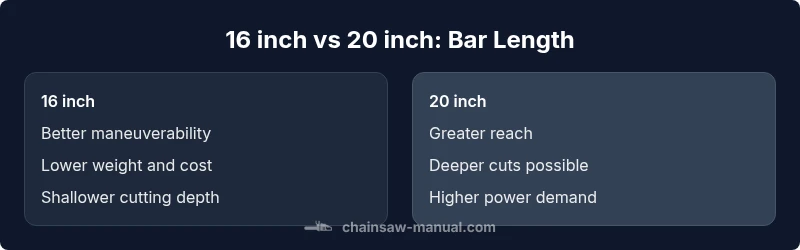
16 vs 20 Inch Chainsaw: Bar Length Guide
Compare 16 and 20 inch chainsaw bars to choose the right length for pruning, limbing, storm cleanup, and firewood. This guide covers reach, depth, safety, and value to help homeowners and professionals decide.


For homeowners and professionals, the decision between a 16 vs 20 inch chainsaw hinges on reach, depth of cut, and handling in tight spaces. This quick comparison explains where each bar length excels, where it falls short, and how to choose based on typical yard projects. With safety and performance in mind, you can select the right size for everyday tasks and occasional heavy cuts. 16 vs 20 inch chainsaw choices are rarely one-size-fits-all, so your selection should reflect your typical jobs.
Why the 16 vs 20 inch chainsaw length matters for bar selection
For homeowners and professionals evaluating a 16 vs 20 inch chainsaw, bar length directly affects how you work, what you can cut, and how safely you operate. The decision influences depth of cut, control in tight spaces, and overall productivity. In this guide, Chainsaw Manual outlines how bar length interacts with power, weight, and handling to help you pick the right setup for your yard and work style. The goal is to balance cutting speed with maneuverability, so the choice feels confident rather than forced. Keep in mind that the 16 vs 20 inch chainsaw option isn’t just about size; it’s about how you plan to use the tool in real-world conditions and how you’ll manage safety, maintenance, and fuel efficiency over time.
Cut depth, reach, and accuracy with bar length
Bar length directly determines cutting depth per pass and the reach you have without compromising stance. A shorter 16 inch bar typically offers tighter turning radii and quicker throttle response in confined spaces, making it ideal for pruning, light-limb work, and backyard chores. A 20 inch bar, by contrast, provides deeper cuts and more reach for larger logs, reducing the number of repositionings required on bigger jobs. Your accuracy improves when you select a length that aligns with limb diameter and log size, while you maintain proper stance to avoid kickback and fatigue.
Power, torque, and bar length compatibility with engine classes
Bar length does not exist in isolation; it interacts with engine displacement, torque curves, and chain pitch. Shorter bars are commonly paired with lighter, mid-range saws that prioritize agility over raw cutting depth. Longer bars demand more torque and precise chain tensioning to sustain cutting speed. If you upgrade to a 20 inch bar, confirm that your saw’s power class can sustain steady RPMs under load and that the oiling system and clutch are compatible with the longer bar for reliable performance.
Weight, balance, and operator comfort
Longer bars add mass above the handle and shift the balance forward, increasing wrist load and fatigue during extended sessions. A 16 inch bar generally feels lighter and easier to maneuver, which reduces user strain when cutting small-diameter wood or working overhead. In contrast, a 20 inch bar increases leverage but requires deliberate stance and stronger control to maintain smooth cuts. Evaluate your typical session length, preferred grip, and whether you have anti-vibration features on your saw before making a change.
Safety implications: kickback risk and bar length
Kickback risk tends to rise with longer bars if technique and setup aren’t correct. The longer your cutting bite, the more attention you must give to stance, chain sharpness, and bar oiling. Use a sharp chain, proper tension, and a reliable chain brake. PPE such as helmet, face shield, gloves, chaps, and sturdy boots remains essential, especially when working with a 20 inch bar on larger trees where cut angles can vary quickly.
Maintenance and service considerations by length
Bar length influences maintenance tasks like chain tensioning, bar rail wear, and oil delivery. Shorter bars generally wear rails less quickly and require less oil, while longer bars demand more frequent inspection of bar groove wear and chain compatibility. Keep the bar and chain clean, verify oil flow at start and mid-cut, and replace worn rails promptly to avoid inefficiencies or heat buildup that can cause chain dulling or kickback.
Real-world task scenarios: pruning, limbing, storm cleanup
In pruning and trimming small branches, a 16 inch bar shines for nimble maneuverability and precise cuts. For limbing larger trees or clearing storm damage, a 20 inch bar can speed up progress by reducing repositioning and enabling deeper, faster cuts. When choosing, map your typical projects to the bar length that minimizes time spent repositioning and maximizes safe cutting angles under variable terrain.
Compatibility: chain pitch, gauge, and bar rails
Ensure your chain pitch and gauge match your chosen bar. Longer bars may require a different chain or an updated bar mount; verify sprocket compatibility and oil delivery routing. Always consult the saw’s manual for maximum supported bar length and verify that your bar, chain, and brake components work cohesively under load. Incorrect compatibility can reduce performance and elevate safety risks.
Budgeting and value: cost vs performance
Longer bars and compatible upgrades can increase upfront costs, yet the performance benefits may justify the expense for homeowners performing routine heavy cuts or professionals handling large timber. Weigh the value of reduced cutting time, fewer repositionings, and the potential resale value of a saw with a longer bar when evaluating a purchase. Consider whether an interim upgrade from a 16 to a 20 inch bar is feasible within your existing saw’s warranty and support plan.
How to choose for common yard sizes and use-cases
Smaller yards typically favor 16 inch bars for quick, precise work and easy transport, while larger properties or heavy-cut requirements justify a 20 inch bar as a longer-term investment. Consider storage space, transport convenience, and your typical tree species. A practical approach is to align bar length with the largest diameter you regularly encounter, while ensuring the saw’s power and balance can handle the longer bar safely.
Quick-start decision framework
- List your primary tasks; 2) Check your saw’s power class and bar compatibility; 3) Assess space constraints and transport needs; 4) Test a practice cut on a safe, controlled surface; 5) Choose the bar length that best balances safety, speed, and comfort for your typical jobs.
Common mistakes to avoid when selecting bar length
Avoid assuming one size fits all; don’t ignore engine power, chain pitch, or safety features; never cut from awkward angles without secure footing; and don’t overlook the need for proper maintenance to sustain performance with a longer bar.
Comparison
| Feature | 16 inch bar chainsaw | 20 inch bar chainsaw |
|---|---|---|
| Ideal for | compact pruning and light-duty cutting | larger logs and deeper cuts |
| Maximum cutting depth per pass | shallower per pass | deeper per pass |
| Reach and leverage | shorter reach, easier control | longer reach, greater leverage with more weight |
| Weight impact | lighter overall weight | heavier bar and saw system balance |
| Power demand | lower power requirement (for light work) | higher power demand (for sustained cuts) |
| Value for money | lower upfront cost and maintenance | higher upfront cost with broader capability |
Strengths
- Improved agility in tight spaces with shorter bars
- Lower weight and easier handling for most homeowners
- Quicker cuts for small-diameter wood when moving around safely
- Better balance for overhead work and portable tasks
Drawbacks
- Limited cutting depth and reach with a 16 inch bar
- Longer setups require more power and stability
- Longer bars can increase maintenance and oil consumption
16 inch bars excel in agility; 20 inch bars excel in reach and depth
Choose 16 inch for pruning and quick work in tight spaces. Opt for 20 inch when you face larger logs, deeper cuts, or need more reach; ensure your saw’s power and balance support the longer bar.
FAQ
What tasks are best suited for a 16 inch bar?
A 16 inch bar is ideal for pruning, trimming, and light-duty cutting. It offers excellent maneuverability in tight spaces and is well-suited for smaller diameter wood.
For pruning and small limbs, a 16 inch bar is a great choice because it's easy to maneuver.
What tasks are best for a 20 inch bar?
A 20 inch bar shines for larger logs, deeper cuts, and when you need additional reach. It is efficient for limbing larger trees and storm cleanup scenarios.
Use a 20 inch bar for large logs and quicker deep cuts.
Can I upgrade from 16 to 20 inch bar on the same saw?
Upgrading may require a different power class, mounting hardware, and possibly a different chain pitch. Not all saws accommodate longer bars without modifications or professional adjustment.
Check the manual or consult the manufacturer before upgrading.
Will a longer bar increase kickback risk?
Longer bars can increase the potential for kickback if technique or safety features are neglected. Maintain sharp chain, proper tension, and a firm stance.
Yes, longer bars raise kickback risk if you don’t cut safely.
How do I know if my saw can handle a longer bar?
Consult the user manual for the maximum supported bar length, and confirm power class compatibility, chain, and bar mount. When in doubt, contact the manufacturer.
Look up the max bar length in the manual and verify the power class.
What other factors influence cutting performance besides bar length?
Chain sharpness, chain tension, oiling, bar quality, and engine condition all dramatically affect cutting performance, sometimes more than bar length alone.
Keep the chain sharp, properly oiled, and maintained for best results.
The Essentials
- Assess your typical projects before choosing length
- 16 inch fits pruning and small jobs best
- 20 inch handles larger diameter cuts more efficiently
- Ensure engine power matches bar length
- Test balance and safety before cutting