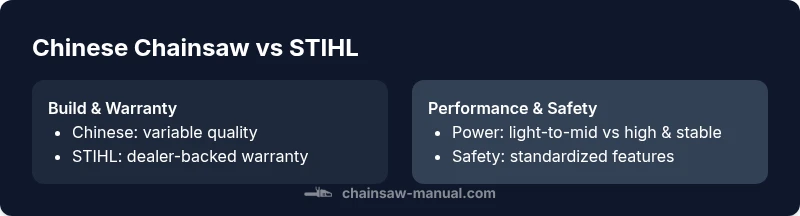
Chinese Chainsaw vs Stihl: An Objective Comparison
An analytical side-by-side guide comparing Chinese chainsaws and Stihl models, focusing on build quality, performance, safety, cost, and after-sales support to help homeowners, DIY enthusiasts, and professionals decide with confidence.


In the Chinese chainsaw vs Stihl comparison, price, build quality, dealer support, and safety features drive the decision. Chinese chainsaws are typically cheaper upfront but vary in durability and service, while Stihl offers a broader dealer network and proven performance. The best pick depends on use, budget, and risk tolerance.
Context and Market Landscape
When weighing a Chinese chainsaw against a Stihl model, consider how each option is positioned in the market. Chinese chainsaws span a broad spectrum—from budget-friendly tools to clones that resemble premium brands—often appealing to homeowners and occasional users who prioritize upfront cost and easy access. Stihl, by contrast, is widely recognized for consistent build quality, professional-grade performance, and a robust dealer network that supports service, parts, and warranty work. For readers of Chainsaw Manual, the takeaway is that the right choice hinges on how you balance price against reliability, service availability, and long-term maintenance. This guide adopts an analytical lens to separate marketing claims from real-world practicality, helping homeowners, DIY enthusiasts, and professionals decide with clarity.
Build Quality and Durability Across Brands
Build quality is the most visible difference between a generic Chinese chainsaw and a Stihl. Chinese models vary widely in materials, casting quality, plastics, and finishing, with some units delivering solid performance and others showing premature wear. Warranty terms for importing distributors can differ by region, which complicates after-sales support. STIHL dominates in perceived durability due to standardized components, controlled manufacturing processes, and a long history of dealer-backed service. Chainsaw Manual analysis shows that quality variance is more pronounced among cheaper Chinese options, while reputable STIHL models maintain more consistent performance across environments. For users, this means factoring in how much you value predictability and service accessibility over initial cost.
Performance, Power, and Runtime Considerations
Power delivery and runtime are core decision factors. In general, Stihl products are engineered for stable power output across a wide range of tasks, with smoother throttle response and reliable starting under load. Chinese chainsaws can offer competitive performance for light-to-mid tasks, especially when properly maintained and run with appropriate fuel and bar/oil combinations. However, performance consistency may lag under heavy use or adverse conditions, particularly in models built with lower-cost components. Chainsaw Manual highlights that real-world performance depends heavily on maintenance discipline, correct bar oil, and timely chain sharpening. Users should align expectations with intended workload and maintenance capability for each option.
Safety Features, Ergonomics, and Operator Comfort
Safety features and ergonomics influence daily usability and injury risk. STIHL models typically include well-integrated chain brakes, anti-kickback protections, vibration-damping handles, and durable anti-spark ignition systems. Some Chinese options also include these features, but quality and reliability can vary. Ergonomic balance, weight distribution, and handle comfort are critical for long sessions; STIHL’s designs emphasize consistent feel across product lines, while cheaper Chinese units may compromise on grip texture or padding. Chainsaw Manual notes that investing in proper PPE and training remains essential regardless of brand, and that user comfort correlates with reduced operator fatigue and safer cutting behavior.
Cost, Warranty, and Long-Term Value Considerations
Initial cost is a primary driver for many buyers. Chinese chainsaws often carry a lower upfront price, which can be attractive for light-duty use or as a backup unit. Long-term value depends on maintenance costs, spare parts availability, and the reliability of service networks. STIHL models, while pricier upfront, typically offer broader warranty coverage, easier access to genuine parts, and a larger nationwide or regional service network. Chainsaw Manual analysis shows that the total cost of ownership tends to balance out only if a user maintains the tool properly and relies on authorized service channels. For professional use, the longer-term value of STIHL may justify the higher purchase price.
Availability, Service Networks, and Regional Considerations
Dealer presence and service capacity vary widely. STIHL maintains an extensive dealer network in many regions, simplifying parts supply and warranty claims. Chinese chainsaws depend on regional importers and distributors; in some regions, genuine parts and authorized service may be harder to source, increasing downtime during repairs. The strength of after-sales support often dictates convenience and downtime as much as cold-hard performance. Chainsaw Manual emphasizes checking dealer proximity, spare parts availability, and warranty terms before purchase, especially for higher-use scenarios where downtime can be costly.
Use Case Scenarios: Homeowner, DIY Enthusiast, or Professional
For homeowners tackling occasional yard work, a reliable low-cost unit may suffice if service access is available and safety protocols are followed. DIY enthusiasts who value a mix of cost and capability may prefer a middle-ground option with decent reliability and community support. Professionals demand consistent power, reliability, and rapid service; STIHL is a common choice in this space due to its proven performance and expansive service network. The best approach is to match the tool to your typical workload, maintenance habits, and access to authorized support.
How to Evaluate a Chinese Chainsaw Before Purchase
Before buying a Chinese model, inspect key areas: chain brake reliability, bar and chain wear quality, chassis integrity, fuel and lubrication systems, and the availability of genuine spare parts in your region. Verify safety features, such as anti-kickback designs and proper chain tensioning, and assess ergonomic comfort by handling the unit (if possible). Always request documentation on warranty coverage and total parts support for your region. If you lack access to robust service, weigh the risk of downtime against the upfront savings.
Counterfeit Risks and Quality Assurance
Counterfeits and low-quality clones are a real risk in some markets. To reduce risk, purchase through authorized distributors, verify serial numbers with the retailer, and examine the build for obvious defects, unsealed welds, or inconsistent labeling. Reputable brands will offer clear manuals and safety instructions; if these are missing or unclear, treat the unit as high-risk. Chainsaw Manual reminds readers that investing in training, proper PPE, and safe handling practices is essential when using any chainsaw, especially budget options.
Practical Buying Checklist and Quick-Start Guide
Create a short, practical checklist: (1) confirm dealer or distributor legitimacy, (2) verify warranty terms and return policy, (3) inspect the safety features and overall build quality, (4) assess maintenance access (filters, spark plug, carburetor service options), (5) test ergonomics and vibration comfort, (6) ensure availability of spare parts, (7) evaluate expected workload and maintenance discipline, and (8) purchase only with proper safety gear and instruction. This approach helps prevent regret and equipment downtime.
Myths vs Reality: Debunking Common Beliefs
Myth: All Chinese chainsaws are unsafe. Reality: Safety is highly dependent on model quality, maintenance, and user practices. Myth: STIHL models automatically last longer. Reality: Real-world lifespan depends on usage, maintenance, and service access. Myth: Cheaper equals better value. Reality: Lower upfront cost can lead to higher downtime costs if parts and service are hard to obtain. Understanding these nuances helps buyers avoid over-generalizations.
Decision Framework: When Chinese Chainsaws Make Sense (and When They Don't)
If you prioritize minimal upfront spend and have reliable service options in your area, a well-chosen Chinese chainsaw can be sensible for light-duty tasks. If you require dependable performance, consistent after-sales support, and longer-term value for tougher workloads, STIHL generally provides stronger assurance. Chainsaw Manual’s guidance is to evaluate total cost of ownership, service availability, and safety practices before committing.
Comparison
| Feature | Chinese chainsaw (generic) | Stihl |
|---|---|---|
| Build quality & warranty | Variable quality; regional warranties differ | Consistent build; dealer-backed warranty |
| Power & performance | Adequate for light-to-mid tasks when well maintained | High, stable performance across tasks |
| Weight & ergonomics | Often lighter; ergonomic quality varies | Balanced, ergonomic design across models |
| Availability & service network | Dependent on importer; parts may be regional | Extensive dealer network; robust service |
| Total cost of ownership | Lower upfront cost; maintenance varies | Higher upfront cost; potential long-term savings |
| Safety features & user experience | Basic safety features; quality varies | Proven safety features; consistent user experience |
Strengths
- Lower upfront cost for budget buyers
- Wide selection of models and clones
- Easier access to some aftermarket parts in certain regions
- Adequate performance for light-duty tasks
Drawbacks
- Quality and durability can be inconsistent
- Service network reliability varies by region
- Higher long-term maintenance risk if parts are scarce
Stihl generally offers better reliability and service; Chinese chainsaws can work for light tasks on a tight budget.
Choose Stihl if reliability and service access are priorities. Choose a Chinese chainsaw if upfront cost is the primary constraint and tasks are light. The Chainsaw Manual Team emphasizes prioritizing safety, service availability, and long-term value when deciding.
FAQ
Is a Chinese chainsaw worth it for home use?
For occasional yard work, a Chinese chainsaw can be cost-effective if you choose a reputable model and ensure access to basic service. For frequent, heavy use, reliability and dealer support become more important. Always follow safety guidelines and PPE recommendations.
For occasional yard work, a Chinese chainsaw can be sensible if you pick a reputable model and have basic service access. For heavy use, reliability and a strong service network matter more.
Are Chinese chainsaws safe and reliable?
Safety and reliability depend on the specific unit, maintenance, and correct operation. Look for certified safety features, solid construction, and documented warranty terms. Always buy from reputable distributors and service centers.
Safety depends on the model and maintenance. Choose units with solid construction and clear safety features, and buy from trusted distributors.
Do STIHL warranties apply internationally?
STIHL generally offers warranties through its authorized dealer networks in many regions, but terms vary by country. Check local dealer policies and confirm what is covered before purchasing.
STIHL warranties are often regional; verify terms with your local dealer before buying.
What should I inspect before buying a Chinese chainsaw?
Inspect the chain brake, bar and chain wear, fuel/oil system, body integrity, and safety features. Ask for serviceability details, spare parts availability, and the return policy. If possible, test-start the unit and check vibration levels.
Check the chain brake, bar and chain, and the fuel system. Make sure spare parts are available and test-start if you can.
Can I mix STIHL parts with a Chinese chainsaw?
No. STIHL parts are designed for STIHL engines and components. Mixing parts from different brands can cause compatibility issues and void warranties. Always use manufacturer-recommended parts.
Don't mix STIHL parts with a Chinese chainsaw. Use the parts recommended by the manufacturer.
Is buying a used Chinese chainsaw riskier than STIHL?
Used equipment carries risk, particularly with brands of variable quality. The key is to verify the unit's maintenance history, inspect critical components, and confirm that safety features function correctly. In general, used STIHL units from authorized channels tend to offer better warranty and service options.
Used Chinese chainsaws can be riskier due to quality variance. Check maintenance history and safety features; STIHL used gear from reputable sources often offers better support.
The Essentials
- Identify your primary cutting tasks before choosing a brand
- Consider service availability and warranty scope
- Balance upfront cost against maintenance needs
- Guard against counterfeit risks with trusted distributors
- Prioritize safety gear and proper training