Curved Cut Troubleshooting Guide for Chainsaws
Learn how to diagnose and fix curved-cut issues in chainsaws with practical steps, safety tips, and expert guidance from Chainsaw Manual.


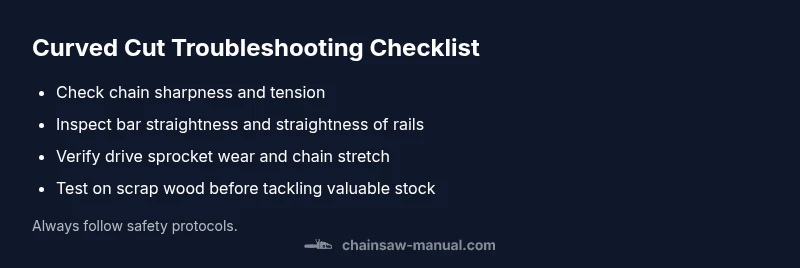
Step 1: Check chain tension and sharpen if needed. Step 2: Inspect the guide bar for wear or misalignment. Step 3: Verify the chain engages evenly by testing on scrap wood. Step 4: If the curve persists, replace dull chain or bent bar and review technique.
Why does chainsaw cut in a curve
According to Chainsaw Manual, a curve in the cut often signals the chain bite is uneven. The most common culprits are a dull or mis-tensioned chain, a bent or worn bar, or improper bar/chain alignment. Correctly diagnosing these issues requires systematic checks and safe testing on scrap wood to avoid kickback or binding.
Common mechanical causes
- Dull chain or teeth that are not square: teeth that are dull or uneven fail to bite wood evenly, producing a curved line.
- Incorrect chain tension: a chain that is too loose can wander; if it’s too tight the chain may not rotate smoothly, causing irregular contact.
- Bent or worn guide bar: a distorted bar skews the chain path and pulls the cut off line.
- Drive sprocket wear or chain stretch: reduced drive consistency can lead to uneven bites and curves.
Wood characteristics and cutting technique
Wood is rarely a perfect straight target. Knots, grain direction, resin pockets, and curved fibers can steer the cutting arc. Anticipate natural curves by aligning your body with the wood, using smooth, steady pressure, and starting the cut slightly off center to account for grain direction. Practicing on scrap pieces helps refine technique without risking valuable stock.
Quick checks you can perform safely
Before touching the chain, power off and secure the saw. Inspect the chain for sharpness and tension, then verify that the bar is straight and true in a bench or vise. Look for any wobble when the bar rotates freely. Ensure the wood is clamped and the saw is in a stable cutting stance. If anything feels off, stop and re-evaluate.
Diagnostic flow overview
Start by observing the cut path on a controlled scrap piece. If it remains curved after adjusting the chain and tension, inspect the bar and drive sprocket. If the bar is bent or the sprocket shows wear, replace them. Only after hardware checks, consider adjusting cutting technique and wood orientation.
Safety and technician steps
Always wear PPE: gloves, eye protection, chaps, and hearing protection. Keep bystanders clear and avoid cutting above shoulder height. A bent bar or a severely worn chain can lead to kickback; stop and replace components if you notice obvious damage or persistent curvature during testing. Document findings to speed up service if needed.
Preventing curved cuts in future
Keep a sharp, properly tensioned chain and a straight, undamaged bar. Regularly lubricate the bar and replace worn sprockets before cutting large workloads. When feasible, vary the cutting direction and rotate the wood piece to distribute wear and reduce curved bite bias.
Steps
Estimated time: 20-40 minutes
- 1
Inspect chain for sharpness
Power off the saw, remove the bar cover, and inspect each tooth. If teeth are rounded, chipped, or uneven, sharpen or replace the chain. A sharp chain bites cleanly into wood and reduces wandering.
Tip: Use a proper file and guide when sharpening; test with a straight edge to confirm evenness. - 2
Check chain tension
With the chain mounted, pull the chain away from the bar. It should have a slight slack but not sag. Adjust to the manufacturer spec and verify rotation without binding.
Tip: Always retest tension after tightening or loosening the bar nuts. - 3
Inspect the guide bar for straightness
Hold the bar up to a straight edge or caliper. Look for bends or uneven wear on the nose and rails. Replace if you detect any warp or cracking.
Tip: Check both the top and bottom rails; a warp on one side can cause curved cuts. - 4
Assess drive sprocket and chain wear
Turn the chain slowly and look for stiff sections or teeth that skip. If the sprocket shows wear or the chain has excessive stretch, replace parts.
Tip: A worn sprocket can cause misalignment even when the chain is sharp and tensioned. - 5
Test on scrap wood
Make a shallow test cut on scrap stock. Observe the cut line for straightness. If curvature persists, re-evaluate bar and chain and consider changing technique.
Tip: Mark a baseline on the scrap to gauge any deviation as you cut. - 6
Review technique and stance
Ensure your body is aligned with the intended cut and consistently apply pressure. Avoid twisting the saw; use smooth, controlled motions and let the chain do the work.
Tip: Maintain a steady feed rate and avoid forcing the saw through the wood.
Diagnosis: Chainsaw consistently cuts with a curved line instead of a straight path
Possible Causes
- highDull or unevenly sharpened chain teeth
- mediumChain tension out of spec (too loose or too tight)
- mediumBent or worn guide bar
- lowCurved grain, knots, or natural wood curvature
- lowDamaged drive sprocket or chain stretch
- mediumImproper chain-to-bar alignment (rail not square to wood)
Fixes
- easySharpen or replace dull chain; ensure teeth are even and square
- easySet chain tension to manufacturer spec and recheck rotation
- mediumInspect and replace bent/worn guide bar; ensure bar is straight
- easyTest cutting technique and alignment; adjust stance and feeding direction
- mediumReplace worn drive sprocket or address chain stretch by replacing chain
- easyVerify proper chain-to-bar alignment and secure nose rail screws
FAQ
Why does a chainsaw cut curved instead of straight?
A curved cut usually stems from a dull chain, improper tension, a bent bar, or natural wood curvature. Address these parts first and test on scrap wood.
Curved cuts come from dull chain, wrong tension, or a bent bar—check those parts and test on scrap.
How can I fix a curved cut quickly?
Sharpen or replace the chain, adjust tension to spec, and inspect the bar for straightness. Test on scrap wood before proceeding.
Sharpen or replace the chain, check tension, inspect the bar, and test on scrap.
Is a bent bar dangerous?
Yes. A bent bar can cause kickback and unpredictable cuts. Stop, replace the bar, and re-check all components.
A bent bar is unsafe; stop and replace it.
When should I replace the chain?
If teeth are chipped or cracked, replace the chain. Otherwise, file to restore sharpness.
Replace a damaged chain or file to restore sharpness.
Can wood grain cause curve?
Yes. Knots and grain direction can steer the cut. Adjust direction and use proper stance.
Wood grain can curve the cut; adjust your technique.
Do I need professional service?
If the bar is bent, the sprocket shows wear, or issues persist after checks, seek professional service.
If unresolved after checks, get a pro.
Watch Video
The Essentials
- Inspect chain and bar before cutting.
- Sharpen or replace dull chain to regain bite.
- Check tension and alignment to prevent curves.
- Use controlled, consistent technique for straight cuts.