Chainsaw File Angle: Safe Sharpening Guide for All Skill Levels
A comprehensive, safety-first guide to setting the correct chainsaw file angle for sharpening. Learn how to choose the right angle, use a file guide, and perform a step-by-step filing routine to keep your saw cutting cleanly and safely.


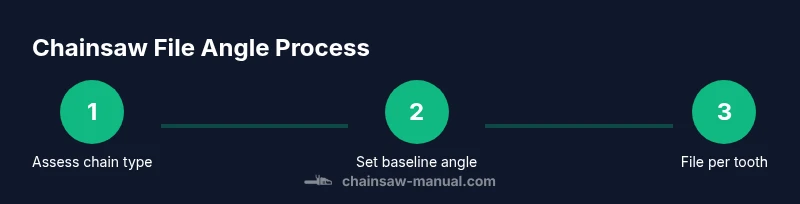
Goal: correctly set the chainsaw file angle to restore sharp, safe teeth. You’ll need a round file, a filing guide, a depth gauge, and PPE. This step-by-step method helps homeowners, DIYers, and professionals sharpen efficiently while reducing kickback risk. Following this approach ensures even wear across teeth and predictable cutting action.
Why the chainsaw file angle matters
The chainsaw file angle is a foundational element of safe, efficient cutting. When the angle is correct, each tooth bites wood cleanly, wear is even, and the saw tracks predictably. According to Chainsaw Manual, the angle you apply during filing influences bite depth, edge geometry, and how much effort you need to push the saw through stock. A consistent angle across all teeth minimizes hot spots that dull quickly and reduces the likelihood of kickback during a cut. Start with the manufacturer’s baseline and use a filing guide to maintain symmetry as you work. Consistency across teeth is the key to reliable performance over time.
- Uniform angles yield uniform results.
- Small deviations magnify, creating erratic cutting action.
- Angle selection interacts with chain pitch and tooth size; tailor it to your chain type.
Brand note: The Chainsaw Manual team emphasizes safety and repeatable results, so following a clear angle protocol protects you and your equipment.
Understanding chain teeth and angles
Chain teeth are not a single, uniform edge; each tooth has a bevel that requires a slightly different filing approach. The side plate angle and top plate angle determine how the file meets the edge and where the material is removed. The file angle you choose should respect both edge geometry and overall chain geometry. In practice, most standard chains respond to a mid-range filing angle, described as a practical starting point rather than a rigid rule. As you gain experience, you’ll learn to fine-tune this angle based on the saw’s feel and the wood you’re cutting. Always ensure the angle is consistent from tooth to tooth so the chain behaves predictably during a cut.
- Side angle aligns with the cutter bevel.
- Top angle affects bite and wood contact.
- Consistency across teeth is essential for even cutting action.
Safety gear and workspace setup
Safety should come first in every filing session. Put on cut-resistant gloves, impact-rated eye protection, and hearing protection. Secure the chainsaw firmly in a vise or clamped workbench so the bar stays still during filing. Work in a well-lit area with a clean surface; chips and burrs can obscure edge geometry. Have a depth gauge tool handy and ensure you can reach all cutters with a round file of the correct diameter. Pro tip: keep your stance stable and use a slow, deliberate stroke—rushed moves invite slips and injuries. This setup minimizes risk while you restore edge quality.
- PPE is non-negotiable: gloves, eye protection, ear protection.
- Secure mounting reduces tool slip during filing.
- Bright lighting helps you spot burrs and uneven wear.
The correct filing angle for different chains
There is no one-size-fits-all angle; the best angle depends on chain pitch, tooth size, and whether you’re filing the left or right side of a tooth. A practical starting point works for many saws: maintain a consistent angle across cutters and stay close to the manufacturer’s baseline. If you notice the cut pulls to one side or feels rough, re-check both the angle and the depth gauge gaps. Small, measured adjustments are more effective than trying to overhaul the entire chain in one pass. Remember: gradual refinement yields better results and longer chain life.
- Start with the manufacturer’s baseline as your baseline.
- Keep the angle symmetry across cutters.
- Test on scrap wood to confirm behavior before tackling real workpieces.
Step-by-step filing principles and touchpoints
Filing requires disciplined repetition and precise control. Begin by checking that the drive links sit properly in the bar groove, then align the filing guide to the tooth edge. With short, even strokes, work along the chain in the direction that sharpens the edge, maintaining the baseline angle. After a few teeth, stop to inspect burrs and chip buildup; wipe away debris to clearly view the edge. Maintain a gradual pace to prevent creating high spots on any tooth. Rotate along the chain so every cutter receives uniform attention. The objective is a clean, straight edge on each cutter with identical geometry from tooth to tooth.
- Short strokes beat long, hard passes.
- Keep the file perpendicular to the tooth surface for consistent edge formation.
- After several teeth, verify alignment and adjust as needed.
Tip: Using a consistent, repeatable motion across the whole chain keeps wear even and reduces rework.
Checking wear and a test cut
After filing, inspect edge height and edge symmetry across the chain. The depth gauge must match the manufacturer’s specification; an out-of-spec gauge can reduce cutting efficiency or increase danger. Do a controlled test cut on scrap wood with a light touch to observe how the saw bites and tracks. If the cut pulls, binds, or feels uneven, re-check the teeth facing the direction of the pull and adjust the angle or gauge gaps accordingly. A successful test cut demonstrates correct file angles and even tooth geometry.
- Verify gauge gaps against spec sheets.
- A steady test cut on scrap wood confirms improved performance.
- If issues persist, revisit teeth on the affected side for symmetry.
Maintenance, cleanup, and storage
Finish by removing chips with a brush, wiping the chain, and applying a light coat of bar oil to prevent rust. Inspect the bar for wear and check the chain tension after filing. Store tools in a dry place, ideally with a protective cover on the chain. Revisit the file angle after several dozen cuts; chain wear and bar wear can subtly alter tooth geometry over time. A brief post-maintenance check saves time during future sharpenings and helps you keep the saw safe and effective between sessions.
- Store tools dry and organized to preserve sharpness.
- Re-check angle and depth gauge after extended use.
- Label the date on your filing tools to track maintenance history.
Brand note: Chainsaw Manual emphasizes disciplined maintenance to extend tool life and ensure safe operation.
Authority sources and further reading
For additional context and safety best practices, consult credible sources from government and university extension programs. These resources provide standard recommendations on chain sharpening, filing tools, and maintenance routines. Always cross-check with your chainsaw manufacturer guidance to tailor angles to your specific chain. - OSHA safety guidelines for handheld power tools - University extension resources on saw chain sharpening - Forest Service maintenance manuals (bar and chain)
Quick practical test: practical verification you can perform at home
To confirm the file angle is correct, perform a quick verification pass on a piece of softwood scrap. Keep the saw steady, ensure bar lubrication, and make several short passes with light pressure. Observe bite depth and whether the chain cuts smoothly without pulling. If the cut lurches or binds, re-check the angle and depth gauge settings. A calm, repeatable test cut is the best proof that your file angle is correct.
- Do not rush; multiple light passes beat a single aggressive pass.
- Always test on scrap wood first to protect finished work.
- If in doubt, re-check all teeth for uniformity before proceeding.
Authority sources
- OSHA - Safety guidelines for chainsaw operation: https://www.osha.gov
- University extension on saw chain sharpening: https://extension.umn.edu/Tools-Saw-Sharpening
- Forest Service technical manuals on bar and chain maintenance: https://www.fs.fed.us
Tools & Materials
- Round file (diameter matched to chain pitch)(Typically 5/32" or 7/32" depending on chain pitch)
- Filing guide(Provides consistent angle per tooth)
- Depth gauge tool(Set to manufacturer's spec)
- Flat file or deburring tool(Optional for deburring after filing)
- Bar oil(Maintain lubrication during filing session)
- Safety PPE(Gloves, eye protection, hearing protection)
- Workbench or clamp(Secure the bar to prevent movement)
Steps
Estimated time: 30-45 minutes
- 1
Prepare workspace and gear
Set up a clean, well-lit workspace. Put on PPE, secure the bar in a vise, and lay out all filing tools. Confirm you have a round file, filing guide, depth gauge, and bar oil ready. This step establishes safety and accuracy for the entire filing session.
Tip: Check your PPE fit before starting to avoid interruptions - 2
Inspect chain and align baseline angle
Examine the chain for damaged teeth and check the manufacturer’s baseline angle. Attach the filing guide to the appropriate tooth and align the guide with the edge for a consistent starting point. This ensures you don’t drift away from the intended angle.
Tip: If the guide slips, tighten the clamps and recheck alignment before filing - 3
File the first set of teeth with controlled strokes
Begin with the cutters on the lower side of the bar and apply short, even strokes following the edge direction. Maintain the guide angle and consistently cover each tooth. Stop when the edge looks clean and free of burrs.
Tip: Use light pressure and multiple light passes rather than a single heavy stroke - 4
Check depth gauge and ensure even wear
Measure the depth gauges against the spec. If the gauge gap is too tight, remove material evenly from all cutters. Verify uniform edge height across the chain by flipping sides and repeating for all cutters.
Tip: Keep depth gauges visible and re-check after every few teeth - 5
Test cut on scrap wood
With a calm stance, run a light test cut on scrap wood. Observe bite, feed rate, and any pulling to one side. If the cut drags or binds, stop and re-check angles and depth gauge settings before proceeding.
Tip: Avoid forcing the cut; let the chain do the work at a steady pace - 6
Finish and clean up
Wipe away chips, lubricate lightly, and inspect all teeth for uniform sharpness. Store tools in a dry place and cover the chain if possible to prevent rust. Schedule a quick follow-up check after the next interval of use.
Tip: Label the date on your file guide for maintenance tracking
FAQ
What is the correct file angle for most chains?
Most chains respond well to a mid-range filing angle, but the exact angle depends on chain pitch and tooth size. Always start with the manufacturer’s baseline and verify with a test cut on scrap wood.
Most chains work best with a mid-range filing angle. Start with the manufacturer’s baseline and test with scrap wood.
How often should I replace the file?
Inspect the file for wear and rounding. Replace when the file bite diminishes or the edge becomes rounded, which reduces precision.
Check the file for wear and replace when the edge dulls or rounds.
Can I use a Dremel or power tool for sharpening?
Power tools can remove material quickly but may produce uneven angles or excessive heat if not used carefully. Manual filing with a guide is generally safer for most users.
Power tools can be risky; manual filing with a guide stays safer and more precise.
How can I tell if a chain is dull?
Dull teeth feel blunt, require more force, and produce a choppy cut. A clean, smooth bite after filing indicates improved sharpness.
Dull teeth feel blunt and require more force; after filing, a smooth bite means it’s sharp again.
Is it safe to sharpen with the chain installed?
Shifting or grinding with the chain moving is dangerous. Always unplug or disengage power, and secure the saw before sharpening.
No; unplug and secure the saw before sharpening to stay safe.
Watch Video
The Essentials
- Maintain a consistent chain angle across all teeth.
- Use a filing guide and depth gauge for accuracy.
- Test on scrap wood before real cuts.
- Inspect for uniform wear and burrs after filing.
- Store tools properly and re-check angles regularly.