Chainsaw Mix Calculator: Safe Fuel Ratios & Tips
Learn to mix gasoline and oil for two-stroke chainsaws with our Chainsaw Mix Calculator. Step-by-step guidance, safety tips, data tables, and practical examples for reliable engine lubrication.


Understanding the fuel mix basics
Two-stroke engines in most consumer chainsaws require a precise gasoline-to-oil mixture. The correct ratio ensures lubrication, reduces wear, and prevents overheating. When you mix fuel on site, you create a lightweight, fast-evaporating blend that must be accurate to avoid damage. According to Chainsaw Manual, deviating from the recommended ratio can cause rapid wear or scoring, especially under heavy loads. In this article, we explore what the ratio means, the difference between premixed fuel and separate oil systems, and why following the recommended range is essential for performance and safety. The Chainsaw Mix Calculator you’ll find here translates the ratio into a practical measurement for your toolkit. Whether you’re a homeowner, a DIY enthusiast, or a professional arborist, a clear grasp of mix ratios will save time and reduce risk during every cut.
What the chainsaw mix calculator does and when to use it
This calculator accepts two core inputs: Gasoline Volume (in liters) and Oil-to-Gas Ratio (as a number, e.g., 50 for 50:1). It outputs the oil quantity needed (in liters) to achieve the chosen ratio, rounded to your preferred precision. The calculator is especially helpful when you’re switching between fuel brands, using different oil types, or refilling after long storage. By showing the direct relationship between gas volume and oil amount, it reduces guessing and helps you maintain optimal engine lubrication. Chainsaw Manual notes that precise mixing is a foundational safety practice that protects both your machine and your hands.
How input values influence the result
The oil amount scales with the gasoline volume and the ratio you select. A higher gas volume increases the oil proportionally, while a larger ratio (e.g., 60:1) reduces the oil per liter of gas. The precision control lets you round the oil quantity to your preferred decimal places, which is particularly useful when you’re working without a precision measuring cup. If you plan to store premixed fuel, accuracy matters for stability and engine performance. Remember to mix in a clean, clearly labeled container and use fresh gasoline.
Example walkthrough: 4 liters of gas at 50:1
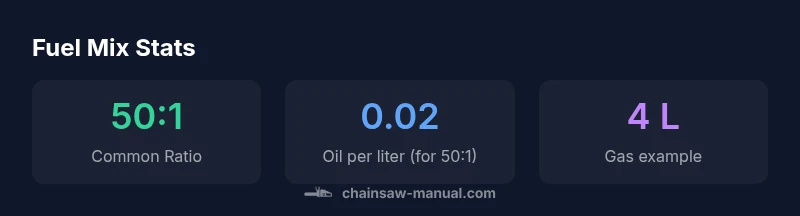
To illustrate, suppose you have 4 liters of gasoline and want a 50:1 mix. Oil needed = gasLiters / ratio = 4 / 50 = 0.08 liters, or 80 milliliters. If your rounding precision is 2 decimals, the oil amount remains 0.08 L. The total fuel volume becomes 4.08 L. This simple arithmetic is the core idea behind the chainsaw mix calculator and can be applied to any gas volume and ratio you choose.
Safety and best practices when mixing fuel
- Always perform mixing outdoors or in a well-ventilated area to avoid fumes accumulation.
- Use a clean, dedicated container for fuel mixing and store premixed fuel away from heat or flames.
- Label containers with the ratio, date, and contents to prevent cross-contamination.
- Wear eye protection and gloves to handle gasoline and oil safely.
- Keep different gasoline and oil brands separate to avoid incompatible blends.
Practical tips for mixing and storage
- Pre-measure gas and oil before reaching the worksite to ensure consistency.
- Use graduated measuring tools to improve accuracy and repeatability.
- Mix oil and gas thoroughly and let the blend sit briefly to ensure even distribution before filling the saw’s tank.
- If you’re uncertain about the recommended ratio, defer to the engine manual or consult a Chainsaw Manual guide for your model.
- Store un-used premixed fuel in a sealed container; avoid using aged fuel that has deteriorated performance.
Common mistakes and how to fix them
- Mistake: Guessing the ratio by eye. Fix: Use the calculator or a measured tool to confirm the ratio before pouring.
- Mistake: Mixing in a dirty container. Fix: Always use a clean container and a clean stir utensil.
- Mistake: Reusing old fuel. Fix: Do not reuse old contents; fresh fuel improves lubrication and performance.
- Mistake: Not considering altitude or temperature. Fix: Be aware that external conditions can affect evaporation and fuel stability; adjust storage and handling accordingly.
When to consult the manual and verify with the manufacturer
If you’re unsure about the correct mix, or if your saw uses a non-standard ratio, consult the manufacturer’s recommendations for your specific model. The Chainsaw Manual guidance emphasizes verifying ratios against your engine’s user guide, especially for high-powered or professional-grade machines. When in doubt, default to safer, slightly richer mixtures rather than lean ones to protect engine bearings and piston rings.