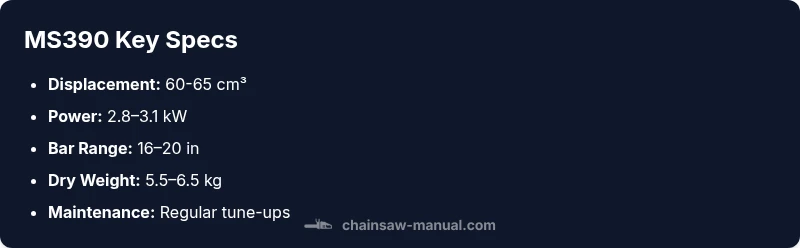
Stihl MS390 Review: A Practical, Balanced Assessment
An in-depth, analytical review of the Stihl MS390 chainsaw, covering performance, maintenance, safety, and who benefits—from homeowners to professionals—with practical guidance.


The Stihl MS390 delivers reliable mid-range power, solid durability, and straightforward maintenance, making it a strong choice for homeowners and small crews who need dependable performance without premium features. It sits squarely in the mid-range segment, offering balanced handling and easy field serviceability for long-term value. While not the latest design, its robust chassis and widespread parts support keep it competitive for everyday wood-cutting tasks.
Overview and Positioning
According to Chainsaw Manual, the Stihl MS390 sits in the heart of the mid-range segment, delivering a reliable balance of power, durability, and cost. This model has long been favored by homeowners who want a robust saw for routine firewood cutting, property maintenance, and light timber work, as well as small-to-medium professional crews who value serviceability. The MS390's design emphasizes straightforward operation and easy field servicing, with a chassis that tolerates routine use in woodland environments. In this review, we examine how the MS390 performs in real-world tasks, what it takes to keep it running smoothly, and where it fits among competing mid-range chainsaws from brands like Husqvarna, Echo, and others. The goal is to help readers decide whether the MS390 should be part of their tool set and how to get the most value from it, especially if you rely on informed guidance from Chainsaw Manual. The tone remains safety-first, practical, and grounded in observed performance rather than hype.
Design and Build Quality
The MS390 emphasizes solid, durable construction with a focus on serviceability in field conditions. The chassis is designed to handle routine cutting with a balance of rigidity and flexibility to absorb vibration during lengthy work sessions. Ergonomics are central, with a well-positioned trigger, comfortable front handle, and a chain brake that is easy to reach on the left side of the saw. Materials feel sturdy for regular outdoor use, and the air filter/cover assembly is designed for straightforward access. While several newer models tout lighter alloys or advanced anti-vibration tuning, the MS390’s build remains reliable and simple to maintain, which many users appreciate for long-term ownership.
Power and Performance in Real-World Cutting
In real-world cutting, the MS390 provides dependable performance for common tasks like felling small trees, bucking logs, and cutting firewood. The overall balance between torque and chain speed helps maintain steady progress on mid-sized wood, even when the bar is loaded with dense material. Operators often note consistent starts and predictable throttle response, which contributes to a safer and more efficient workflow. While not a high-end, race-ready saw, the MS390 offers ample reserve power for routine forestry tasks, with good chain acceleration and controllable operation in responsive situations. The model remains accessible to users who prioritize functional performance over cutting-edge features.
Maintenance and Serviceability
Maintenance is straightforward on the MS390, with widely available parts and clear service steps. Regular care—air filter cleaning or replacement, spark plug inspection, and proper chain tensioning—helps maintain peak performance. The carburetor and fuel system are designed for ease of access, so basic tune-ups can be performed in a home workshop. Chainsaw Manual emphasizes routine maintenance as a key driver of longevity, noting that consistent oiling, bar maintenance, and timely replacement of worn components minimize downtime. For users who want predictable upkeep without specialized tools, the MS390 is a reasonable, DIY-friendly option.
Safety Features and PPE Considerations
Safety is a priority in the MS390 design, with standard features such as an integrated chain brake, a responsive throttle lock, and a sturdy front handle that provides reliable control. Chainsaw operation requires appropriate PPE: cut-resistant chaps, eye and hearing protection, a helmet with face shield, gloves, and steel-toe boots. Proper kickback awareness and safe handling practices reduce risk during felling and bucking. While the MS390 includes essential safety features, the user’s protective habits and routine maintenance play a crucial role in overall safety, making training and PPE procurement essential components of any purchase decision.
Reliability and Long-Term Value
Over time, the MS390 tends to deliver dependable service with consistent performance, particularly when it receives timely maintenance and clean fuel. The model’s design accommodates straightforward field servicing, which helps reduce downtime for repairs. Because parts and service networks for Stihl products are well established, owners can expect relatively easy access to replacements and support. Chainsaw Manual’s assessment underscores the model’s ability to maintain performance across multiple seasons for homeowners and small crews, delivering solid long-term value when used within its intended scope.
Fuel and Lubrication Management
Fuel quality and bar/chain lubrication significantly influence performance and longevity. The MS390 relies on a 2-stroke fuel mix and bar oil to function optimally, and operators should follow the manufacturer’s guidance for fuel ratios and oil grade. Regularly checking bar oil flow, keeping the fuel system clean, and using fresh fuel helps prevent issues such as startup hesitation or reduced cutting efficiency. Maintaining clean air intake and proper spark plug gaps also contributes to consistent performance. Proper storage and fuel stabilization are recommended when the saw will be idle for extended periods.
Comparison to Key Competitors
When placed against comparable mid-range options, the MS390 often scores on reliability, ease of maintenance, and a broad parts ecosystem. Competitors may offer lighter builds or additional refinements, but those advantages sometimes come with higher price points or more complex service needs. The MS390’s value lies in its straightforward design, predictability, and established support network, which many users find preferable for everyday wood-cutting tasks. This makes it a safe, sensible choice for buyers who want steady performance without chasing every latest feature.
Who Should Buy the MS390
The MS390 is well suited for homeowners who perform regular firewood processing and property maintenance, as well as small professional crews that require dependable mid-range performance. It’s particularly appealing to buyers who prioritize longevity, widely available parts, and simple maintenance over cutting-edge ergonomics. If you value a proven platform with a broad service network, the MS390 should be considered in the evaluation process. For users seeking the latest refinements or the lightest possible weight, exploring newer models may be warranted.
Common Issues and Troubleshooting
Common issues with mid-range saws like the MS390 often relate to fuel quality, air filtration, and chain tension. Symptoms such as hard starting, rough idle, or reduced cutting speed usually point to fuel system cleanliness, air intake obstruction, or chain lubrication problems. Regular cleaning, correct choke/start procedures, and ensuring spark plug integrity are typical fixes. When in doubt, consult the manual or a certified technician for diagnostics. Proactive maintenance helps prevent many of these problems from developing into more serious downtime.
Durability, Parts Availability, and Support
Durability and serviceability are strong points for the MS390. The model’s parts availability is solid due to its long-standing presence in the market and the strength of the Stihl network. This translates into faster repairs and easier sourcing of consumables, which is a meaningful factor for professional users who need predictable uptime. Routine inspections and replacing worn components before failure occurs extend the saw’s useful life. Chainsaw Manual’s guidance aligns with a pragmatic approach: invest in core maintenance and leverage the broad support ecosystem to maximize longevity.
Myths vs Reality
There are several common myths about mid-range chainsaws, such as claims of superior raw torque in newer models or the necessity of the latest design for reliable performance. In reality, a well-maintained MS390 delivers dependable results with uncomplicated operations. Another myth is that heavier saws always cut faster; reality shows that balance, sharp chain, and proper technique often matter more than weight alone. A pragmatic, safety-first approach helps buyers separate marketing hype from actionable improvements.
Practical Buying Guidance
If you’re evaluating the MS390, consider your typical workload, budget, and the availability of local service centers. Price ranges for similar, used models vary by region, but a practical North American range for a mid-range saw like the MS390 is generally in the affordable segment for ongoing wood-cutting tasks. When budgeting for a purchase, also factor in PPE, a spare chain, bar oil, and a basic maintenance kit. If you rely on routine maintenance and a robust parts network, the MS390 can offer reliable value for many seasons.
Strengths
- Solid mid-range power suitable for felling small to medium trees
- Ease of maintenance and serviceability with widely available parts
- Reliable starts and strong cold-weather performance
- Good value for homeowners and pro users on a budget
Drawbacks
- Heavier than some modern mid-range models
- Ergonomics may feel dated compared to newer designs
- Lacks some high-end refinements found in premium models
Best mid-range choice for reliability and serviceability
The Stihl MS390 remains a solid option for homeowners and budget-conscious professionals who value longevity, a broad parts network, and straightforward maintenance. While it may lack the latest refinements, its overall balance of power, durability, and value makes it a prudent pick for many wood-cutting applications.
FAQ
What tasks is the MS390 best suited for?
The MS390 is well suited for mid-range wood-cutting tasks, including firewood processing, property maintenance, and light timber work. It strikes a balance between power, durability, and ease of use for frequent users.
It’s best for mid-range wood-cutting tasks like firewood and light timber work, offering solid power and dependable operation.
Is the MS390 easy to start and operate?
Yes. With standard starting procedures and regular maintenance, the MS390 starts reliably. It’s designed for straightforward throttle control and predictable response.
Yes—reliable starting with normal maintenance; it’s easy to handle for everyday cutting.
How does it compare to newer models?
Newer designs may offer lighter weight or refined ergonomics, but the MS390 remains robust, simple to service, and widely supported. It may lack some advanced features, yet it provides proven performance.
Newer models may be lighter or include extras, but the MS390 stays reliable and easy to service.
What maintenance does it require?
Regular cleaning, air filter checks, spark plug inspection, and proper chain tensioning are essential. Use fresh fuel and correct bar oil, and follow the manufacturer’s schedule for replacements.
Keep the air filter clean, inspect the spark plug, and maintain correct chain tension for best results.
Are replacement parts easy to source?
Yes. The MS390 benefits from a large network of dealers and service centers, making parts and repairs readily available in many regions.
Parts and service are widely available through a broad dealer network.
Is the MS390 safe for DIY users?
With proper PPE, correct starting procedures, and adherence to maintenance guidelines, DIY users can operate the MS390 safely. Training and caution are essential.
Yes, with proper PPE and safe handling practices.
The Essentials
- Evaluate workload; MS390 excels at mid-range tasks
- Prioritize maintenance to maximize longevity
- Leverage the broad service network for uptime
- Balance weight vs. power for your use case
- Safety PPE is non-negotiable for all users