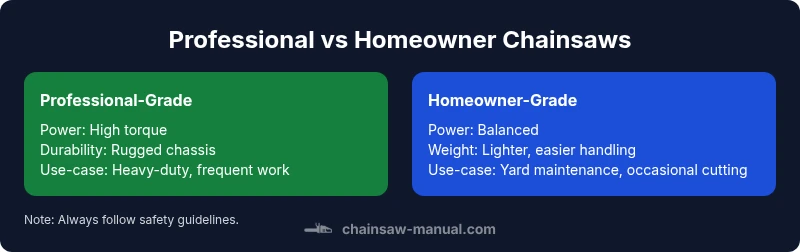
Professional Chainsaw vs Homeowner: A Practical Guide
Compare professional-grade chainsaws with homeowner-friendly models. This analytical buying-guide examines power, safety, maintenance, and use scenarios to help you choose the right tool for your job.


In practical terms, the professional chainsaw vs homeowner decision comes down to workload, risk tolerance, and maintenance discipline. Pro models deliver power, durability, and uptime under demanding conditions, while homeowner-oriented saws emphasize safety, lighter weight, and easier maintenance for occasional use. Aligning tool capability with task frequency is the safest and most economical approach; this choice hinges on how often you cut, project scope, and your safety commitment.
The professional chainsaw vs homeowner dynamic
In practical terms, the professional chainsaw vs homeowner decision comes down to workload, risk tolerance, and maintenance discipline. A quick takeaway: pro models deliver power, durability, and uptime under demanding conditions, while homeowner-oriented saws emphasize safety, lighter weight, and easier maintenance for occasional use. According to Chainsaw Manual, aligning tool capability with task frequency is the safest and most economical approach. When you’re deciding, ask how many hours you’ll run the saw each year, what kinds of cuts you expect to make, and whether you can commit to the maintenance routine that a higher-end saw requires. The professional chainsaw vs homeowner comparison is not just about horsepower; it’s about total ownership, including fuel efficiency, bar length, chain quality, vibration control, and your ability to handle kickback risk. For homeowners, the appeal of a lighter, safer design is clear: simpler maintenance, better balance, and safer operation in yard work. For professionals, durability, extended service intervals, and a dealer network that can supply parts and service quickly justify the higher upfront price. In both cases, understanding typical job profiles—nuisance pruning, storm cleanup, property maintenance, or commercial cutting—helps you map the right tool to your needs. If you’re replacing an old saw, consider whether you’ll benefit more from a performance upgrade or a maintenance-friendly design. The overall takeaway is practical: choose the tool that matches your actual workload, skill level, and safety commitment.
Performance and power: capacity, speed, and torque
Powerful, professional-grade chainsaws deliver sustained performance under heavy workloads, with longer bars and higher torque designed for rapid felling, bucking, and pruning in tough conditions. Homeowner-oriented models prioritize lighter weight, smoother idling, and a friendlier startup process, which reduces fatigue during routine yard work and storm cleanup. Real-world testing shows a noticeable gap in sustained cutting speed between pro and homeowner models, especially as bar length increases. Chainsaw Manual analysis shows that the difference is not just raw horsepower; it’s the combination of bar length, clutch design, air filtration, and vibration management that keeps a pro saw productive during long sessions. When choosing, consider the typical diameter of the material you’ll tackle and whether you’ll often work in challenging terrain or on windy, damp days. If your jobs are primarily small to medium-sized logs, a homeowner model may be sufficient; if you expect frequent heavy cutting, a pro saw wins on uptime and efficiency. Budget-conscious buyers should also assess maintenance intervals and the availability of service networks for the chosen model.
Safety features, PPE, and training requirements
Safety is a core factor in the professional chainsaw vs homeowner decision. Pro saws often incorporate robust kickback protection, enhanced chain brakes, anti-vibration systems, and heavy-duty chains designed for aggressive use. Homeowner models emphasize built-in safety features and ergonomics that reduce user fatigue while maintaining straightforward operation. Regardless of model class, proper PPE is non-negotiable: helmet, face shield, hearing protection, cut-resistant chaps, gloves, and sturdy boots. Training matters as much as tool selection; a well-trained user learns safe starting protocols, correct cut sequences, and how to respond to kickback and binding scenarios. Chainsaw Manual notes that safety training reduces the likelihood of accidents and improves overall efficiency on the job. If you plan to work near other people, in uneven terrain, or with heavy wind, consider taking a certified course to complement your tool choice. Remember: even the best saw cannot compensate for inadequate safety practices.
Cost of ownership: upfront price, maintenance, depreciation
The cost of ownership for professional-grade chainsaws is higher upfront, but the longer service life and resilience under heavy use can justify the investment. Homeowner models typically come at a lower initial price, with simpler maintenance and widely available replacement parts. When evaluating total cost, consider fuel efficiency, bar and chain replacement frequency, clutch wear, and the cost of professional servicing if you don’t perform maintenance yourself. Chainsaw Manual emphasizes factoring in downtime costs—if a pro model keeps you working longer between service visits, that productivity value can outweigh the higher purchase price. Depreciation and resale value also play a role; pro saws that hold their condition and come with strong dealer support may retain more value over time. Regardless of choice, maintaining sharp chains, clean air filters, and keeping the bar oiled are critical to sustaining performance and safety.
Durability, reliability, and use-case fit
Durability and reliability are the deciding factors in the professional chainsaw vs homeowner debate. Pro saws are engineered for extended use, with tougher housings, heavy-duty bars, and hardened components designed to withstand frequent overheating and long cutting sessions. Homeowner models focus on reliability for occasional use, lighter frames, and simplified maintenance to minimize downtime. Use-case fit matters more than raw power: if your work involves long sessions in challenging conditions—mud, cold weather, or storm cleanup—a pro saw’s resilience shines. For standard property maintenance, light felling, and routine pruning, a homeowner model can handle the job effectively, especially when paired with proper technique and safety equipment. Consider your typical environment, the duration of job cycles, and your willingness to service and tune equipment regularly as you decide which class best matches your needs.
Model variety, brand ecosystem, and how to shortlist choices
There is a wide spectrum of models within both professional-grade and homeowner-oriented lines. The professional space emphasizes durability, service networks, and warranty terms, often with dealer-based support that minimizes downtime on the job site. Homeowner models span compact, user-friendly designs with safety-first features, balanced power, and lower maintenance demands. Shortlisting should start with your primary use case and budget, then filter by bar length (commonly 16–36 inches for pros, shorter for homeowners), weight, transmission type, and safety features. Check the availability of spare parts, service intervals, and warranty terms that align with your anticipated workload. Read user reviews focused on reliability under real-world conditions and verify that the model you select is compatible with your preferred chains, bars, and PPE. If you’re unsure, consult a chainsaw professional for a hands-on demo and model comparison.
Practical scenario walkthroughs: homeowner tasks vs pro jobs
Consider typical tasks: for a homeowner performing routine yard work, a lighter saw with strong safety features can deliver consistent results with less fatigue. For professionals performing storm cleanup, large-diameter bucking, or commercial felling, a higher-power model with longer bar length and a robust cooling system is more productive and durable over time. The professional chainsaw vs homeowner scenario becomes clear when you map job types to tool capability: casual pruning and limb removal benefit from safer, easier-to-handle homeowner models; heavy logging, utility-line clearance, and rapid material processing demand the endurance and uptime of professional gear. Regardless of choice, plan for training, PPE adherence, and a maintenance routine that keeps you safe and efficient on every job.
Comparison
| Feature | Professional-grade chainsaw | Homeowner-friendly chainsaw |
|---|---|---|
| Power and cutting speed | Higher sustained power and faster cuts | Balanced power for general tasks |
| Safety and training requirements | Rigorous safety features; working knowledge advised | Safety-first design; simpler operations for casual users |
| Weight and maneuverability | Heavier; optimized for long sessions | Lighter; easier for one-person use |
| Durability and maintenance | Rugged construction; dealer service networks | Easier maintenance; widely available parts |
| Cost and ownership | Higher upfront price; potential value for uptime | Lower upfront price; standard warranty often included |
| Typical use cases | Land clearing, heavy felling, commercial work | Yard work, pruning, occasional cutting |
| Warranty and service | Pro-level warranties; extensive dealer networks | Residential warranties; accessible service options |
Strengths
- Clear differentiation based on workload and safety needs
- Helps readers budget for long-term ownership
- Supports risk-aware decision making across use cases
- Encourages proper training and PPE adherence
- Guides selection toward appropriate maintenance commitments
Drawbacks
- May oversimplify model nuances across brands
- Could imply larger tool gaps for mid-range buyers
Professional-grade chainsaws are the right choice for frequent, heavy-duty work; homeowner models fit casual, safety-focused use.
If you cut often and need uptime, invest in a pro saw with dealer support and robust safety features. For occasional property work, a homeowner model delivers adequate power with easier handling and lower upkeep, making it the practical choice for most non-professional users.
FAQ
What defines professional-grade chainsaws vs homeowner models?
Professional-grade chainsaws are built for heavy, frequent use, with higher power, longer bars, and tougher components. Homeowner models emphasize safety, lighter weight, and simpler maintenance for casual tasks. The choice should align with expected workload and safety commitments.
Pro saws are for heavy-duty work; homeowners’ models are for lighter chores with safety in mind.
Is it worth renting a pro saw for a one-time job?
For a single small job, renting can be cost-effective and safer than purchasing a high-end pro saw. If you anticipate multiple tasks, owning a suitable homeowner model or a mid-range saw may be more economical over time.
Renting can work for one-off jobs, but owning often pays off if you have ongoing needs.
What safety features should I look for?
Key features include chain brake, kickback protection, chain catcher, and effective anti-vibration systems. Ensure you have proper PPE and complete a safety training course before use.
Look for chain brakes and good protective gear, then get trained.
Can a homeowner safely operate a professional-grade saw?
With proper training, PPE, and adherence to safety protocols, a homeowner can operate a pro saw. If training isn’t available, choose a homeowner-grade model with safer features and easier handling.
Yes, with training and safety gear. Always respect the tool’s power.
What maintenance differences exist between the two?
Pro saws require more frequent service, specialized parts, and attention to cooling due to heavy use. Homeowner models emphasize simpler maintenance and widely available parts; follow the manufacturer’s service schedule.
Pro saws need more upkeep; homeowners sticks to simpler maintenance.
How should I store and transport a chainsaw safely?
Store in a dry, locked area with the bar covered; transport with the bar cooled and chain away from you. Use a proper carrying case and follow local regulations for transport.
Store safely, cover the bar, and transport with care.
The Essentials
- Assess workload to guide tool choice
- Prioritize safety features and PPE
- Match bar length to typical cutting needs
- Factor total cost of ownership, not just upfront price
- Leverage training to maximize safety and productivity