Skip Tooth Chainsaw Chains: Is It Better for Your Job? A Buying Guide
Compare skip tooth vs standard chainsaw chains to decide which delivers smoother cuts, safer handling, and best value for homeowners and professionals.


Is a skip tooth chainsaw chain better? The quick answer is: not universally. Skip-tooth designs can reduce tooth crowding and improve chip evacuation in soft or irregular wood, which helps in limbing and rough clearing. However, they can cut more slowly in hardwood and may demand different maintenance. Your task, saw size, and wood type drive the choice.
Understanding the Core Question
In buying guide terms, the question is not simply about what is best but about what is best for the task at hand. When you ask whether is a skip tooth chainsaw chain better, you are weighing how the spacing and number of cutting teeth affect bite, debris clearance, and overall control. According to Chainsaw Manual, the best choice hinges on wood type, cutting technique, and operator experience. The phrase itself serves as a helpful prompt: is a skip tooth chainsaw chain better for limbing softwood or for fast rough cuts? The answer, like many chainsaw questions, is task-dependent and depends on your typical projects, saw size, and bar configuration. This framing helps decide between general versatility and specialized performance. Chainsaw Manual Team notes emphasize evaluating real-world needs over chasing one “superior” option.
How skip tooth chains differ from standard chains
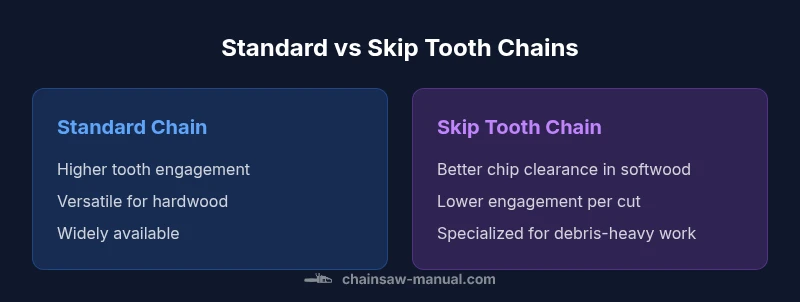
Skip tooth chains differ primarily in tooth count and spacing. A standard chain uses more teeth in contact with the wood, producing a dense, steady bite and a clean kerf in many hardwoods. A skip tooth chain reduces teeth engagement by design, leaving larger gaps between cutters. This reduces crowding and can improve chip evacuation in softwood or resin-heavy wood, which can help with debris management and smoother re-sawing of uneven logs. However, the reduced bite can feel less aggressive when cutting dense hardwoods. When evaluating if is a skip tooth chainsaw chain better for your jobs, consider bar length, chain pitch, and your typical wood species. The Chainsaw Manual team emphasizes that compatibility with your bar and drive links matters as much as the tooth pattern itself.
Performance implications: speed, kerf, heat
In practice, the performance differences come down to bite force and waste management. Skip tooth chains tend to produce less aggressive initial bite in some conditions, which can translate to steadier control on uneven surfaces. Chip evacuation is often improved because fewer teeth are pulling at once, helping prevent clogging in resin-rich wood. On the flip side, hardwoods and dense material may respond more slowly with a skip tooth chain, since more teeth contribute to initial cutting power in standard designs. Temperature and wear dynamics also shift: skip tooth chains can experience different wear patterns due to fewer active cutting teeth. When choosing, assess your typical workload, as the difference in cutting speed and finish is task-dependent. Chainsaw Manual Analysis, 2026, suggests matching the tooth pattern to wood type and operation style to maximize efficiency.
Use cases: best tasks for skip tooth vs standard
There isn’t a one-size-fits-all answer. Skip tooth chains shine in softwood, rough clearing, and limbing where quick chip clearance reduces clogging and improves maneuverability. Tasks like pruning and brush cleanup benefit from smoother engagement and reduced kick-in resistance when the wood is lighter and less dense. Standard chains excel in general-purpose use, including felling and cross-cutting hardwoods, where aggressive bite and precise control are valued. If your typical work involves mixed species, variability in log diameter, or frequent high-resin cuts, you may favor a standard chain for its versatility. The key is to align tooth pattern with the wood type, bar length, and user technique rather than chasing a universal “better.”
Safety considerations and kickback implications
Kickback risk is influenced by many factors, including chain geometry, bar design, and technique. Skip tooth chains do not automatically eliminate kickback; in some setups, they can feel gentler during rough cuts, but improper technique remains a critical risk factor. For beginners, mastering proper stance, grip, and push-pull dynamics is essential regardless of chain type. If you routinely cut near soil, rocks, or embedded objects, ensure your chain’s depth gauge settings and raker configuration are appropriate for the tooth pattern. Always follow manufacturer recommendations for PPE and maintain a predictable cutting rhythm to reduce hazards. Chainsaw Manual Team emphasizes safety as the primary priority over any minor performance gains.
Sharpening and maintenance for skip tooth chains
Sharpening a skip tooth chain can require different thinking than standard chains. The spacing between cutters changes the way you file, grind, or use a semi-automatic sharpener. Some skip tooth designs may have fewer teeth in contact, which means each tooth bears more load during sharpening. Always use the correct pitch and tooth count for your chain, and verify you’re following the bar/drive link specifications. Keep tension consistent and inspect for uneven wear that can throw off cutting accuracy. Regular cleaning, correct lubrication, and scheduled dullness checks are essential to maintain performance across both standard and skip tooth chains.
Compatibility: bar length, pitch, drive links
Before purchasing, confirm your bar length, chain pitch, and drive links match the chain type. Skip tooth chains often require specific compatibility with the bar and may alter recommended bar widths or drive link counts. If your bar was supplied with a standard chain, switching to skip tooth may necessitate a different bar or updated sprocket alignment. Always consult the saw’s manual and engage a reputable service technician if you’re unsure. Chainsaw Manual recommends validating compatibility to avoid reduced engagement, binding, or unexpected wear.
Cost and lifecycle considerations
Cost considerations for skip tooth chains can vary with brand, bar compatibility, and availability. In many markets, standard chains are widely available and priced predictably; skip tooth options can carry a premium or harder-to-find parts depending on region and model. Consider total lifecycle costs, including sharpening frequency, potential bar replacements, and how often you’ll encounter tasks that favor a skip tooth design. A careful assessment of your typical projects helps determine whether the investment pays off in time saved and improved debris management.
Common myths and misconceptions
A common myth is that skip tooth chains reduce all kickback or are inherently safer. In reality, kickback risk depends on technique, bar geometry, and wood conditions, not solely on the tooth pattern. Another misconception is that skip tooth chains always cut faster; in dense hardwoods, a standard chain may outperform a skip tooth chain for overall speed and finish. Education, practice, and adherence to safety protocols remain essential regardless of the chain type. The Chainsaw Manual team notes that myths can lead to unsafe assumptions, so verify claims with practical testing and manufacturer guidelines.
Practical decision framework: quick checklist
Use this quick framework to decide between standard and skip tooth chains:
- Identify wood species and typical log size.
- Consider bar length and drive linkage compatibility.
- Evaluate whether debris clearance or aggressive bite is more important for your tasks.
- Assess sharpening tools and maintenance capacity.
- Confirm replacement parts availability and total cost of ownership.
- If unsure, test both patterns on a small batch of wood to compare performance. The decision should hinge on practical outcomes rather than general opinions.
Real-world scenarios and takeaways
In mixed-use workspaces, a standard chain often covers the broadest range of tasks, from felling to cross-cutting hardwoods. For constant softwood pruning and brush cleanup, a skip tooth chain can reduce clogging and speed up routine work, provided you don’t push it into dense timber. The key takeaway is to align chain pattern with the wood type and project scope, using one as your primary setup and the other as a niche option for specific conditions. Chainsaw Manual’s practical guidance is to start with your typical tasks and then tailor the chain choice based on observed results during real cutting sessions.
Comparison
| Feature | standard chain | skip tooth chain |
|---|---|---|
| Tooth engagement per cut | high engagement | lower engagement |
| Cutting speed in hardwood | fast/strong bite | often slower or smoother bite |
| Chip evacuation and debris clearance | typical clearance | improved clearance in softwood |
| Sharpening requirements | common sharpening method | may require alternative techniques |
| Bar length compatibility | broad compatibility | requires skip-tooth-compatible bar |
| Availability and cost | widely available, affordable | more variable availability/price |
| Best use case | general purpose and hardwood work | softwood clearing and rough cuts |
Strengths
- Better chip clearance in softwood
- Reduced tooth crowding lowers resin buildup
- Smoother engagement for rough, uneven cuts
- Useful for light-duty trimming and limbing
Drawbacks
- Slower cutting in hardwood and dense timber
- Less versatile for general purpose use
- Sharpening may require different techniques
- Availability may vary by region
Choose tooth pattern based on task, not habit
The Chainsaw Manual Team emphasizes task-driven selection: skip tooth for softwood and rough clearing, standard for versatility and hardwood work. Test in real conditions to confirm which pattern delivers the best balance of speed, control, and maintenance.
FAQ
What is a skip tooth chainsaw chain?
A skip tooth chain has fewer cutting teeth along the chain, creating larger gaps between cutters. This design can improve debris clearance and reduce crowding in some woods, but it may alter bite and cutting speed. Understanding the tooth pattern helps you predict performance for your specific tasks.
Skip tooth chains have fewer cutters and bigger gaps, which helps debris clear and can smooth some cuts. It’s task-dependent, so test it on your wood type.
Is a skip tooth chain better for hardwood or softwood?
Skip tooth chains tend to perform well in softwood or resin-heavy wood where chip evacuation matters. For hardwood, the bite is often stronger with standard chains, leading to faster cutting and better control in dense timber. Your wood type largely drives the decision.
It depends on the wood—softwood can benefit from skip tooth, hardwood often benefits from standard chains.
Can I use a skip tooth chain on any bar length?
Bar length and drive links must match the chain pattern. Not all bars support skip tooth chains, so verify your saw’s bar compatibility before switching patterns. Check the bar groove width and sprocket alignment for safe operation.
Make sure your bar and drive links match the chain type you choose.
How do I sharpen a skip tooth chain?
Skip tooth chains may require a different filing pattern or guidance depending on the tooth spacing. Use a file guide compatible with your chain pitch and follow manufacturer instructions. Regular inspection for uneven wear is important to maintain performance.
Follow the chain’s pitch with the right file and guide; keep an eye on wear and adjust as needed.
Does a skip tooth chain reduce kickback risk?
No chain type guarantees zero kickback. Kickback is influenced by technique, bar design, wood conditions, and chain sharpness. Use proper stance and push/pull control regardless of tooth pattern.
Kickback is more about how you cut than the tooth pattern alone.
How should I decide between standard and skip tooth for my project?
Assess wood type, log size, bar compatibility, and maintenance willingness. If you work mostly softwood with debris, skip tooth may help; for mixed tasks or hardwood, a standard chain is typically safer and more versatile.
Think wood type and task first, then check compatibility before choosing.
The Essentials
- Match tooth pattern to wood type and job scope
- Skip tooth excels in softwood debris clearance
- Standard chains offer broad versatility for mixed tasks
- Sharpening approaches differ by tooth pattern
- Always verify bar compatibility before buying